
Loading, please wait...
LOT 1150
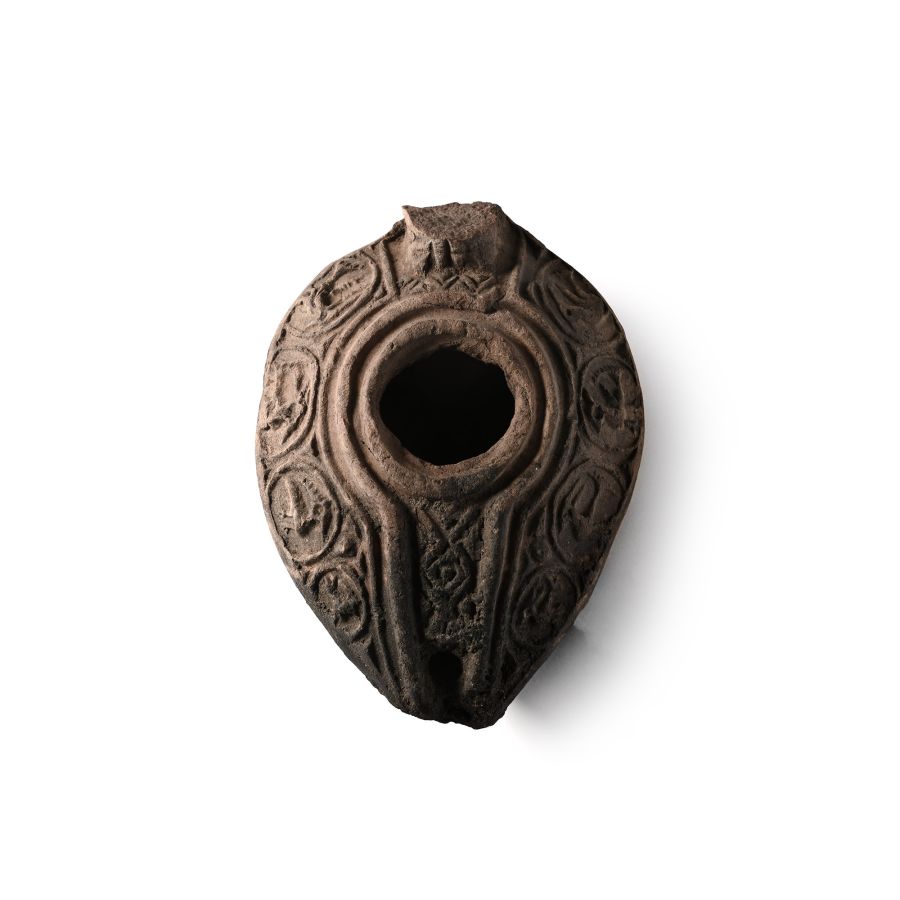
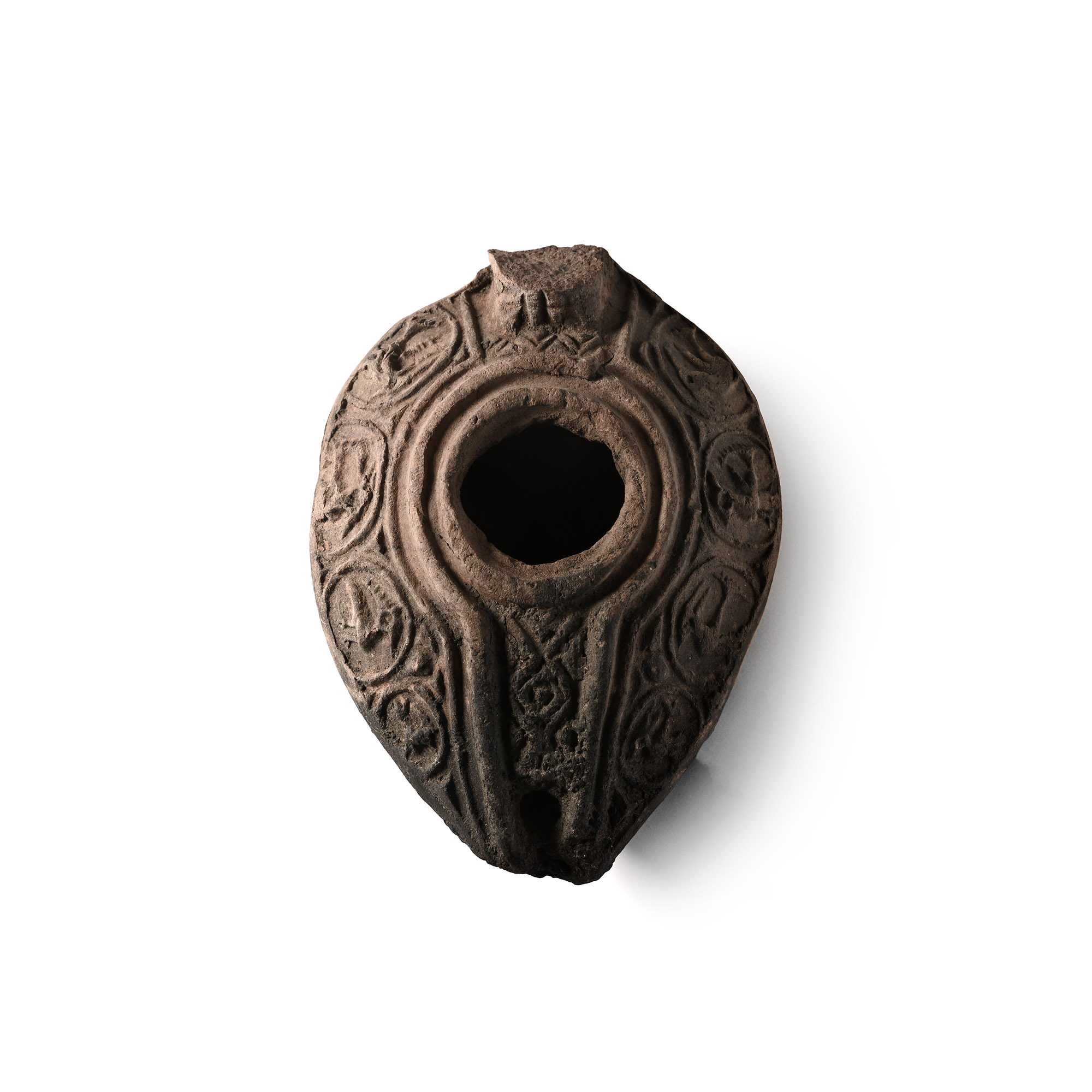
Byzantine Terracotta Oil Lamp with Cross and Birds
HOLY LAND, CIRCA 6TH-7TH CENTURY A.D.
4 in. (142 grams, 10 cm).
Large lamp with high pointed body, a partial knob handle and a small filling hole outlined by a ridge; another ridge extending toward the wick-hole, creating a 'channel' decorated with a line; rim divided into two bands, the outer one filled with tondo with birds, the inner one decorated with a stylised cross and geometric pattern on the nozzle. [No Reserve]
ProvenanceFrom the collection of Mr W.A. Stewart, Director of School of Arts and Crafts, Cairo, 1919-1929.
Acquired Christie's, London, Antiquities, Works of Art and Important Renaissance Bronzes, Plaquettes and Limoges Enamels, 8 July 1981, no.126 (part).
From a private Wiltshire, UK, collection.
Accompanied by a copy of the relevant Christie's catalogue page.
Cf. De Vincenz, A., 'Ceramic Vessels and Oil Lamps from the Burial Cave at 'En Lavan, Nahal Refa'im' in Atiqot 98, 2020, pp.102-122, fig.5-8, for the type.
FootnotesThis type of lamp is a precursor of the early Islamic channel-nozzle lamp, which has a tongue handle. The small knob handle indicates an earlier date, while the channel implies a later date. The lamp, in correspondence with similar lamps found in Israel, can be dated to the 6th-7th century A.D., belonging to the eastern Roman culture or even to the early Islamic period.
CONDITIONTimeLine Auctions follows a vetting process to ensure the authenticity and legality of all items, reinforcing our commitment to integrity and responsible trading. Each antiquity, antique, and coin lot undergoes thorough examination by a vetting committee of at least ten external specialists, professional trade association members, scientists, and archaeologists: Our Vetting Process
AUCTIONS:
TimeLine is a leading auction house specialising in antiquities, ancient art, collectables, natural history, coins, medals, and books. Our auctions offer museums, collectors, historians, and enthusiasts the opportunity to acquire unique and historically significant pieces.
-
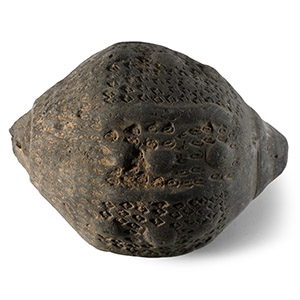
Byzantine 'Greek Fire' Ceramic Fire Bomb or Hand Grenade
9th-11th century A.D.Estimate: £100 - 140 (+bp*)
Opening Bid: £50
A piriform missile with domed filler-hole (chipped), segmented flanges to the sidewall and impressed texture; intended to be filled with explosive liquid and a wick, and used as a hand grenade. 844 grams, 13 cm
From an important specialist collection, London, UK, 1990s onwards. Accompanied by an academic paper by military specialist Dr Raffaele D'Amato, dated 15 July 2019 and titled 'Eastern Roman Empire - Greek Fire Bomb or Hand Grenade (μεσαίον kακάβιον) 9th-11th century AD'.
Apart from the use of siphons or manual flame-throwers called cheirosiphona, special corps of Roman soldiers employed terracotta grenades, in the form of small jars, abundantly evidenced in archaeological excavations. They were called μεσαία kακαβιά or κυτροκακάβια where the former had a bulbous shape and the latter a more cylindrical form. -
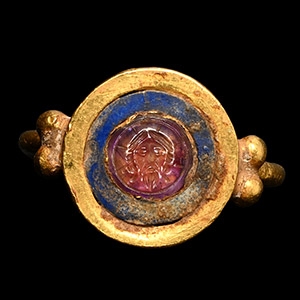
Byzantine Gold Ring with Head of Christ Gemstone
Circa 6th-8th century A.D.Estimate: £4,500 - 6,500 (+bp*)
Opening Bid: £2,250
Round-section hoop with granules to the shoulders, discoid bezel with inset lapis lazuli circle enclosing a later amethyst gemstone with facing bust of Christ Pantocrator. 10.36 grams, 25.80 mm overall, 20.26 mm internal diameter (approximate size British S, USA 9, Europe 19, Japan 18).
Ex collection of a London lady, 1980s. This lot has been checked against the Interpol Database of stolen works of art and is accompanied by search certificate number no.12968-246371. -
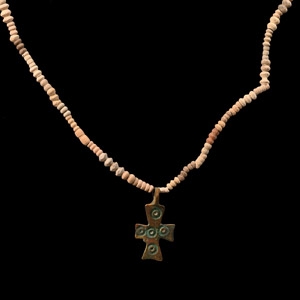
Byzantine Bronze Cross with African Terracotta Bead Necklace
6th-12th century A.D. or laterSold for (Inc. bp): £85
Mainly tubular and biconvex beads and bronze pendant cross with five ring-and-dot motifs. 7.82 grams, 66 cm
London, UK, art market, 1990s.
