
Loading, please wait...
LOT 0809
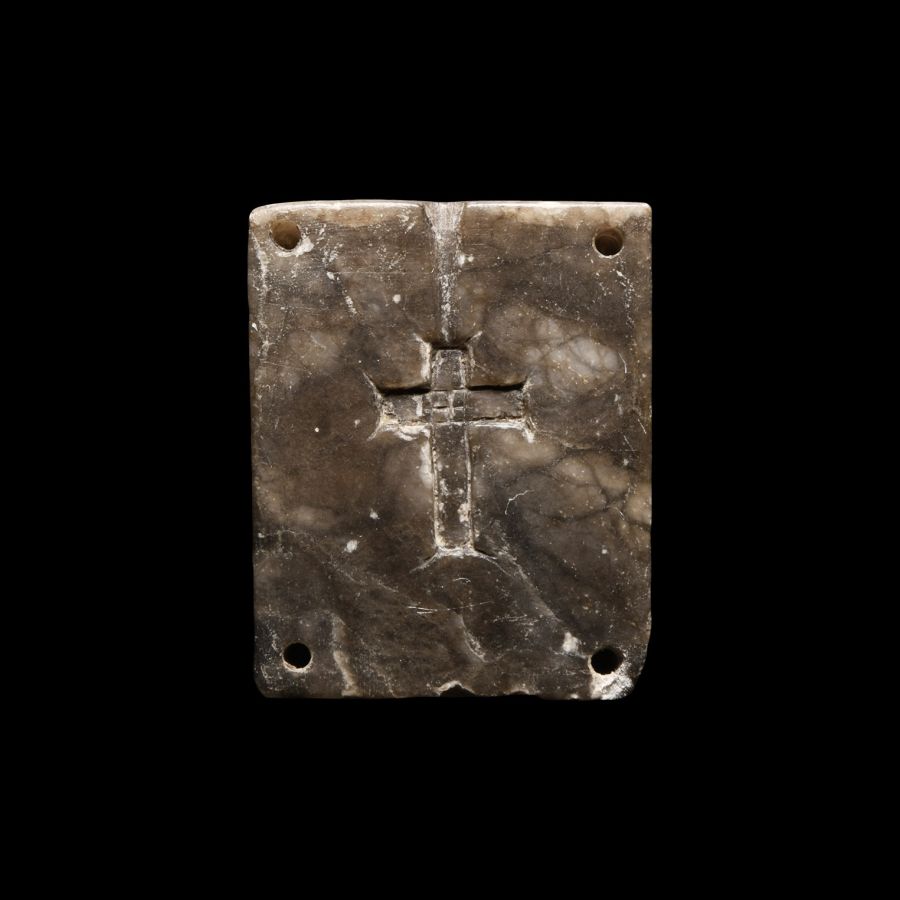
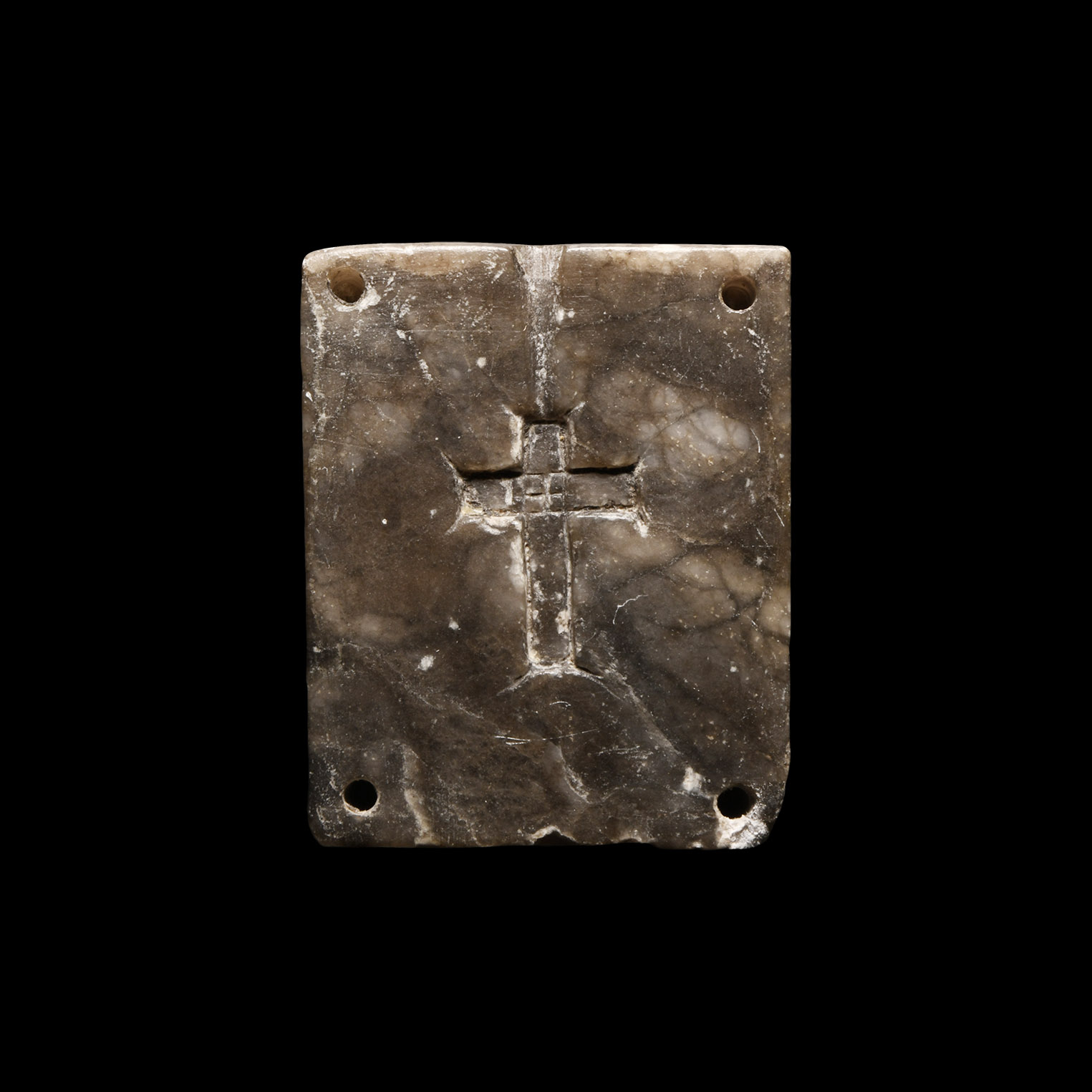
Byzantine Stone Cross Mould
10TH-14TH CENTURY A.D.
2 5/8 in. (163 grams, 67 mm).
Rectangular in plan with central recessed Christian cross, small recessed cross within a square to centre, pouring channel above; circular recess to each corner; soapstone.
ProvenanceAcquired on the London art market, 1960s-1980s.
Ex Hertfordshire, UK collector.
The Kusmirek Collection, UK.
TimeLine Auctions follows a vetting process to ensure the authenticity and legality of all items, reinforcing our commitment to integrity and responsible trading. Each antiquity, antique, and coin lot undergoes thorough examination by a vetting committee of at least ten external specialists, professional trade association members, scientists, and archaeologists: Our Vetting Process
AUCTIONS:
TimeLine is a leading auction house specialising in antiquities, ancient art, collectables, natural history, coins, medals, and books. Our auctions offer museums, collectors, historians, and enthusiasts the opportunity to acquire unique and historically significant pieces.
-
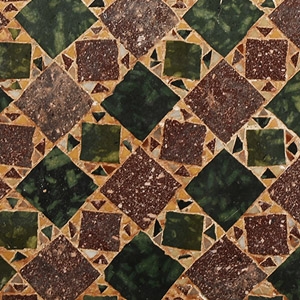
Byzantine Cosmatesque Marble Mosaic Panel
12th-13th century A.D.Sold for (Inc. bp): £9,100
Recalling workmanship similar to that found in the floor of the Sistine Chapel, comprising a large central panel with a design of alternating green and speckled porphyry lozenges, with interstitial green and porphyry squares flanked by a green or porphyry triangle on each edge; border of plain marble and outer band of green and porphyry roundels made up from vesica-shaped panels with inset squares and triangles. 23.5 kg, 53.5 cm
French gallery, Paris, 1990s. From a family collection. Accompanied by an academic report by Dr Raffaele D'Amato. This lot has been checked against the Interpol Database of stolen works of art and is accompanied by search certificate number no.203555.
The Cosmatesque style was a characteristic type of ornamentation of Eastern Roman origin (opus alexandrinum) used by post-Roman marble makers of the 12th and 13th centuries A.D. It embellishes the floors, ciboria and cloisters of churches by means of polychrome marble inlays of varied and imaginative geometric shapes. The wider use of this decoration began in the 12th century, at which time techniques were improved: the Cosmati floors were made with pieces of stone cut in various shapes and sizes, a property quite different from the mosaics in opus tessellatum, in which the motifs were made from small units all having the same size and shape, or from the opus sectile, intended to create representations with pieces of multi-coloured marble cut out and arranged for this purpose. The stones used by Cosmati artists were often material salvaged from the ruins of ancient Roman buildings. The composition of such mosaics recalls the floors of the most important churches of Rome; in addition to the floor of the Sistine Chapel (created probably in the 14th century for the previous building or Cappella Maggiore), one can cite that of Santa Maria Maggiore (1145-1153 A.D.), San Giovanni in Laterano (14th century A.D.), Saint Clement (1099-1120 A.D.), Santi Quattro Coronati (13th century A.D.), Santa Croce in Gerusalemme (12th century A.D.) and many others. The same technique (but differing in its design, materials and motifs) was used to create the Cosmati pavement in Westminster Abbey, where the king rests during the coronation ceremony. The pavement has undergone a major cleaning and conservation programme and was re-dedicated by the Dean at a service on 21st May 2010. -
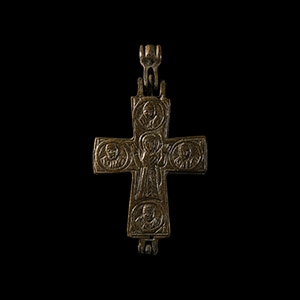
Byzantine Bronze Reliquary Cross
10th-11th century A.D.Sold for (Inc. bp): £624
Comprising two narrow hinged plates and articulated suspension loop with two vertical ribs; obverse with Jesus on the cross, dressed in a long robe with standing Virgin and Saint John on his side, Greek inscription 'ἴδε ὁ υἱός σου.Ἰδοὺ ἡ μήτηρ σου' (John 19:27-28: 'Here is your son. Here is your mother') under the arms; titulum, the sun and the moon above; on the tabula ansata of the titulum a Greek inscription 'Χ fur XΡΙΣΤΟΣ'; reverse with Theotokos (Mother of God) in orans pose and the four busts of the evangelists, at the four arms of the cross. 82 grams, 83 mm
Acquired on the German art market around 2000. From the collection of Surrey, UK, gentleman.
This enkolpion is a beautiful example of the type of pendant cross widespread in the 11th-12th centuries. Many variants of enkolpia reflected the new artistic fashions in vogue at Byzantium, influenced by the political and artistic vigour of the Macedonian dynasty. This enkolpion corresponds to type I of the Pitarakis classification. -
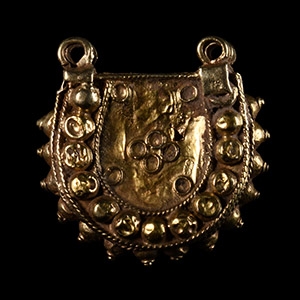
Byzantine Age Gold Filigree Pendant
12th-14th century A.D.Sold for (Inc. bp): £260
Composed of a hollow tongue-shaped body with four suspension loops to the top, bifacial ornament in the form of twisted filigree, applied bulbs and pellets. 6.79 grams, 28 mm
Acquired UK market. Ian Roper collection.
Likely a temple pendant, believed to have been hung near the temple or cheek, suspended from the wearer's headdress. The hollow interior likely concealed a piece of perfumed cloth.
