
Loading, please wait...


LOT 0180
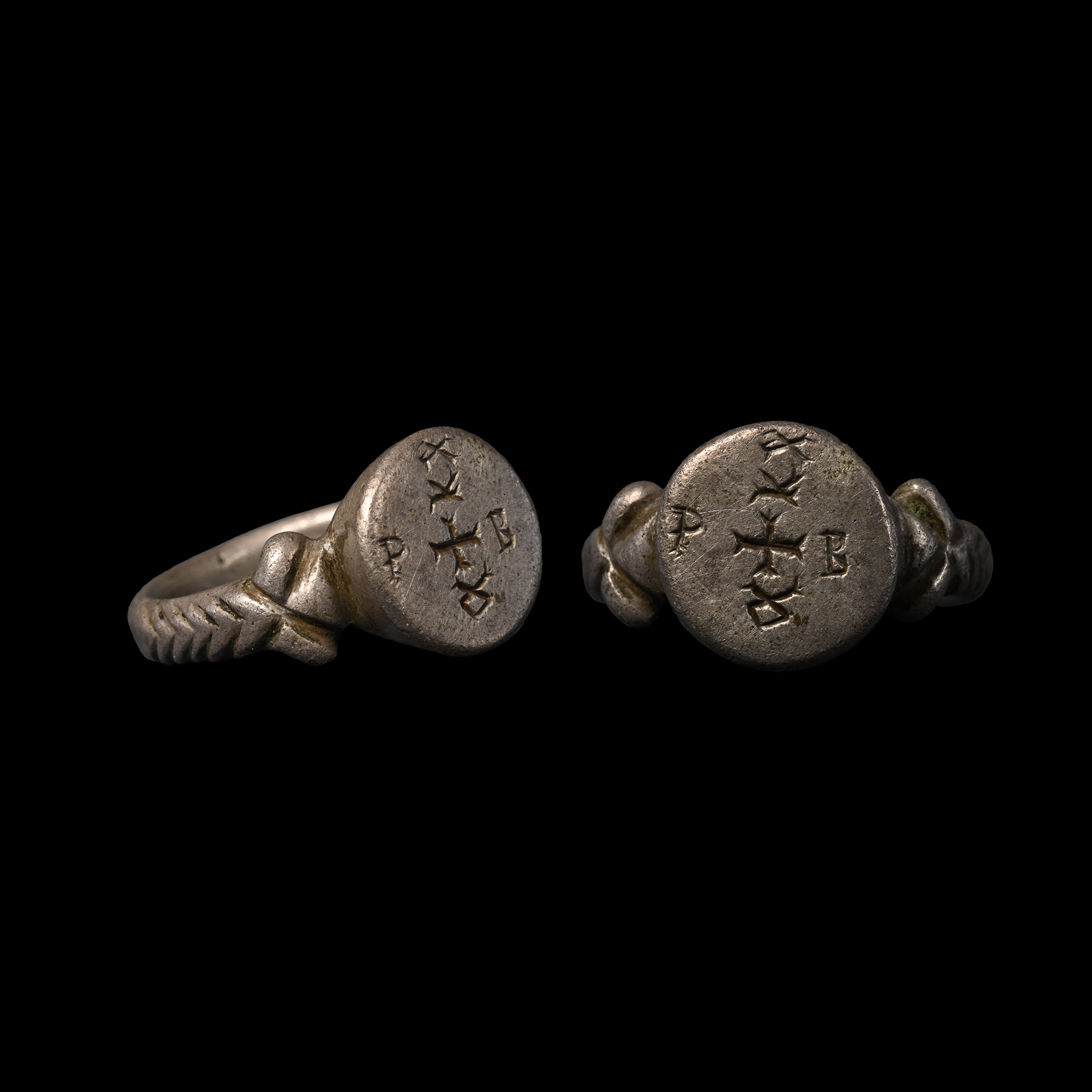
Byzantine Silver Ring with Epigraphy
6TH CENTURY A.D.
7/8 in. (9.71 grams, 24.51 mm overall, 18.56 mm internal diameter (approximate size British Q, USA 8, Europe 17.49, Japan 16)).
The shank with herringbone markings in imitation of braiding, trefoil shoulders, drum-shaped bezel with incised cruciform texts 'P+B' and 'ω+KX'.
ProvenanceGerman art market.
Acquired by the present owner from the above in 2003.
Cf. Ruseva-Slokoska, L., Roman Jewellery, Sofia, 1991, item 227, for type.
CONDITIONTimeLine Auctions follows a vetting process to ensure the authenticity and legality of all items, reinforcing our commitment to integrity and responsible trading. Each antiquity, antique, and coin lot undergoes thorough examination by a vetting committee of at least ten external specialists, professional trade association members, scientists, and archaeologists: Our Vetting Process
AUCTIONS:
TimeLine is a leading auction house specialising in antiquities, ancient art, collectables, natural history, coins, medals, and books. Our auctions offer museums, collectors, historians, and enthusiasts the opportunity to acquire unique and historically significant pieces.
-
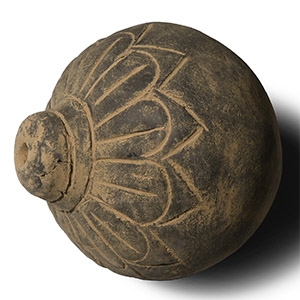
Byzantine 'Greek Fire' Ceramic Fire Bomb or Hand Grenade
9th-11th century A.D.Sold for (Inc. bp): £182
Piriform body with domed filler-hole forming the centre of a flower with radiating petals; intended to be filled with explosive liquid and wick, used as a hand grenade. 449 grams, 10.1 cm
From a specialist collection of militaria, London, UK, collected 1990s onwards. Accompanied by an academic paper by military specialist Dr Raffaele D'Amato, dated 15 July 2019 and titled 'Eastern Roman Empire - Greek Fire Bomb or Hand Grenade (μεσαίον kακάβιον) 9th-11th century AD'.
Apart from the use of siphons or manual flame-throwers called cheirosiphona, special corps of Roman soldiers employed terracotta grenades, in the form of small jars, abundantly evidenced in archaeological excavations. They were called μεσαία kακαβιά or κυτροκακάβια where the former had a bulbous shape and the latter a more cylindrical form. -
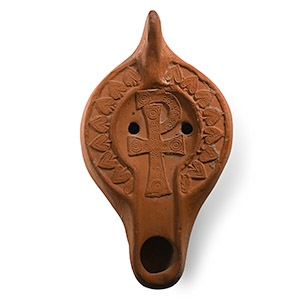
Byzantine Terracotta Oil Lamp with Chi Rho
5th century A.D.Sold for (Inc. bp): £494
Piriform in plan with two small circular filling holes; rounded nozzle and basal ring with concentric rings; raised Christogram between the filling holes and raised ivy-leaf motifs. 173 grams, 14.7 cm
Marceaux Collection, France. Private collection Mr. D, France, before 2000. -
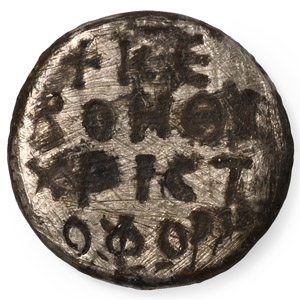
Byzantine Silver Intaglio with Inscription
Circa 6th-12th century A.D.Sold for (Inc. bp): £117
Discoid-shaped with Greek inscription in four lines. 2.01 grams, 13 mm
From an important collection formed before 1988, London and Geneva.
