
Loading, please wait...
_900x900.jpg "Byzantine Silver-Gilt Ring with Saint")
_200x200.jpg "Byzantine Silver-Gilt Ring with Saint")
.jpg "Byzantine Silver-Gilt Ring with Saint")
LOT 0966
Byzantine Silver-Gilt Ring with Saint
CIRCA 6TH-8TH CENTURY A.D.
1 in. (3.13 grams, 24.45 mm overall, 20.03 mm internal diameter (approximate size British T, USA 9 1/2, Europe 21.26, Japan 20)).
With round-section hoop and integral discoid plaque, tondo with intaglio of a robed nimbate figure with one arm raised facing a similar figure, all between fronds.
ProvenanceEx M.N. London collection, 2000s.
LiteratureCf. Chadour, A.B., Rings. The Alice and Louis Koch Collection, volume I, Leeds, 1994, item 481, for type.
CONDITIONTimeLine Auctions follows a vetting process to ensure the authenticity and legality of all items, reinforcing our commitment to integrity and responsible trading. Each antiquity, antique, and coin lot undergoes thorough examination by a vetting committee of at least ten external specialists, professional trade association members, scientists, and archaeologists: Our Vetting Process
AUCTIONS:
TimeLine is a leading auction house specialising in antiquities, ancient art, collectables, natural history, coins, medals, and books. Our auctions offer museums, collectors, historians, and enthusiasts the opportunity to acquire unique and historically significant pieces.
LOT 0966
Byzantine Silver-Gilt Ring with Saint
Estimate £400 - 600€460 - 700 (for guidance only)$540 - 810 (for guidance only)
-
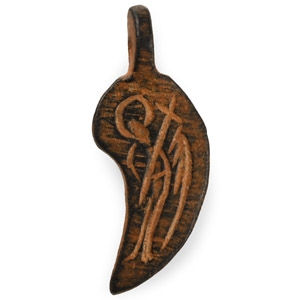
Byzantine Bronze Pendant with Angel and Inscription
6th-7th century A.D.Sold for (Inc. bp): £143
Claw-shaped with cross and angel motif to the obverse; an inscription reading '+O KAT...Y' to the reverse. 7.9 grams, 39 mm
Acquired on the London, UK, art market in the 1990s. From a gentleman's private collection.
While one side is engraved with an angel with a cross-staff, the other side is engraved with the beginning of Psalm 91 (90): + Ο ΚΑΤΟΙΚΟΝ ΕΝ ΒΟΗΘΙΑ ΤΟΥ ΥΨΙϹΤΟΙ…(He who dwells in the shadow of the Most High…). -
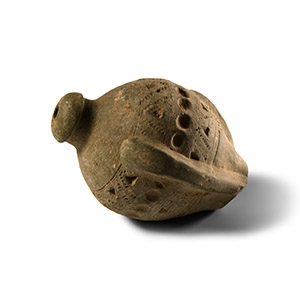
Miniature Byzantine 'Greek Fire' Ceramic Fire Bomb or Hand Grenade
9th-11th century A.D.Sold for (Inc. bp): £130
Piriform body with lateral ribs and impressed ornament to the upper body, domed filler-hole, intended to be filled with explosive liquid and wick, used as a hand grenade. 132 grams, 79 mm
From a specialist collection of militaria, London, UK, collected 1990s onwards. Accompanied by an academic paper by military specialist Dr Raffaele D'Amato, dated 15 July 2019 and titled 'Eastern Roman Empire - Greek Fire Bomb or Hand Grenade (μεσαίον kακάβιον) 9th-11th century AD'.
Apart from the use of siphons or manual flame-throwers called cheirosiphona, special corps of Roman soldiers employed terracotta grenades, in the form of small jars, abundantly evidenced in archaeological excavations. They were called μεσαία kακαβιά or κυτροκακάβια where the former had a bulbous shape and the latter a more cylindrical form. -
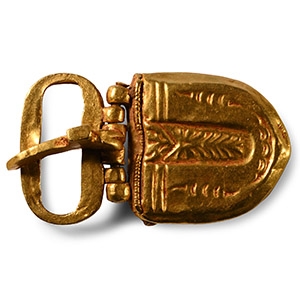
Byzantine Decorated Gold Belt Buckle
8th century A.D.Estimate: £4,000 - 6,000 (+bp*)
Opening Bid: £2,000
Comprising a D-shaped plate with acanthus-leaf motif in low-relief, beaded wire band above the hinge, kidney-shaped rectangular-section loop, flat tongue with spur to the upper face; three mounting studs to reverse. 33.02 grams, 55 mm
Acquired from Bernard Hern, 1970s. From an old UK collection, 1970s-1980s. This lot has been checked against the Interpol Database of stolen works of art and is accompanied by a search certificate number no.12113-217070.
