
Loading, please wait...
_900x900.jpg "Byzantine Silver-Gilt Ring with Saint")
_200x200.jpg "Byzantine Silver-Gilt Ring with Saint")
.jpg "Byzantine Silver-Gilt Ring with Saint")
LOT 0979
Byzantine Silver-Gilt Ring with Saint
CIRCA 6TH-8TH CENTURY A.D.
1 in. (3.13 grams, 24.45 mm overall, 20.03 mm internal diameter (approximate size British T, USA 9 1/2, Europe 21.26, Japan 20)).
With round-section hoop and integral discoid plaque, tondo with intaglio of a robed nimbate figure with one arm raised facing a similar figure, all between fronds.
ProvenanceEx M.N. London collection, 2000s.
LiteratureCf. Chadour, A.B., Rings. The Alice and Louis Koch Collection, volume I, Leeds, 1994, item 481, for type.
CONDITIONTimeLine Auctions follows a vetting process to ensure the authenticity and legality of all items, reinforcing our commitment to integrity and responsible trading. Each antiquity, antique, and coin lot undergoes thorough examination by a vetting committee of at least ten external specialists, professional trade association members, scientists, and archaeologists: Our Vetting Process
AUCTIONS:
TimeLine is a leading auction house specialising in antiquities, ancient art, collectables, natural history, coins, medals, and books. Our auctions offer museums, collectors, historians, and enthusiasts the opportunity to acquire unique and historically significant pieces.
LOT 0979
Byzantine Silver-Gilt Ring with Saint
Estimate £400 - 600€460 - 700 (for guidance only)$540 - 810 (for guidance only)
-
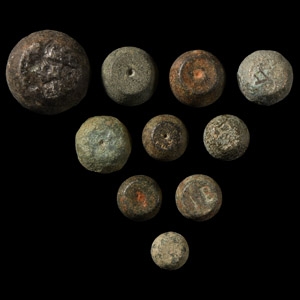
Byzantine Bronze Weight Collection
Circa 8th-12th century A.D.Sold for (Inc. bp): £65
Including mainly barrel-shaped types. 225 grams total, 11-26 mm
Ex Simmons gallery, London, UK. Ex North London collection, 1990s. -
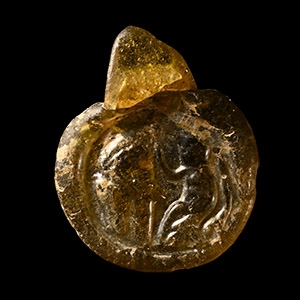
Byzantine Glass Medallion Pendant with Moses Hitting the Rock
5th-7th century A.D.Sold for (Inc. bp): £598
Discoid with integral loop, incuse image of Moses striking a desert rock in order to make water flow. 1.82 grams, 22 mm
Ex Monnaies d'Antan, Poses, France. From the collection of an London antiquarian. Accompanied by a previous illustrated cataloguing card. -
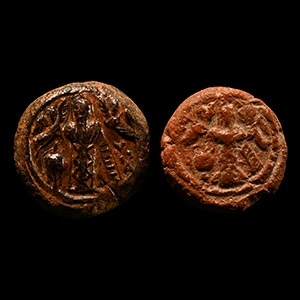
Byzantine Terracotta Pilgrim's Token Group
6th-7th century A.D.Sold for (Inc. bp): £33
Each plano-convex with low-relief image of Simon Stylites flanked by airborne angels. 10.7 grams total, 21-23 mm
Acquired European art market, 1980s. From the collection of an London antiquarian.
