
Loading, please wait...
LOT 1125
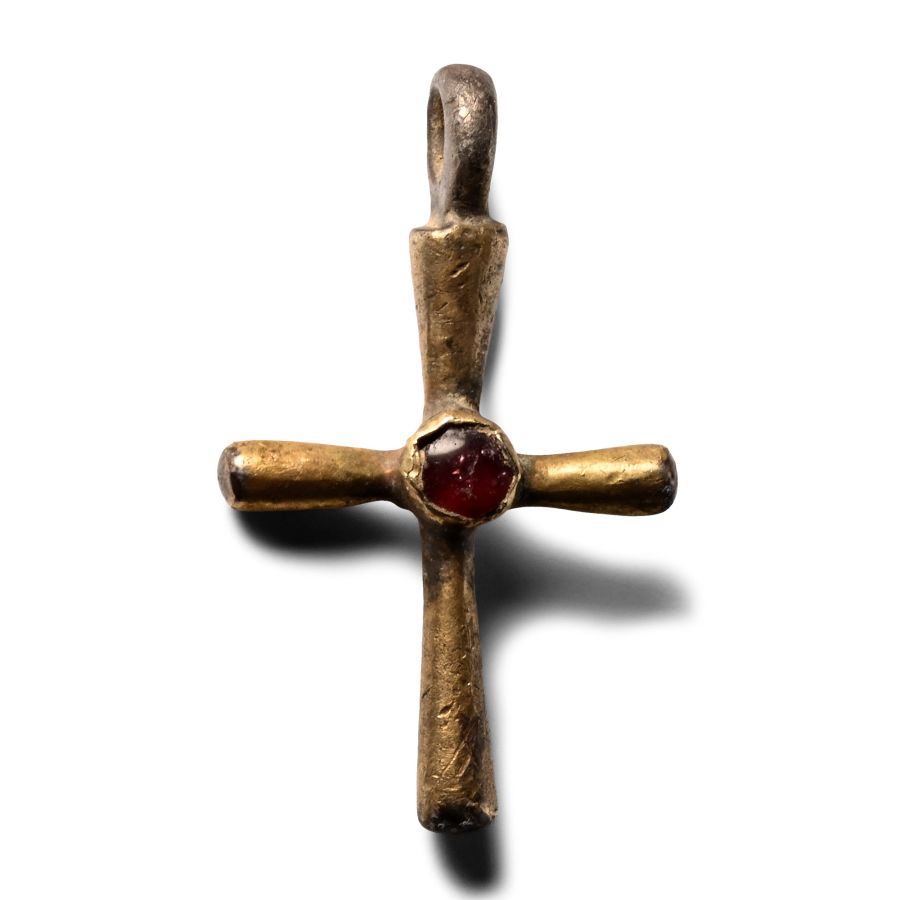
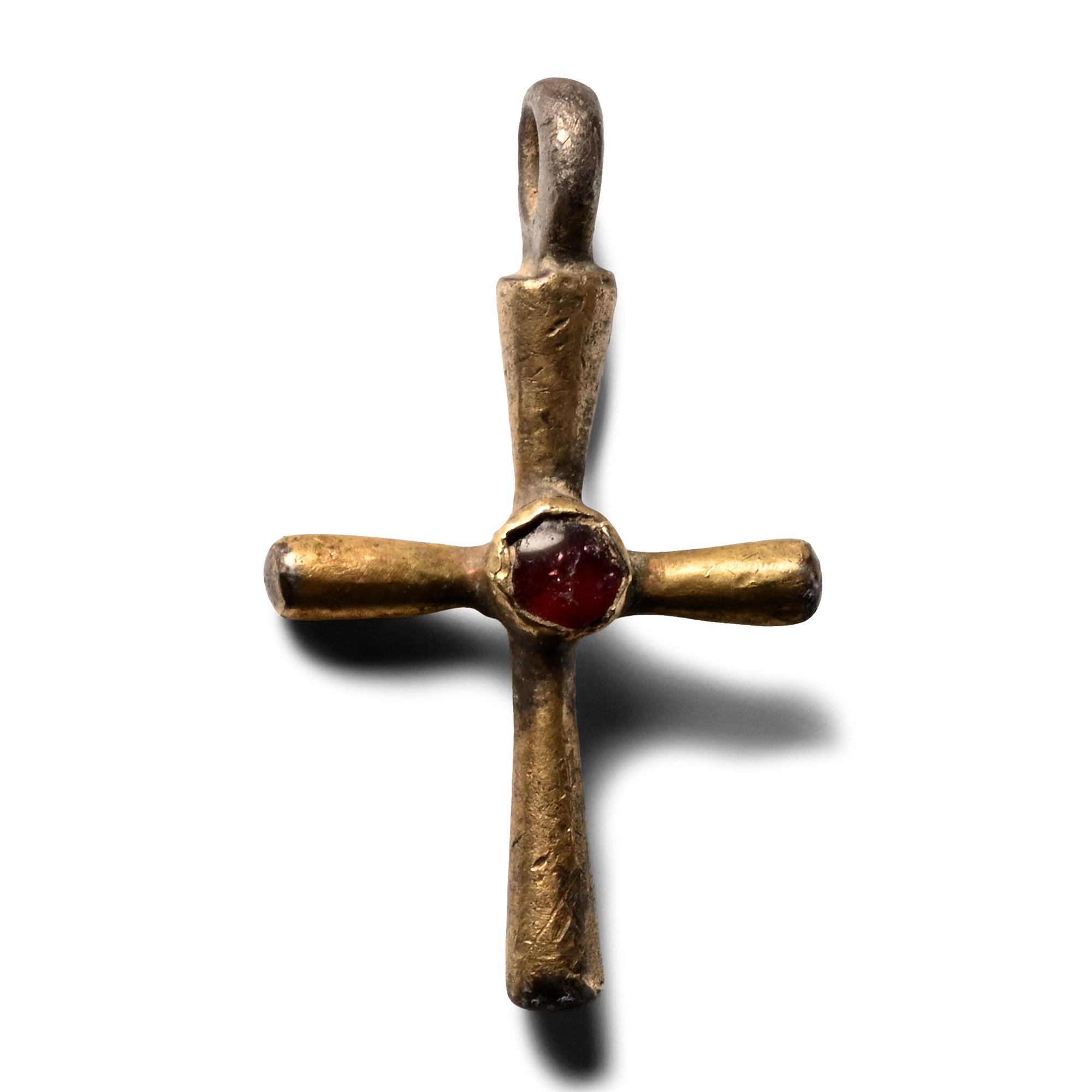
Byzantine Silver-Gilt Cross Pendant with Garnet
CIRCA 6TH CENTURY A.D.
1 1/4 in. (2.61 grams, 31 mm).
Formed as four conical arms and a central circular cell with an inset garnet cabochon, pierced lug for suspension. [No Reserve]
ProvenanceEx Den of Antiquity, Cambridge, UK.
From the private collection of a West London, UK, gentleman, formed since the early 2000s.
Accompanied by a typed dealer's ticket.
TimeLine Auctions follows a vetting process to ensure the authenticity and legality of all items, reinforcing our commitment to integrity and responsible trading. Each antiquity, antique, and coin lot undergoes thorough examination by a vetting committee of at least ten external specialists, professional trade association members, scientists, and archaeologists: Our Vetting Process
AUCTIONS:
TimeLine is a leading auction house specialising in antiquities, ancient art, collectables, natural history, coins, medals, and books. Our auctions offer museums, collectors, historians, and enthusiasts the opportunity to acquire unique and historically significant pieces.
-
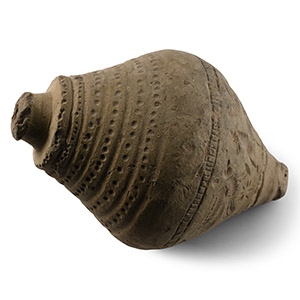
Byzantine 'Greek Fire' Ceramic Fire Bomb or Hand Grenade
9th-11th century A.D.Sold for (Inc. bp): £117
Biconical in profile with pointillé and linear decoration; intended to be filled with explosive liquid and a wick, and used as a hand grenade. 544 grams, 13 cm
From an important specialist collection, London, UK, 1990s onwards. Accompanied by an academic paper by military specialist Dr Raffaele D'Amato, dated 15 July 2019 and titled 'Eastern Roman Empire - Greek Fire Bomb or Hand Grenade (μεσαίον kακάβιον) 9th-11th century AD'.
Apart from the use of siphons or manual flame-throwers called cheirosiphona, special corps of Roman soldiers employed terracotta grenades, in the form of small jars, abundantly evidenced in archaeological excavations. They were called μεσαία kακαβιά or κυτροκακάβια where the former had a bulbous shape and the latter a more cylindrical form. -
.jpg)
Large Byzantine Gold Ring Of Mary and Eutropius
6th-9th century A.D.Sold for (Inc. bp): £5,980
Comprising a D-section hoop with flat sides bearing wave-pattern ornament and legend 'MAPIAC / EYTPOΠIOY' (belonging to Mary and Eutropius); tiered bezel with incised key-pattern and undulating line to the edges; shoulders with palmette motif; discoid plaque with incuse wreath surrounding a bird with star above and lizard; with platinum inclusions. 23.66 grams, 31.00 mm overall, 19.87 mm internal diameter (approximate size British R 1/2, USA 8 3/4, Europe 19.38, Japan 18)
Private English collection, formed between the late 1970s and early 1990s. Private collection, UK. This lot has been checked against the Interpol Database of stolen works of art and is accompanied by search certificate number no.12970-246013. -
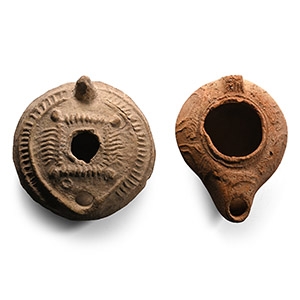
Byzantine Ceramic Oil Lamp Collection
6th-8th century A.D.Estimate: £180 - 240 (‡+bp*)
Opening Bid: £90
Comprising: a piriform lamp with a band of stylised quadrupeds surrounding the large filler hole, ribbed handle; a discoid lamp with raised linear decoration, wheel motif to base. 195 grams total, 9.6-10.1 cm
with Galerie Rhéa, Zurich, Switzerland.
