
Loading, please wait...


LOT 1093
Byzantine Seal Matrix with Inscription
CIRCA 11TH-12TH CENTURY A.D.
3/4 in. (13.1 grams, 18 mm).
With inscription '+ΘKEB / OΘTO / ΔΟΛΟ / ΤΘΛΑ' for 'ΘΕΟΤΟΚΕ ΒΟΗΘΕI ΤΩ ΔΟΥΛΩ ΤΟΥ ΘΕΟΥ ΛΑΔΕ' (Mother of God, help Lades, the servant of God).
ProvenanceFrom an important collection formed before 1988, London and Geneva.
This lot is accompanied by an illustrated lot declaration signed by the Head of the Antiquities Department, Dr Raffaele D’Amato.
This lot is accompanied by an illustrated lot declaration signed by the Head of the Antiquities Department, Dr Raffaele D'Amato.
Cf. Wamser, L., Die Welt von Byzanz - Europas Östliches Erbe, München, 2004, item 743, for type.
FootnotesThe stamp seals that have survived in large numbers from Byzantium are objects a few centimeters high and conical in shape, featuring a sealing surface at the lower end and a pendant at the upper end. They served the same function as signet rings and were used to seal everyday objects, primarily in private areas, using wax and other soft materials.
CONDITIONTimeLine Auctions follows a vetting process to ensure the authenticity and legality of all items, reinforcing our commitment to integrity and responsible trading. Each antiquity, antique, and coin lot undergoes thorough examination by a vetting committee of at least ten external specialists, professional trade association members, scientists, and archaeologists: Our Vetting Process
AUCTIONS:
TimeLine is a leading auction house specialising in antiquities, ancient art, collectables, natural history, coins, medals, and books. Our auctions offer museums, collectors, historians, and enthusiasts the opportunity to acquire unique and historically significant pieces.
LOT 1093
Byzantine Seal Matrix with Inscription
Estimate £150 - 200€170 - 230 (for guidance only)$200 - 270 (for guidance only)
-
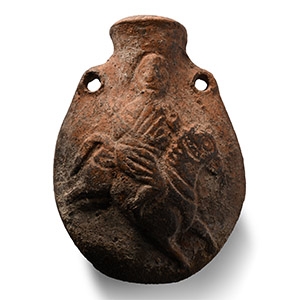
Byzantine Ceramic Pilgrim's Flask with Christ and Donkey
Circa 6th-8th century A.D.Sold for (Inc. bp): £338
Lentoid in section and teardrop-shaped in profile with flared mouth and pierced shoulders, low-relief image of a nimbate man riding a donkey to each face. 30.3 grams, 71 mm
Ex Mayfair, London, UK, gallery, 2000s. -
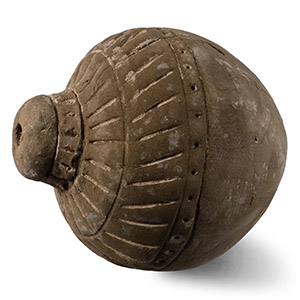
Byzantine 'Greek Fire' Ceramic Fire Bomb or Hand Grenade
9th-11th century A.D.Sold for (Inc. bp): £117
Ovoid in profile with incised linear decoration to the shoulder; intended to be filled with explosive liquid and a wick, and used as a hand grenade. 401 grams, 11 cm
From an important specialist collection, London, UK, 1990s onwards. Accompanied by an academic paper by military specialist Dr Raffaele D'Amato, dated 15 July 2019 and titled 'Eastern Roman Empire - Greek Fire Bomb or Hand Grenade (μεσαίον kακάβιον) 9th-11th century AD'.
Apart from the use of siphons or manual flame-throwers called cheirosiphona, special corps of Roman soldiers employed terracotta grenades, in the form of small jars, abundantly evidenced in archaeological excavations. They were called μεσαία kακαβιά or κυτροκακάβια where the former had a bulbous shape and the latter a more cylindrical form. -
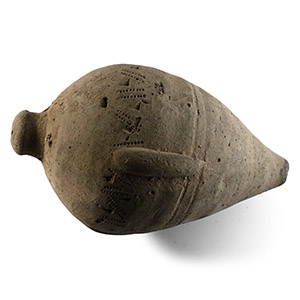
Byzantine 'Greek Fire' Ceramic Fire Bomb or Hand Grenade
9th-11th century A.D.Sold for (Inc. bp): £117
Piriform in profile with domed mouth, vertical raised lugs dividing the body into four fields each with pointillé herringbone patterns; intended to be filled with explosive liquid and a wick, and used as a hand grenade. 646 grams, 14.5 cm
From an important specialist collection, London, UK, 1990s onwards. Accompanied by an academic paper by military specialist Dr Raffaele D'Amato, dated 15 July 2019 and titled 'Eastern Roman Empire - Greek Fire Bomb or Hand Grenade (μεσαίον kακάβιον) 9th-11th century AD'.
Apart from the use of siphons or manual flame-throwers called cheirosiphona, special corps of Roman soldiers employed terracotta grenades, in the form of small jars, abundantly evidenced in archaeological excavations. They were called μεσαία kακαβιά or κυτροκακάβια where the former had a bulbous shape and the latter a more cylindrical form.
