
Loading, please wait...
_900x900.jpg "Byzantine Seal Matrix with Inscription")
_200x200.jpg "Byzantine Seal Matrix with Inscription")
.jpg "Byzantine Seal Matrix with Inscription")
LOT 0916
Byzantine Seal Matrix with Inscription
CIRCA 6TH-12TH CENTURY A.D.
3/4 in. (13.1 grams, 18 mm).
With inscription '+ΘKEB / OΘTO / ΔΟΛΟ / ΤΘΛΑ' for 'ΘΕΟΤΟΚΕ ΒΟΗΘΕI ΤΩ ΔΟΥΛΩ ΤΟΥ ΘΕΟΥ ΛΑΔΕ' (Mother of God, help Lades, the servant of God).
ProvenanceFrom an important collection formed before 1988, London and Geneva.
This lot is accompanied by an illustrated lot declaration signed by the Head of the Antiquities Department, Dr Raffaele D’Amato.
This lot is accompanied by an illustrated lot declaration signed by the Head of the Antiquities Department, Dr Raffaele D'Amato.
TimeLine Auctions follows a vetting process to ensure the authenticity and legality of all items, reinforcing our commitment to integrity and responsible trading. Each antiquity, antique, and coin lot undergoes thorough examination by a vetting committee of at least ten external specialists, professional trade association members, scientists, and archaeologists: Our Vetting Process
AUCTIONS:
TimeLine is a leading auction house specialising in antiquities, ancient art, collectables, natural history, coins, medals, and books. Our auctions offer museums, collectors, historians, and enthusiasts the opportunity to acquire unique and historically significant pieces.
LOT 0916
Byzantine Seal Matrix with Inscription
Estimate £180 - 240€210 - 280 (for guidance only)$240 - 320 (for guidance only)
-
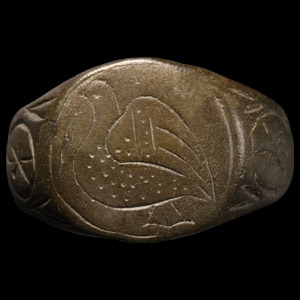
Byzantine Bronze Ring with Bird
14th-15th century A.D.Sold for (Inc. bp): £111
Flat-section hoop and a large discoid bezel with a stylised bird, possibly a dove, with its wings spread. 6.23 grams, 22.66 mm overall, 19.73 mm internal diameter (approximate size British T, USA 9 1/2, Europe 21.26, Japan 20)
Ex German art market, 2000s. Acquired from an EU collector living in London. From the collection of a Surrey, UK, gentleman. This lot is accompanied by an illustrated lot declaration signed by the Head of the Antiquities Department, Dr Raffaele D'Amato. -
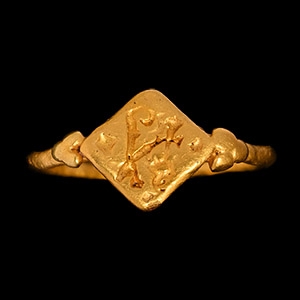
Byzantine Gold Ring with NP
7th-9th century A.D.Estimate: £1,500 - 2,000 (+bp*)
Opening Bid: £750
With granule cluster to each shoulder, lozenge bezel with incuse 'NP' monogram flanked by pellets. 3.23 grams, 20.11 mm overall, 17.58 mm internal diameter (approximate size British L, USA 5 3/4, Europe 11.24, Japan 10)
Acquired on the UK art market. Private collection, UK. This lot has been cleared against the Art Loss Register database, and is accompanied by an illustrated lot declaration signed by the Head of the Antiquities Department, Dr Raffaele D'Amato. -
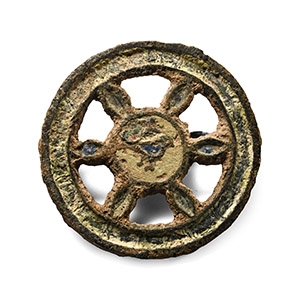
Byzantine Enamelled Brooch with Bird
9th century A.D.Estimate: £100 - 140 (+bp*)
Opening Bid: £45
Comprising: Outer ring linked by six radiating ellipsoid spokes to central hun, pin-lug, pin and catch to the reverse; outer ring with median band of enamel, similar to each of the spokes; hub with enamel-filed bird motif on a plain enamelled field. 9.73 grams, 35 mm
Acquired before 1978. Private collection, UK. This lot is accompanied by an illustrated lot declaration signed by the Head of the Antiquities Department, Dr Raffaele D'Amato.
