
Loading, please wait...
LOT 0219
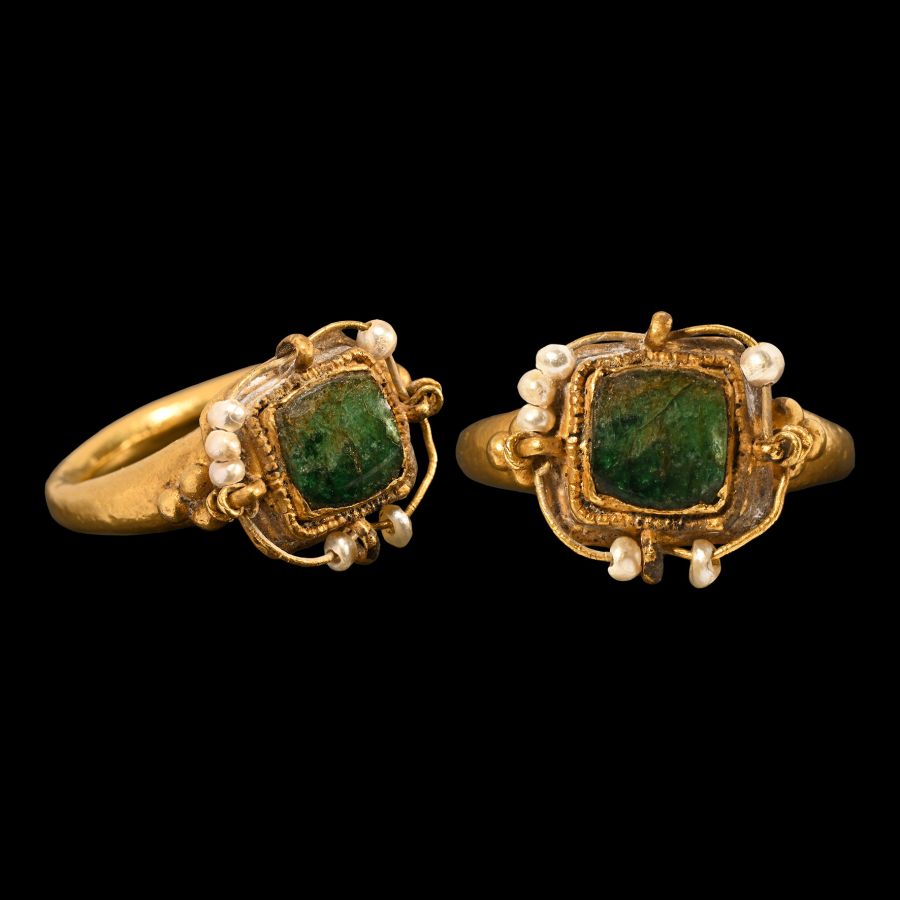
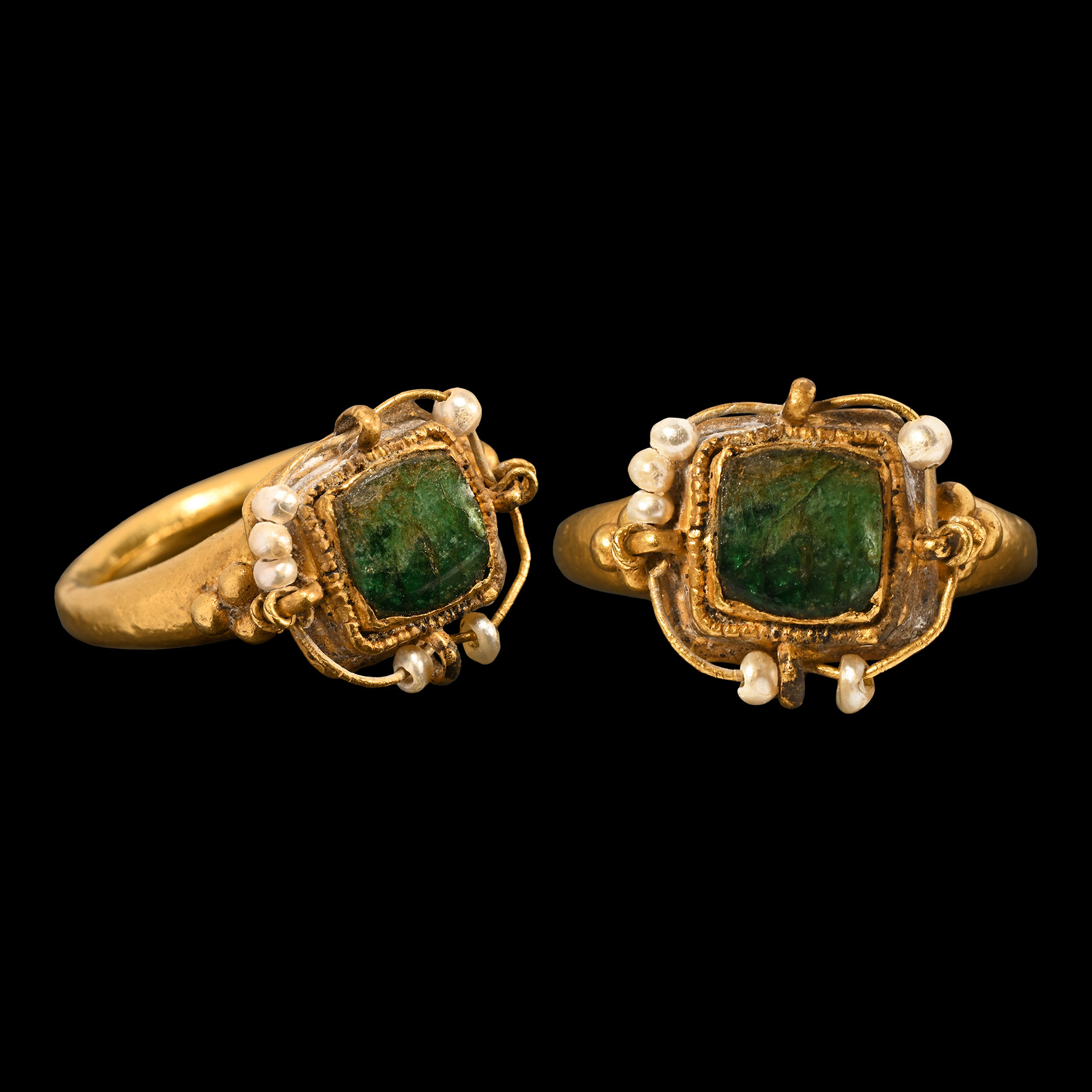
Byzantine or Merovingian Gold Ring with Emerald and Pearls
7TH-9TH CENTURY A.D.
1 in. (6.70 grams, 27.95 mm overall, 16.94 mm internal diameter (approximate size British I, USA 4 1/4, Europe 7.44, Japan 7)).
With a heavy hollow-formed hoop, three pellets to each shoulder; raised square bezel set with emerald framed with pelletted border, four applied loops to the outer edge holding decorative gold wire with seed pearls. [No Reserve]
ProvenanceEx New York, USA, private collection in the early 1990s.
This lot has been checked against the Interpol Database of stolen works of art and is accompanied by search certificate no.12105-214336.
Cf. Hadjadj, R., Bagues Merovingiennes - Gaul du Nord, Paris, 2007, item p.39, for similar emerald cabochon.
CONDITIONTimeLine Auctions follows a vetting process to ensure the authenticity and legality of all items, reinforcing our commitment to integrity and responsible trading. Each antiquity, antique, and coin lot undergoes thorough examination by a vetting committee of at least ten external specialists, professional trade association members, scientists, and archaeologists: Our Vetting Process
AUCTIONS:
TimeLine is a leading auction house specialising in antiquities, ancient art, collectables, natural history, coins, medals, and books. Our auctions offer museums, collectors, historians, and enthusiasts the opportunity to acquire unique and historically significant pieces.
LOT 0219
Byzantine or Merovingian Gold Ring with Emerald and Pearls
Sold for (Inc. bp): £2,080
-
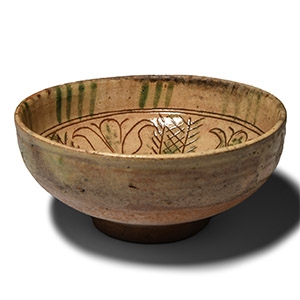
Byzantine Green-Glazed Sgraffito Bowl
Circa 12th-15th century A.D.Sold for (Inc. bp): £585
Broad with basal disc, cream-glazed inner face with green detailing, sgraffito design of tulip flowers and hatched bands. 322 grams, 15.2 cm
From a collection acquired on the UK art market from various auction houses and collections mostly before 2000. From an important Cambridgeshire estate; thence by descent. -
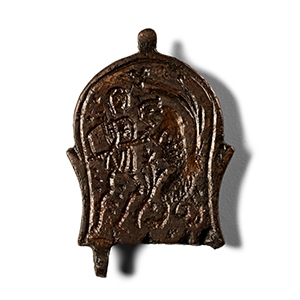
Byzantine Belt Mount with Lion Combat Scene
Circa 6th-7th century A.D.Sold for (Inc. bp): £59
Belt buckle plate with loops, lateral spurs and knop finial; low-relief scene of a man grappling with a beast in a landscape with tree and flowers; mounting lugs to the reverse; old collector's envelop with handwritten text 'sceau / Carthage / combat Homme et Lion / [..] Jardin' (seal / Carthage / fight between man and lion / [..] garden). 18.5 grams, 47 mm
Found in Carthage. From a 19th century collection based on the handwritten package. From the collection of a London antiquarian. Accompanied by an old hand written collector's envelope. -
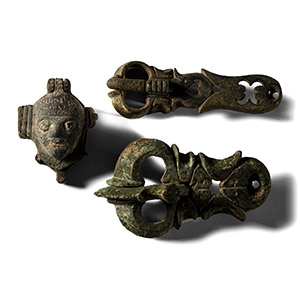
Byzantine Bronze Artefact Group
6th-7th century A.D.Sold for (Inc. bp): £234
Comprising: a large bronze buckle with thick round-section loop, ribbed tongue with acanthus-leaf design in-high relief, two pierced lugs to the reverse; a smaller buckle with long plate decorated with openwork geometric forms; a small seal box shaped as a youthful head with details on hair and face, open catch at the top. 107 grams total, 39-68 mm
Acquired in Europe in 1992. European private collection.
This type of belt elements, although present in the Avar graves of the second half of the 7th century, were most likely produced in the workshops of the Eastern Roman Empire, from where they reached the Avar lands as imperial gifts or spoils of war. They could be simple fastenings for belts, or part of multiple belts, to which sabres and knives were attached, commonly used among Avars, Bulgars and Romans during the 6th -7th centuries A.D.
