
Loading, please wait...

LOT 0990
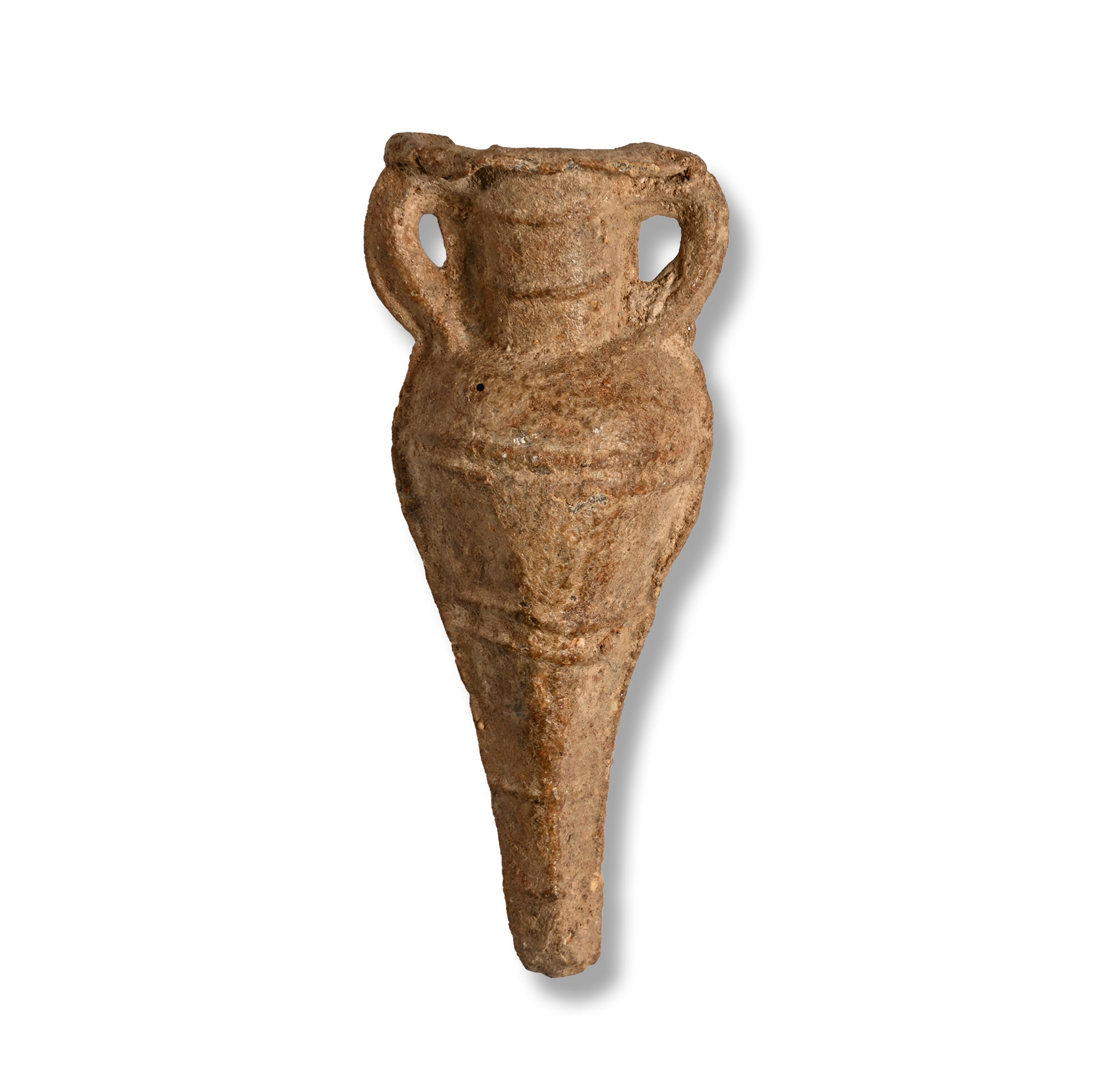
Byzantine Lead Pilgrim's Ampulla
6TH-8TH CENTURY A.D.
2 1/8 in. (25.3 grams, 54 mm).
Modelled as a two-handled amphora with decorative bands to the body. [No Reserve]
ProvenanceEx German art market, 2000s.
Acquired from an EU collector living in London.
From the collection of Surrey, UK, gentleman.
TimeLine Auctions follows a vetting process to ensure the authenticity and legality of all items, reinforcing our commitment to integrity and responsible trading. Each antiquity, antique, and coin lot undergoes thorough examination by a vetting committee of at least ten external specialists, professional trade association members, scientists, and archaeologists: Our Vetting Process
AUCTIONS:
TimeLine is a leading auction house specialising in antiquities, ancient art, collectables, natural history, coins, medals, and books. Our auctions offer museums, collectors, historians, and enthusiasts the opportunity to acquire unique and historically significant pieces.
-
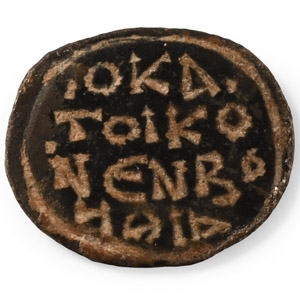
Byzantine Intaglio Gemstone
Circa 6th-12th century A.D.Sold for (Inc. bp): £117
With incised legend '+OKA / TOIKO / NENBO / HΘIA' (for 'O KATOIKΩN EN BOHΩEIA' "Whoever dwells in the shelter (of the most high)' from Psalm 90. 1.3 grams, 17 mm
From an important collection formed before 1988, London and Geneva. -
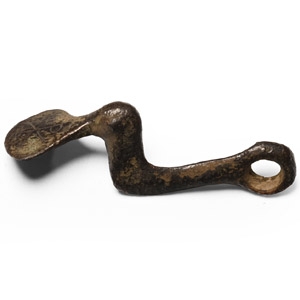
Byzantine Bronze Hanger with Chi Rho and Cross
6th-8th century A.D.Sold for (Inc. bp): £39
Comprising an L-shaped body with integral loop and fan-shaped finial perpendicular to the body; one side with incised crossed and the other with Christogram. 5.2 grams, 43 mm
Ex German art market, 2000s. Acquired from an EU collector living in London. From the collection of Surrey, UK, gentleman. -
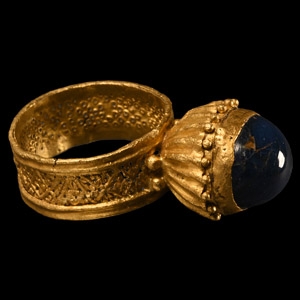
Byzantine Gold Ring with Sapphire
5th-6th century A.D.Sold for (Inc. bp): £1,972
Flat-section hoop displaying geometric pierced work between raised bands, fluted hemispherical bezel adorned with granules and set with possibly a later polished cabochon sapphire. 8.66 grams, 33.78 mm overall, 16.94 mm internal diameter (approximate size British M 1/2, USA 6 1/4, Europe 13.09, Japan 13)
Acquired 1990s-early 2000s. East Anglian private collection. This lot has been checked against the Interpol Database of stolen works of art and is accompanied by search certificate no.201084.
