
Loading, please wait...
_900x900.jpg "Byzantine Iron Horse Bit")
_200x200.jpg "Byzantine Iron Horse Bit")
.jpg "Byzantine Iron Horse Bit")
LOT 1108
Byzantine Iron Horse Bit
14TH-16TH CENTURY A.D.
7 3/4 in. (340 grams, 19.5 cm).
Composed of arched openwork shanks with looped terminals; one end fitted with large hoops and bar between; one end with a tripartite mouthpiece comprising two collared bars connected by a central hoop; Byzantine or early Ottoman.
ProvenanceCollection of Dr. Hanns-Ulrich Haedeke (1928-2017), author of ‘Schmuck Aus Drei Jahrtausenden’ and who became the director of the Museum of Klingenmuseum in Solingen, Germany, in 1968; the collection was formed in the early 1960s.
From an important private Dutch collection.
See Витлянов, С., Старобългарското въоъжение (The Old Bulgarian Armament), София, 1996, fig.1, pl.XXIV and fig.5, for an identical example.
FootnotesThis type of horse bit is visible on one of the most important equestrian artworks of the 15th century - the Cappella dei Magi by Benozzo Gozzoli, a painting representing the Three Kings visiting Christ, depicted in costumes belonging to the early quarter of 15th century. All the cavalrymen in the artwork had heavy curb-bits (with short and curved shanks, as in our specimen) and heavy, single reins.
CONDITIONTimeLine Auctions follows a vetting process to ensure the authenticity and legality of all items, reinforcing our commitment to integrity and responsible trading. Each antiquity, antique, and coin lot undergoes thorough examination by a vetting committee of at least ten external specialists, professional trade association members, scientists, and archaeologists: Our Vetting Process
AUCTIONS:
TimeLine is a leading auction house specialising in antiquities, ancient art, collectables, natural history, coins, medals, and books. Our auctions offer museums, collectors, historians, and enthusiasts the opportunity to acquire unique and historically significant pieces.
LOT 1108
Byzantine Iron Horse Bit
Estimate £250 - 350€290 - 410 (for guidance only)$340 - 470 (for guidance only)
-
.jpg)
Byzantine 'Greek Fire' Fire Bomb or Hand Grenade
9th-11th century A.D.Sold for (Inc. bp): £182
Piriform in shape with raised lugs to the upper body with stamped concentric roundels between. 588 grams, 15.3 cm
Family collection, acquired 1980-2015. Ex property of a North London gentleman. Accompanied by an academic paper by military specialist Dr Raffaele D'Amato, dated 15 July 2019 and titled 'Eastern Roman Empire - Greek Fire Bomb or Hand Grenade (μεσαίον kακάβιον) 9th-11th century AD'.
Apart from the use of siphons or manual flame-throwers called cheirosiphona, special corps of Roman soldiers employed terracotta grenades, in the form of small jars, abundantly evidenced in archaeological excavations. Such were the γανωτα, vessels (sometimes also of bronze) used for Greek fire. They were called μεσαία kακαβιά or κυτροκακάβια where the former had a bulbous shape and the latter a more cylindrical form. -
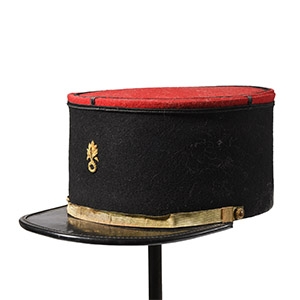
French Foreign Legion Kepi
Circa 1930-1940s A.D.Sold for (Inc. bp): £104
Black and red cloth with gold-coloured banding and 'button'; red lining and typed label reading 'Sergent BUYUKISPIR Haluk 1o R.E. Quartier Viénot C.S.L.E./S.I.H.L.E....'. 197 grams, 24.5 cm wide
Acquired from Czerny's Auctions, Italy, lot 104, 2016. The Kusmirek Collection, UK. Accompanied by copy of Czerny's invoice and information. -
.jpg)
English Cuirassier Single Bar Burgonet
Circa 1620 A.D.Sold for (Inc. bp): £4,680
Iron fronted with visor, nasal guard bar and front and back gorget plates, the lifting visor marked with parallel lines; the front and back plates secured with a single hook. 2.25 kg, 34.5 cm high
Acquired on the UK art market. The Kusmirek Collection, UK. Accompanied by an academic report by Dr Raffaele D'Amato. This lot has been checked against the Interpol Database of stolen works of art and is accompanied by search certificate number no. 11766-203985.
During the latter half of the 16th century, the heavy 'knightly' lance gradually fell out of use, possibly because of the widespread adoption of the infantry pike. Also, the lance required a great amount of practice to perfect its use, whilst proficiency in the use of firearms was considerably more easily acquired. The lancer or demi-lancer, when he had abandoned his lance, became the pistol-armed cuirassier or reiter. The adoption of the pistol as the primary weapon led to the development of the stately caracole tactic, where cuirassiers fired their pistols at the enemy, then retired to reload whilst their comrades advanced in turn to maintain firing. Following some initial successes, this tactic proved to be extremely ineffective, as infantry, with superior firearms and numbers, could easily outgun the cuirassiers. The change from cavalry being reliant on firearms, to shock-capable close combat cavalry, reliant mainly on the sword, was attributed to Gustavus Adolphus of Sweden in the 1620s and 1630s, but was actually already widely practiced throughout Europe since the invention of pistol-armed heavy cavalrymen in the late 16th century.
