
Loading, please wait...
_900x900.jpg "Byzantine 'Greek Fire' Fire Bomb or Hand Grenade")
_200x200.jpg "Byzantine 'Greek Fire' Fire Bomb or Hand Grenade")
.jpg "Byzantine 'Greek Fire' Fire Bomb or Hand Grenade")
LOT 1112
Byzantine 'Greek Fire' Fire Bomb or Hand Grenade
9TH-11TH CENTURY A.D.
6 in. (588 grams, 15.3 cm).
Piriform in shape with raised lugs to the upper body with stamped concentric roundels between. [No Reserve]
ProvenanceFamily collection, acquired 1980-2015.
Ex property of a North London gentleman.
Accompanied by an academic paper by military specialist Dr Raffaele D'Amato, dated 15 July 2019 and titled 'Eastern Roman Empire - Greek Fire Bomb or Hand Grenade (μεσαίον kακάβιον) 9th-11th century AD'.
Cf. Arendt, W. I., Granaten des 13-14. Jahrhunderts, die an der Wolga gefunden sind, Zeitschrift fur Historische Waffen-und Kostumkunde, 11 (1926-8), p.42; cf. Arendt, W., Die Spharisch-konischen Gefasse aus Gebranntem Ton, ibid; cf. Ayalon, D., Gunpowder and Firearms in the Mamluk Kingdom, London, 1956, p.16.
FootnotesApart from the use of siphons or manual flame-throwers called cheirosiphona, special corps of Roman soldiers employed terracotta grenades, in the form of small jars, abundantly evidenced in archaeological excavations. Such were the γανωτα, vessels (sometimes also of bronze) used for Greek fire. They were called μεσαία kακαβιά or κυτροκακάβια where the former had a bulbous shape and the latter a more cylindrical form.
CONDITIONTimeLine Auctions follows a vetting process to ensure the authenticity and legality of all items, reinforcing our commitment to integrity and responsible trading. Each antiquity, antique, and coin lot undergoes thorough examination by a vetting committee of at least ten external specialists, professional trade association members, scientists, and archaeologists: Our Vetting Process
AUCTIONS:
TimeLine is a leading auction house specialising in antiquities, ancient art, collectables, natural history, coins, medals, and books. Our auctions offer museums, collectors, historians, and enthusiasts the opportunity to acquire unique and historically significant pieces.
-
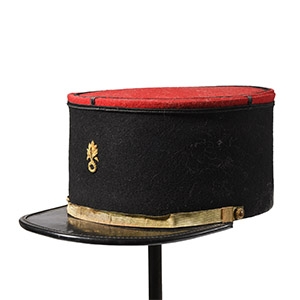
French Foreign Legion Kepi
Circa 1930-1940s A.D.Sold for (Inc. bp): £104
Black and red cloth with gold-coloured banding and 'button'; red lining and typed label reading 'Sergent BUYUKISPIR Haluk 1o R.E. Quartier Viénot C.S.L.E./S.I.H.L.E....'. 197 grams, 24.5 cm wide
Acquired from Czerny's Auctions, Italy, lot 104, 2016. The Kusmirek Collection, UK. Accompanied by copy of Czerny's invoice and information. -
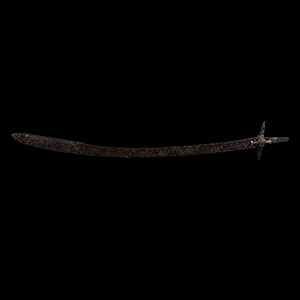
Turkish Iron Sabre
15th century A.D.Sold for (Inc. bp): £585
Comprising a cross-shaped hand guard, the blade with a slight curvature widening towards the point; mounted on a custom-made wall mount. 1.35 kg total, 95 cm including stand
Still-homogenous blade structure, pitting and traces of surface material losses due to the permanence in water; presence of many battle nicks on the cutting part of the blade.
Private collection, Munich, Germany, 1970s. Private collection, London, UK, 2014, acquired from the above.
The Turkish sabres from 15th century, had hilts similar to Omayyad and Abbasid's swords. The blades were long and heavy and were most probably used for swinging cuts, and were particularly convenient for point-thrusts when fighting on foot. -
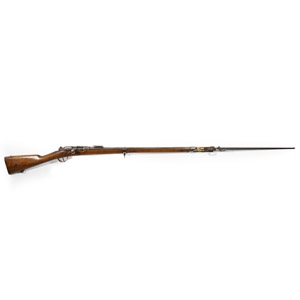
1866/74 Model Gras Rifle and Bayonet
Dated 1868 A.D.Estimate: £500 - 700 (+bp*)
Opening Bid: £222
Round rifled 90cm (35½") barrel of 11mm calibre with folding rear sight (without slide), bolt action with serial no.52431 to breech; fitted with full wood stock with steel butt cap, trigger guard, sling swivels and fore-end, steel cleaning rod; with correct Gras bayonet inscribed 'M[--] d'Armes de St Etienne 8bre 1878' to back and steel scabbard. 4.8 kg, 1.84 m
Acquired from Czerny's Auctions, Italy, 2019. The Kusmirek Collection, UK. Accompanied by a copy of Czerny's invoice and listing.
Sold as an exempt item under Section 58 (2) of the Firearms Act, 1968, to be held as a curiosity or ornament. No license required but buyer must be over 18 years of age. Overseas bidders should note that, due to UK regulations governing export of all firearms, overseas buyers will need to make arrangements for shipping this lot out of the UK directly, by air freight, with a specialist company or agent.
