
Loading, please wait...
LOT 1179
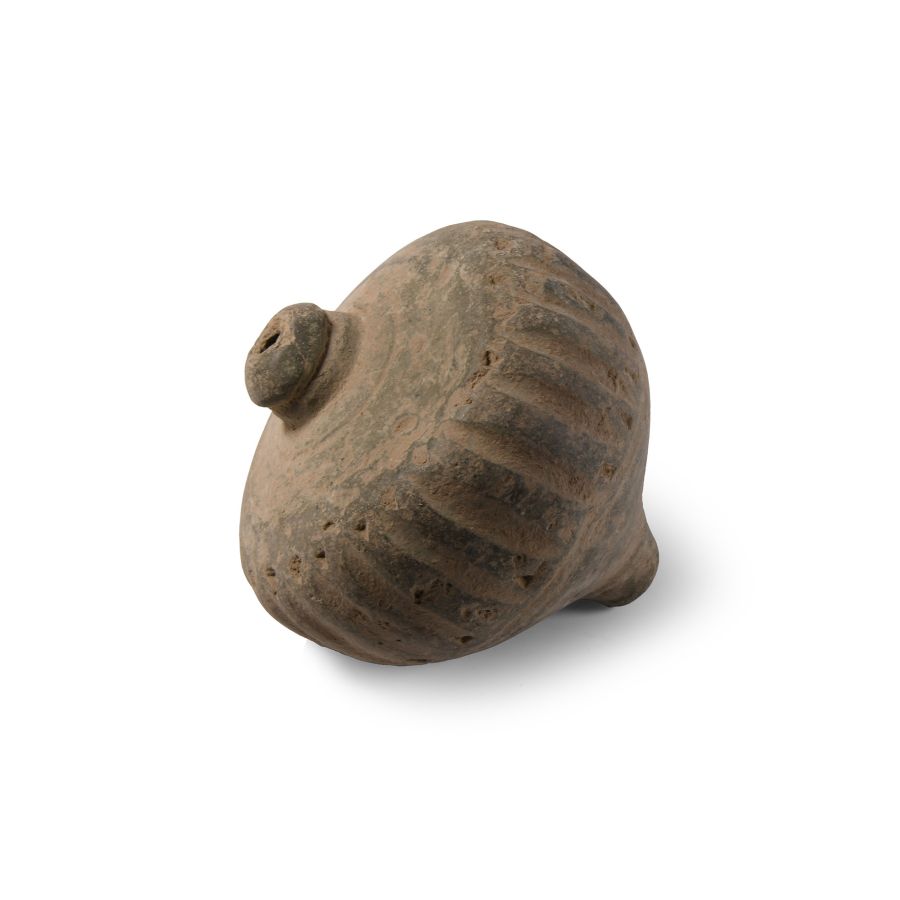
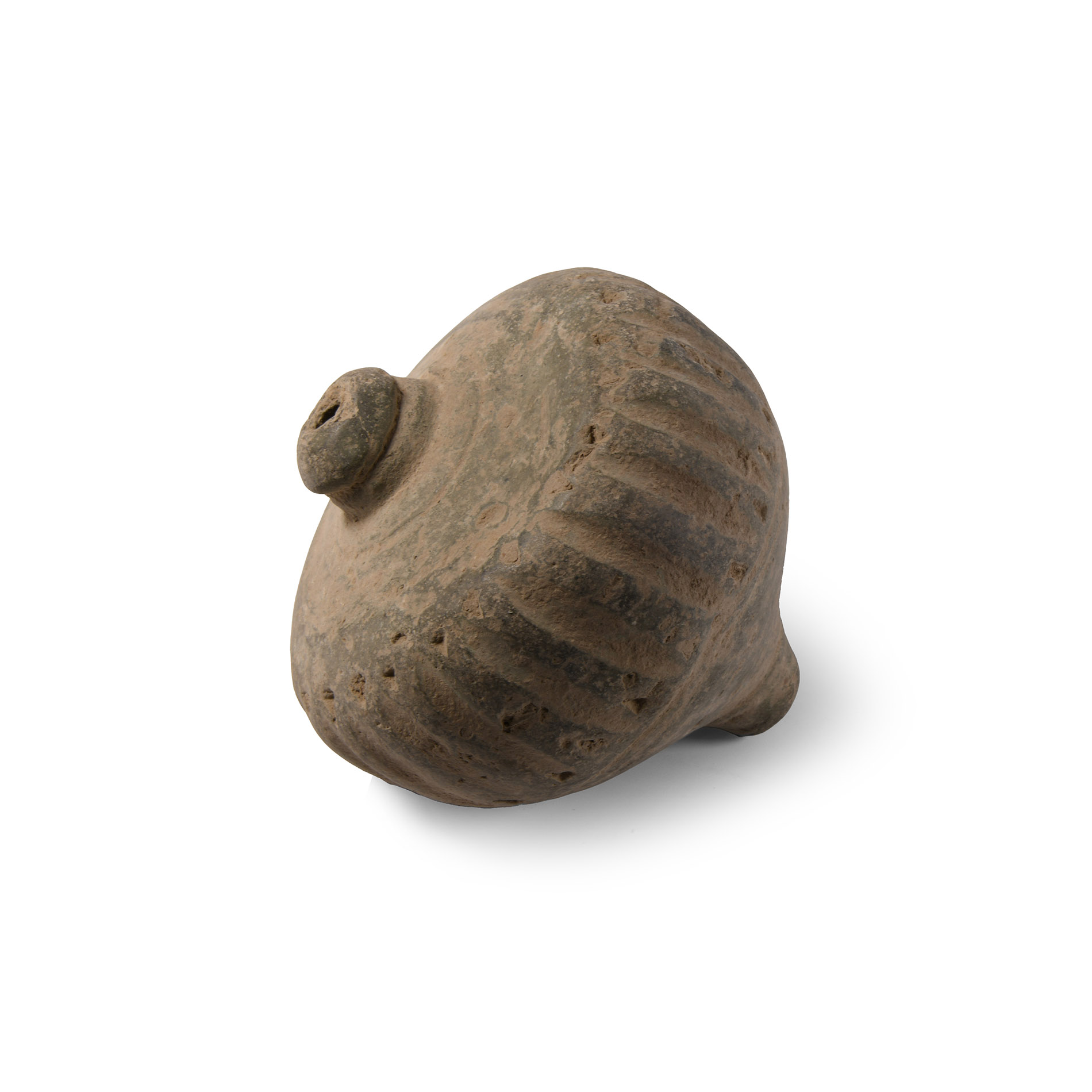
Byzantine 'Greek Fire' Fire Bomb or Hand Grenade
9TH-11TH CENTURY A.D.
4 1/8 in. (579 grams, 10.4 cm).
Of squat piriform shape with shallow vertical dashes decorating the upper body, stamped triangles above and below. [No Reserve]
ProvenanceFamily collection, acquired 1980-2015.
Ex property of a North London gentleman.
Accompanied by an academic paper by military specialist Dr Raffaele D'Amato, dated 15 July 2019 and titled 'Eastern Roman Empire - Greek Fire Bomb or Hand Grenade (μεσαίον kακάβιον) 9th-11th century AD'.
Cf. Arendt, W. I., Granaten des 13-14. Jahrhunderts, die an der Wolga gefunden sind, Zeitschrift fur Historische Waffen-und Kostumkunde, 11 (1926-8), p.42; cf. Arendt, W., Die Spharisch-konischen Gefasse aus Gebranntem Ton, ibid; cf. Ayalon, D., Gunpowder and Firearms in the Mamluk Kingdom, London, 1956, p.16.
FootnotesApart from the use of siphons or manual flame-throwers called cheirosiphona, special corps of Roman soldiers employed terracotta grenades, in the form of small jars, abundantly evidenced in archaeological excavations. Such were the γανωτα, vessels (sometimes also of bronze) used for Greek fire. They were called μεσαία kακαβιά or κυτροκακάβια where the former had a bulbous shape and the latter a more cylindrical form.
CONDITIONTimeLine Auctions follows a vetting process to ensure the authenticity and legality of all items, reinforcing our commitment to integrity and responsible trading. Each antiquity, antique, and coin lot undergoes thorough examination by a vetting committee of at least ten external specialists, professional trade association members, scientists, and archaeologists: Our Vetting Process
AUCTIONS:
TimeLine is a leading auction house specialising in antiquities, ancient art, collectables, natural history, coins, medals, and books. Our auctions offer museums, collectors, historians, and enthusiasts the opportunity to acquire unique and historically significant pieces.
-
.jpg)
Smith and Wesson Old Model No 2 Revolver
1861-1874 A.D.Sold for (Inc. bp): £780
Also known as 'Model No 2 Army' with hinged frame, six shot .32 calibre rimfire cylinder with 'PATENTED APRIL 3 1855 JULY 5 1859 & DEC 18 1860' and 15cm (6") octagonal barrel marked 'SMITH & WESSON SPRINGFIELD MASS' to top with fixed extractor pin and spur trigger; serial number 47946 to butt strap with plain wood grip scales; action working. 690 grams, 27 cm
Acquired from Bolk Antique Arms, Netherlands, 2016. The Kusmirek Collection, UK. Accompanied by an original Bolk invoice.
Sold as an exempt item under Section 58 (2) of the Firearms Act, 1968, to be held as a curiosity or ornament. No license required but buyer must be over 18 years of age. Overseas bidders should note that, due to UK regulations governing export of all firearms, overseas buyers will need to make arrangements for shipping this lot out of the UK directly, by air freight, with a specialist company or agent. -
.jpg)
Belgian Simonis 12 Shot Pinfire Revolver
1877-1890 A.D.Estimate: £1,000 - 1,400 (+bp*)
Opening Bid: £472
Single and double action twelve shot 9mm calibre revolver with 13cm (5¼") round barrel with extractor rod mounted at right and hinged loading gate with Liege proof marks and marked 'CAL 9mm' to right frame with serial number 2676; fitted with plain wood scale grips and lanyard ring (usually fitted to revolvers intended for military use); action working well. 975 grams, 25 cm
Acquired from Bolk Antique Arms, Netherlands, 2016. The Kusmirek Collection, UK. Accompanied by Bolk invoice and details.
Sold as an exempt item under Section 58 (2) of the Firearms Act, 1968, to be held as a curiosity or ornament. No license required but buyer must be over 18 years of age. Overseas bidders should note that, due to UK regulations governing export of all firearms, overseas buyers will need to make arrangements for shipping this lot out of the UK directly, by air freight, with a specialist company or agent. -
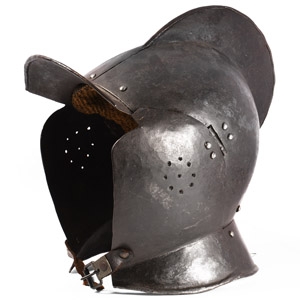
South German Burgonet Helm
Circa 1580-1610 A.D.Sold for (Inc. bp): £2,340
The rounded two-piece skull joined along the crest with a high medial comb, internally fitted with a quilted canvas lining sewn to a leather lining-band, the brow with a fixed rounded peak, outward-flanged rear edge with a matching one-piece neck guard, hinged cheek-pieces flanged outwards at the lower edge to serve as a continuation of the neck-guard. 1.7 kg, 29 cm
with Thomas Del Mar Ltd, 7th December 2017, lot 542. The Kusmirek Collection, UK. Accompanied by a copy of the Thomas Del Mar invoice. Accompanied by an academic report by Dr Raffaele D'Amato. This lot has been checked against the Interpol Database of stolen works of art and is accompanied by search certificate number no.11762-203983.
The burgonet (Italian borgognotta) had developed at the beginning of the 16th century from the sallet and soon became a very popular helmet worn in many parts of Europe (especially in Germany and Northern Italy) by infantry and later cavalry units. A clear advantage of this helmet was the unifying a good protective function against cut and thrust weapons with a unhindered field of sight, good ventilation and user comfort due to the small weight and the fact it could be worn independently without an armour.
