
Loading, please wait...
LOT 1408
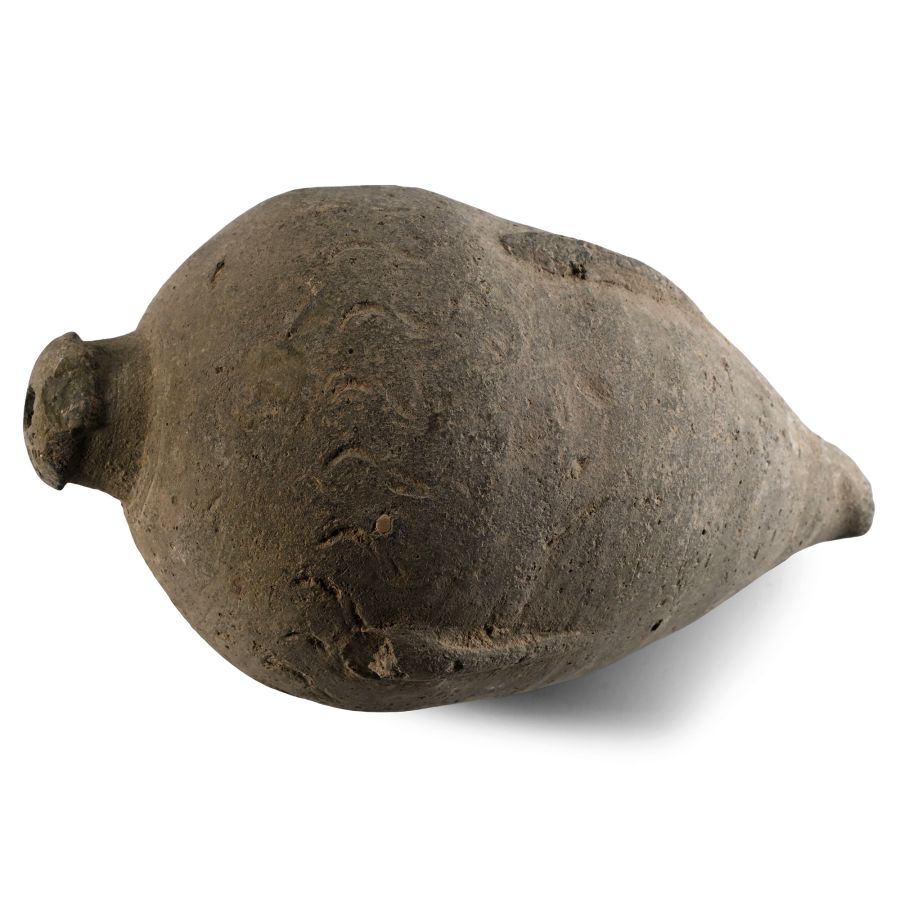
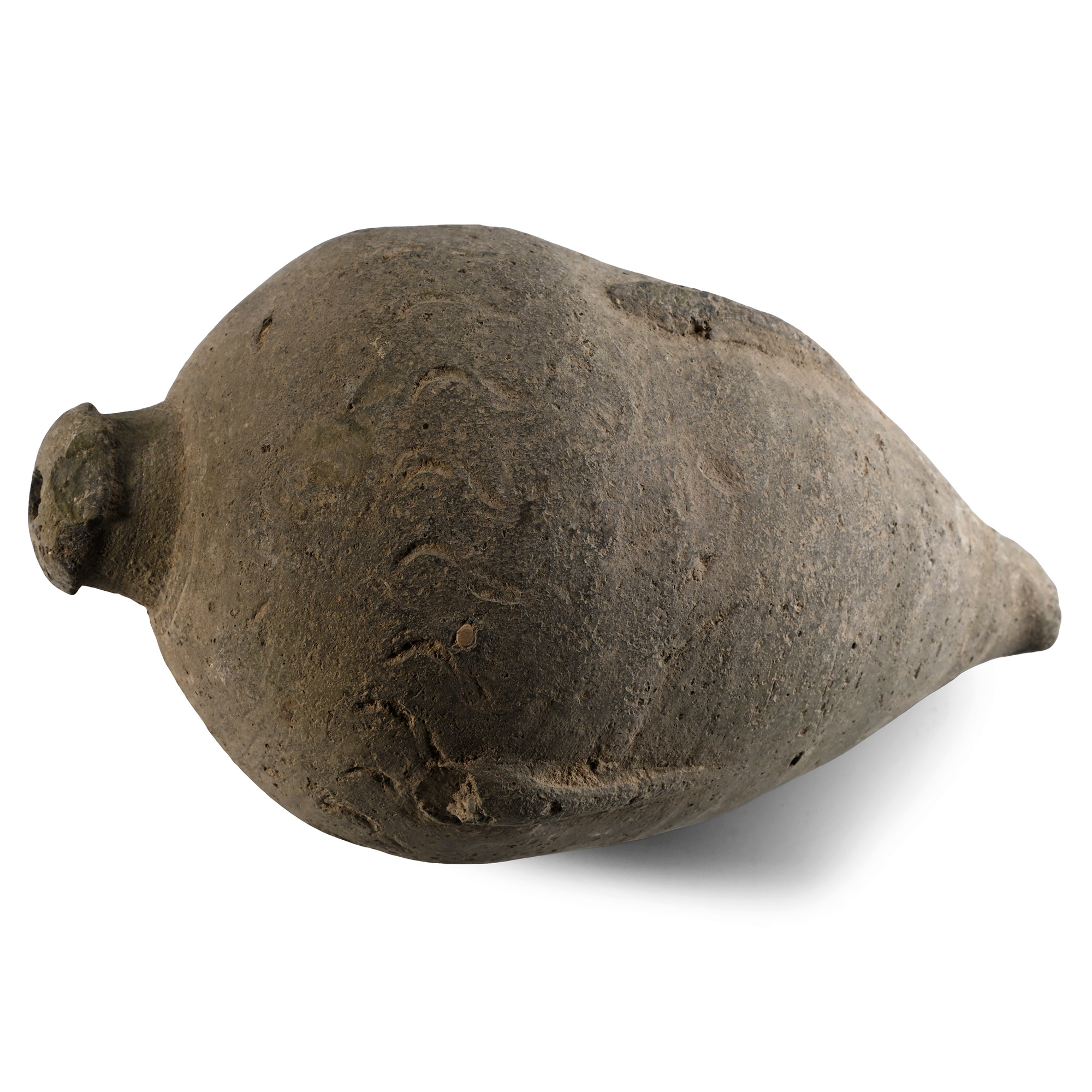
Byzantine 'Greek Fire' Ceramic Fire Bomb or Hand Grenade
9TH-11TH CENTURY A.D.
5 1/4 in. (513 grams, 14.5 cm).
Cylindrical body with pointed tip, two vertical lugs on the upper body; intended to be filled with explosive liquid and a wick, and used as a hand grenade.
ProvenanceFrom an important specialist collection, London, UK, 1990s onwards.
Accompanied by an academic paper by military specialist Dr Raffaele D'Amato, dated 15 July 2019 and titled 'Eastern Roman Empire - Greek Fire Bomb or Hand Grenade (μεσαίον kακάβιον) 9th-11th century AD'.
Cf. Arendt, W. I., Granaten des 13-14. Jahrhunderts, die an der Wolga gefunden sind, Zeitschrift fur Historische Waffen-und Kostumkunde, 11 (1926-8), p.42; cf. Arendt, W., Die Spharisch-konischen Gefäße aus Gebranntem Ton, ibid; cf. Ayalon, D., Gunpowder and Firearms in the Mamluk Kingdom, London, 1956, p.16.
FootnotesApart from the use of siphons or manual flame-throwers called cheirosiphona, special corps of Roman soldiers employed terracotta grenades, in the form of small jars, abundantly evidenced in archaeological excavations. They were called μεσαία kακαβιά or κυτροκακάβια where the former had a bulbous shape and the latter a more cylindrical form.
CONDITIONTimeLine Auctions follows a vetting process to ensure the authenticity and legality of all items, reinforcing our commitment to integrity and responsible trading. Each antiquity, antique, and coin lot undergoes thorough examination by a vetting committee of at least ten external specialists, professional trade association members, scientists, and archaeologists: Our Vetting Process
AUCTIONS:
TimeLine is a leading auction house specialising in antiquities, ancient art, collectables, natural history, coins, medals, and books. Our auctions offer museums, collectors, historians, and enthusiasts the opportunity to acquire unique and historically significant pieces.
LOT 1408
Byzantine 'Greek Fire' Ceramic Fire Bomb or Hand Grenade
Sold for (Inc. bp): £117
-
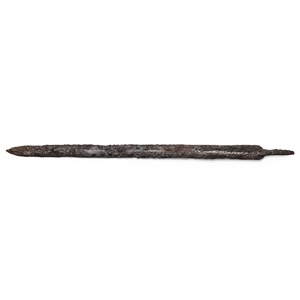
Merovingian Iron Pattern-Welded Sword
Circa 6th century A.D.Estimate: £2,000 - 3,000 (+bp*)
Opening Bid: £400
A double-edged spatha with a lentoid parallel-sided blade and pointed tip; evidence of battle nicks on both cutting edges; long tang and traces of wooden scabbard on the blade; signs of damask pattern running along the length of the blade, especially on the upper part; cleaned and conserved. 694 grams, 86.5 cm
From the private collection of a London gentleman, from his grandfather's collection formed before the early 1970s. Accompanied by an academic report by Dr Raffaele D’Amato. This lot has been checked against the Interpol Database of stolen works of art and is accompanied by search certificate number no.12919-245174.
Usually the term ‘damascened’ is only used for blades, describing the way in which their individual rods are forged to create a desired pattern effect that remained visible on the surfaces of the finished product (technique B.II.1.2.). The shape and regularity of the pattern was essentially dependent on the number and nature of the individual rods and on the skills of the blacksmith. The scholars differentiate on this basis more or less careful and complicated variants (e.g. striped, diamond, herringbone, angular, rosette, mosaic, etc.), in which the individual rods from different iron lamellae, which are parallel or twisted (torsion pattern-welding), were built up often in connection with each other (technique B.II.1.2.1-2). Combining striped rods that were partially straight and partially twisted - clockwise or counter-clockwise - allowed the formation of a very decorative blade. -
.jpg)
Elamite Decorated Bronze Axehead
2nd-1st millennium B.C.Sold for (Inc. bp): £572
With a crescentic blade, ornamental curved edging to the upper shaft hole, a collar to the lower shaft hole, raised band around the edge of the blade. 330 grams, 11.6 cm
French collection, 1980s. Acquired on the London art market. Private collection, London, UK. -
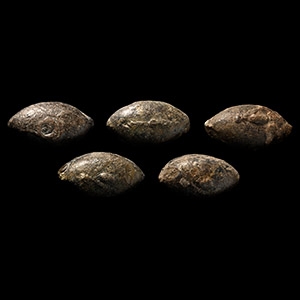
Roman Lead Slingshot Group
1st century B.C.Sold for (Inc. bp): £247
A mixed group of four lentoid-section biconical lead slingshot, three fitted with iconic winged thunderbolts on one side, and one with the Tanit goddess symbol, possibly alluding to a Balearic-Punic origin. 155 grams total, 28-30 mm
From the collection of a Surrey, UK, gentleman; acquired in the 1990s.
The slingshots are belonging to the type IIb of the Völling classification. The practice of inscribing slingshots developed early, in 4th century BC Greece. Most inscriptions are names (in full or abbreviated) of generals or commanders of units of slingers. Some are slogans of the contesting sides. Individual letters occasionally appear, sometimes in conjunction with a name or motif or numbers.
