
Loading, please wait...
LOT 1465
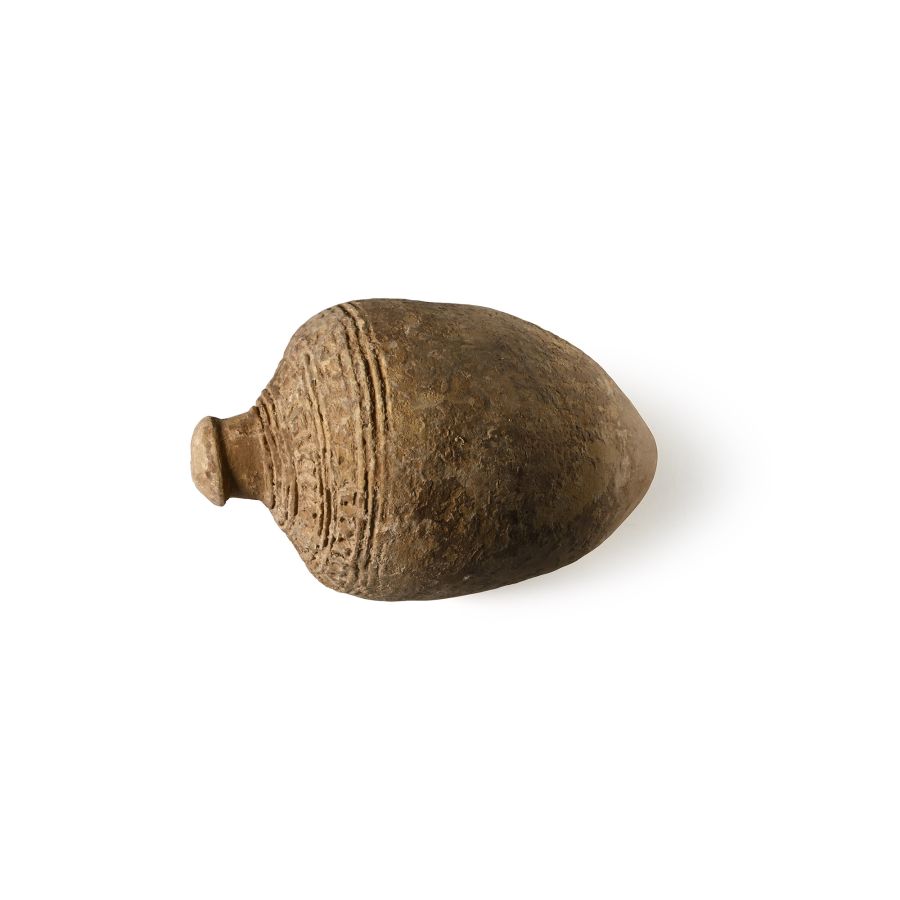
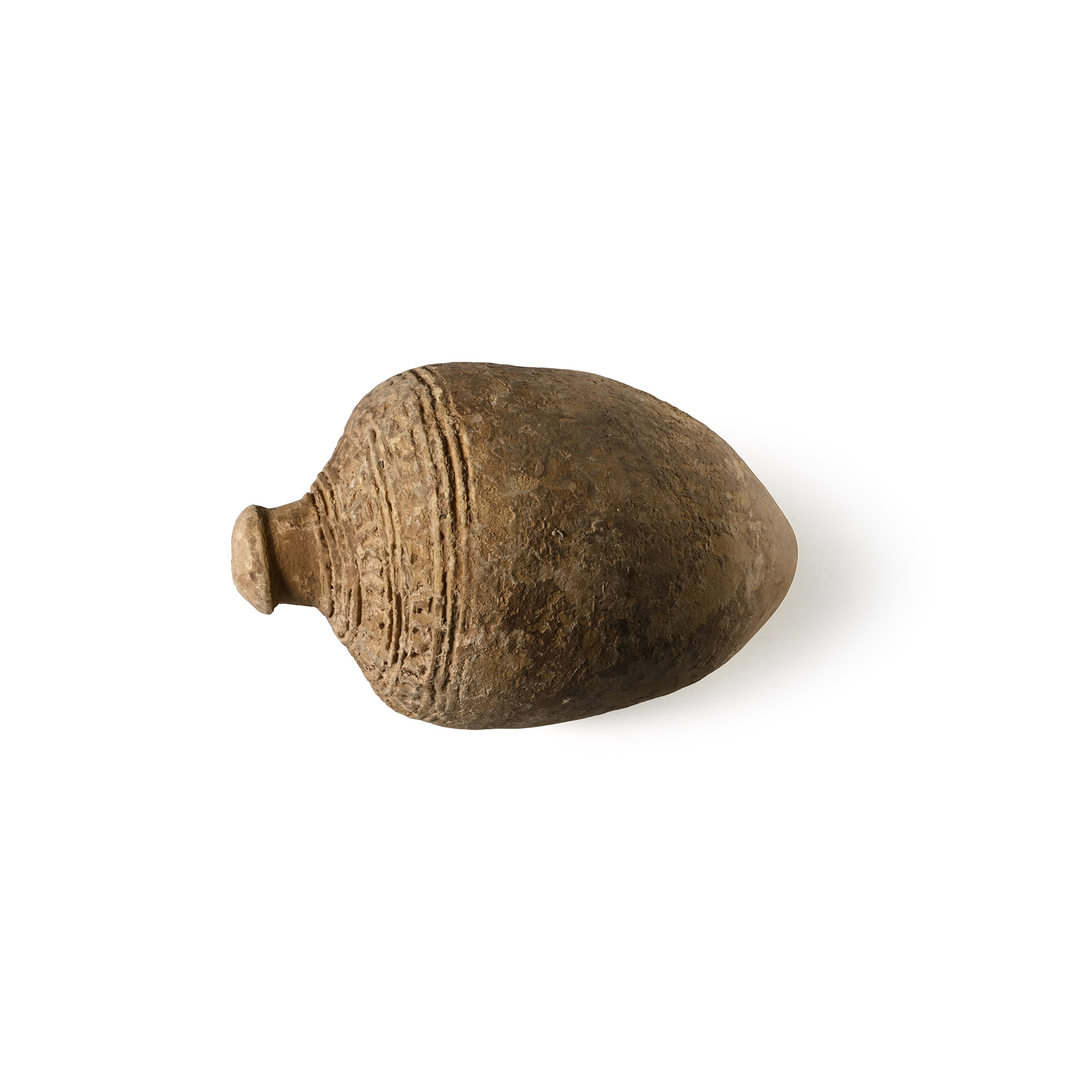
Byzantine 'Greek Fire' Ceramic Fire Bomb or Hand Grenade
9TH-11TH CENTURY A.D.
5 5/8 in. (612 grams, 14.3 cm).
Piriform in profile with narrow point and domed mouth; bands of concentric circles to the upper body; intended to be filled with explosive liquid and a wick, and used as a hand grenade. [No Reserve]
ProvenanceFrom an important specialist collection, London, UK, 1990s onwards.
Accompanied by an academic paper by military specialist Dr Raffaele D'Amato, dated 15 July 2019 and titled 'Eastern Roman Empire - Greek Fire Bomb or Hand Grenade (μεσαίον kακάβιον) 9th-11th century AD'.
This lot is accompanied by an illustrated lot declaration signed by the Head of the Antiquities Department, Dr Raffaele D'Amato.
Cf. Arendt, W. I., Granaten des 13-14. Jahrhunderts, die an der Wolga gefunden sind, Zeitschrift fur Historische Waffen-und Kostumkunde, 11 (1926-8), p.42; cf. Arendt, W., Die Spharisch-konischen Gefäße aus Gebranntem Ton, ibid; cf. Ayalon, D., Gunpowder and Firearms in the Mamluk Kingdom, London, 1956, p.16.
FootnotesApart from the use of siphons or manual flame-throwers called cheirosiphona, special corps of Roman soldiers employed terracotta grenades, in the form of small jars, abundantly evidenced in archaeological excavations. They were called μεσαία kακαβιά or κυτροκακάβια where the former had a bulbous shape and the latter a more cylindrical form.
CONDITIONTimeLine Auctions follows a vetting process to ensure the authenticity and legality of all items, reinforcing our commitment to integrity and responsible trading. Each antiquity, antique, and coin lot undergoes thorough examination by a vetting committee of at least ten external specialists, professional trade association members, scientists, and archaeologists: Our Vetting Process
AUCTIONS:
TimeLine is a leading auction house specialising in antiquities, ancient art, collectables, natural history, coins, medals, and books. Our auctions offer museums, collectors, historians, and enthusiasts the opportunity to acquire unique and historically significant pieces.
LOT 1465
Byzantine 'Greek Fire' Ceramic Fire Bomb or Hand Grenade
Sold for (Inc. bp): £124
-
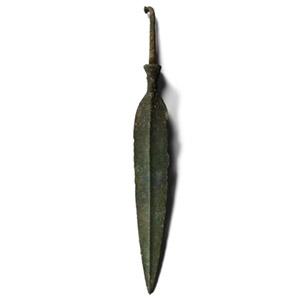
Large Luristan Bronze Spearhead
Late 3rd millennium B.C.Sold for (Inc. bp): £117
Leaf-shaped blade with pronounced midrib and thick neck, flared base, square-section tang with stud. 504 grams, 41cm
Ex London art market, 1980-1990s. This lot is accompanied by an illustrated lot declaration signed by the Head of the Antiquities Department, Dr Raffaele D'Amato.
The type belongs to the category of tripartite lances with long pointed biconvex blade and single bevelled tang. In this typology the blade, of rhomboidal section, is usually well balanced. The stem, medium or short, is widened at its base and forms a fairly clean stop. Elements of shaft of a similar spear found at Tepe Hissar has allowed to reconstruct the length of the spear reaching up to 1.40 m. -
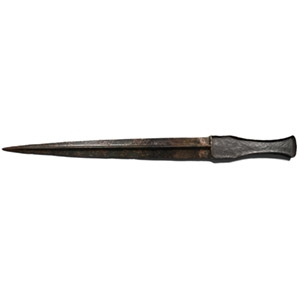
Large Luristan Bronze Dirk
12th century B.C.Sold for (Inc. bp): £294
With raised flanges to the grip, possibly to accept organic inserts, tapering triangular blade with a strong mid-rib. 216 grams, 39.5 cm
Acquired in the 1990s. Ex Abelita family collection. This lot is accompanied by an illustrated lot declaration signed by the Head of the Antiquities Department, Dr Raffaele D'Amato.
The dirk belongs to Type IIIa bronze dirks of the Medveskaya classification. It was cast in one piece (hilt and blade). The presence of the mid-rib however represents an exception to the general typology. -
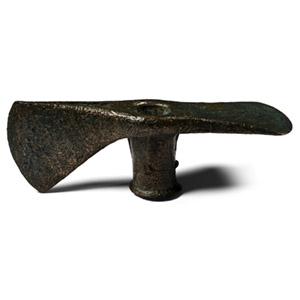
Large Luristan Socketted Bronze Adze
2nd-early 1st millennium B.C.Sold for (Inc. bp): £468
An adze-axe head with central shaft hole and curved blades, flange to socket. 570 grams, 16.5 cm
Acquired in the 1990s. Ex Abelita family collection. This lot is accompanied by an illustrated lot declaration signed by the Head of the Antiquities Department, Dr Raffaele D'Amato.
The adze-axe was a fundamental weapon of many Bronze Age cultures around the world. The form lends itself to dual purposes - for war and peace. As a tool, it functions in fabricating wood and as a weapon, its heavy mass and compact form make it a deadly striking and chopping weapon, even able to defeat light armour.
