
Loading, please wait...

LOT 1000
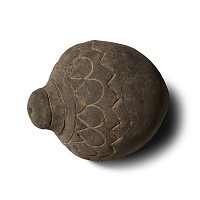
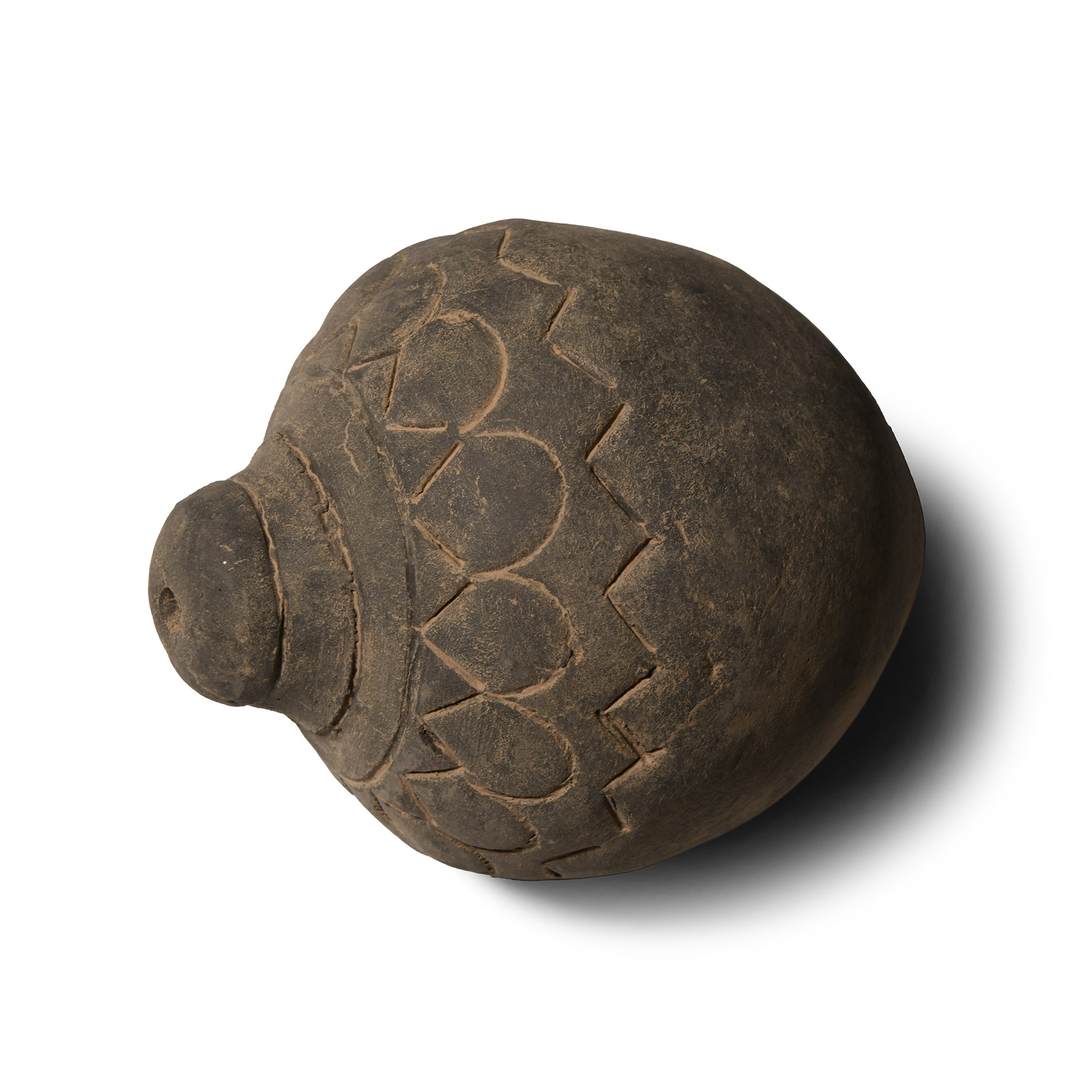
Byzantine 'Greek Fire' Ceramic Fire Bomb or Hand Grenade
9TH-11TH CENTURY A.D.
4 1/4 in. (432 grams, 10.8 cm).
Piriform body with domed filler-hole, band of tightly arranged teardrop motifs above a zig-zag line to the shoulder; intended to be filled with explosive liquid and wick, used as a hand grenade. [No Reserve]
ProvenanceFrom a specialist collection of militaria, London, UK, collected 1990s onwards.
Accompanied by an academic paper by military specialist Dr Raffaele D'Amato, dated 15 July 2019 and titled 'Eastern Roman Empire - Greek Fire Bomb or Hand Grenade (μεσαίον kακάβιον) 9th-11th century AD'.
Cf. Arendt, W. I., Granaten des 13-14. Jahrhunderts, die an der Wolga gefunden sind, Zeitschrift fur Historische Waffen-und Kostumkunde, 11 (1926-8), p.42; cf. Arendt, W., Die Spharisch-konischen Gefäße aus Gebranntem Ton, ibid; cf. Ayalon, D., Gunpowder and Firearms in the Mamluk Kingdom, London, 1956, p.16.
FootnotesApart from the use of siphons or manual flame-throwers called cheirosiphona, special corps of Roman soldiers employed terracotta grenades, in the form of small jars, abundantly evidenced in archaeological excavations. They were called μεσαία kακαβιά or κυτροκακάβια where the former had a bulbous shape and the latter a more cylindrical form.
CONDITIONTimeLine Auctions follows a vetting process to ensure the authenticity and legality of all items, reinforcing our commitment to integrity and responsible trading. Each antiquity, antique, and coin lot undergoes thorough examination by a vetting committee of at least ten external specialists, professional trade association members, scientists, and archaeologists: Our Vetting Process
AUCTIONS:
TimeLine is a leading auction house specialising in antiquities, ancient art, collectables, natural history, coins, medals, and books. Our auctions offer museums, collectors, historians, and enthusiasts the opportunity to acquire unique and historically significant pieces.
LOT 1000
Byzantine 'Greek Fire' Ceramic Fire Bomb or Hand Grenade
Sold for (Inc. bp): £195
-
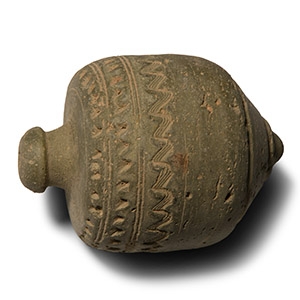
Byzantine 'Greek Fire' Ceramic Fire Bomb or Hand Grenade
9th-11th century A.D.Sold for (Inc. bp): £182
Piriform body with domed filler-hole, the body with wavy lines; intended to be filled with explosive liquid and wick, used as a hand grenade. 441 grams, 11.5 cm
From a specialist collection of militaria, London, UK, collected 1990s onwards. Accompanied by an academic paper by military specialist Dr Raffaele D'Amato, dated 15 July 2019 and titled 'Eastern Roman Empire - Greek Fire Bomb or Hand Grenade (μεσαίον kακάβιον) 9th-11th century AD'.
Apart from the use of siphons or manual flame-throwers called cheirosiphona, special corps of Roman soldiers employed terracotta grenades, in the form of small jars, abundantly evidenced in archaeological excavations. They were called μεσαία kακαβιά or κυτροκακάβια where the former had a bulbous shape and the latter a more cylindrical form. -
.jpg)
Byzantine Silver-Gilt Priest's Altar Group
6th-7th century ADSold for (Inc. bp): £30,000
A mixed group of silver-gilt liturgical items comprising: a hanging lamp with flared foot, carinated segmented body, flared neck with band of repoussé quatrefoils and florets, rolled rim, three suspension chains with loops and hook; a hollow piriform finial, possibly from a throne or a standard finial, with ropework collar and vertical tendril bands with pellets alternating with plain segments; a two-part vestment clasp set, each half formed as a parcel-gilt scallop shell with flared rim and pierced trapezoidal plaque, hook-and-eye hinge. 201 grams total, 90-110mm
Very fine condition.
Property of a Surrey gentleman; formerly from the private collection of a Canadian gentleman; from his father's collection formed 1965-1990; accompanied by an archaeological report by Dr. Raffaele D’Amato, Art Loss Register certificate numbers S001261511, S001261512 & S001261513, dated 5 September 2017 and a copy of a photograph taken prior to professional cleaning; this lot has been checked against the Interpol Database of stolen works of art and is accompanied by AIAD certificate number no. 10373-167792.
Hanging lamps, of different dimensions, were used to create the spiritual atmosphere surrounding the Divine Liturgy. Light was important not only from a practical point of view but also symbolically. The parcel gilt flask, if not the finial of a throne, episcopal chair or church labarum (standard), could be a miniature version of a large ceramic oil or wine container with a pointed base for setting them in sand at the cargo hold of a ship, and was probably used as a small flask for myrrh, the liturgical oil. The ornamented wreath border between shoulder and neck of the finial is a typical Byzantine decoration in the workshops active in the Imperial capital of Constantinople, as attested on a vase in the same ornament and style preserved in the Louvre collections (RGZM, 2010, p.173). -
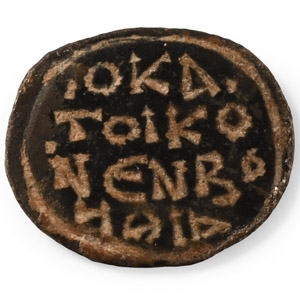
Byzantine Intaglio Gemstone
Circa 6th-12th century A.D.Sold for (Inc. bp): £117
With incised legend '+OKA / TOIKO / NENBO / HΘIA' (for 'O KATOIKΩN EN BOHΩEIA' "Whoever dwells in the shelter (of the most high)' from Psalm 90. 1.3 grams, 17 mm
From an important collection formed before 1988, London and Geneva.
