
Loading, please wait...

LOT 1003
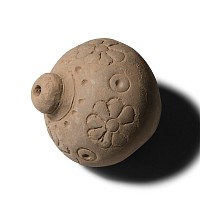
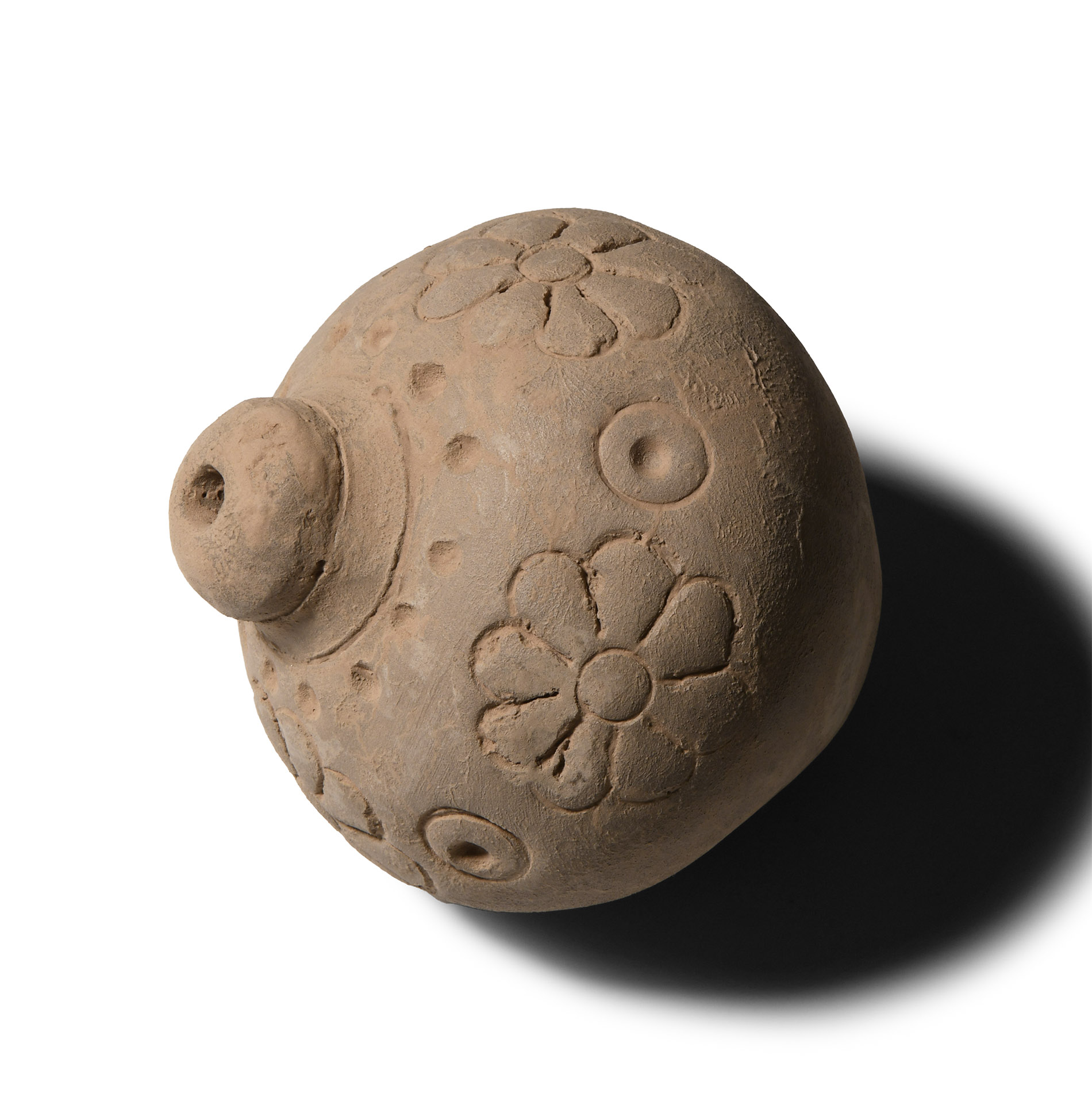
Byzantine 'Greek Fire' Ceramic Fire Bomb or Hand Grenade
9TH-11TH CENTURY A.D.
4 1/8 in. (426 grams, 10.5 cm).
Piriform body with domed filler-hole, stamped flowers and ring-and-dot motifs to the shoulder; intended to be filled with explosive liquid and wick, used as a hand grenade. [No Reserve]
ProvenanceFrom a specialist collection of militaria, London, UK, collected 1990s onwards.
Accompanied by an academic paper by military specialist Dr Raffaele D'Amato, dated 15 July 2019 and titled 'Eastern Roman Empire - Greek Fire Bomb or Hand Grenade (μεσαίον kακάβιον) 9th-11th century AD'.
Cf. Arendt, W. I., Granaten des 13-14. Jahrhunderts, die an der Wolga gefunden sind, Zeitschrift fur Historische Waffen-und Kostumkunde, 11 (1926-8), p.42; cf. Arendt, W., Die Spharisch-konischen Gefäße aus Gebranntem Ton, ibid; cf. Ayalon, D., Gunpowder and Firearms in the Mamluk Kingdom, London, 1956, p.16.
FootnotesApart from the use of siphons or manual flame-throwers called cheirosiphona, special corps of Roman soldiers employed terracotta grenades, in the form of small jars, abundantly evidenced in archaeological excavations. They were called μεσαία kακαβιά or κυτροκακάβια where the former had a bulbous shape and the latter a more cylindrical form.
CONDITIONTimeLine Auctions follows a vetting process to ensure the authenticity and legality of all items, reinforcing our commitment to integrity and responsible trading. Each antiquity, antique, and coin lot undergoes thorough examination by a vetting committee of at least ten external specialists, professional trade association members, scientists, and archaeologists: Our Vetting Process
AUCTIONS:
TimeLine is a leading auction house specialising in antiquities, ancient art, collectables, natural history, coins, medals, and books. Our auctions offer museums, collectors, historians, and enthusiasts the opportunity to acquire unique and historically significant pieces.
LOT 1003
Byzantine 'Greek Fire' Ceramic Fire Bomb or Hand Grenade
Sold for (Inc. bp): £208
-
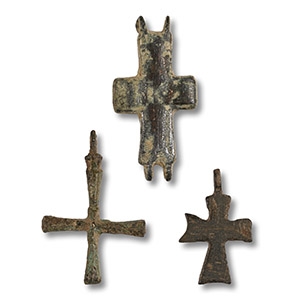
Byzantine Bronze Cross Group
10th-14th century A.D.Sold for (Inc. bp): £117
Comprising: a flat-section cross with annulets; an enkolpion plate; a cross with conical arms, raised cross to the centre. 12.1 grams total, 27-38 mm
Ex German art market, 2000s. Acquired from an EU collector living in London. From the collection of Surrey, UK, gentleman. -
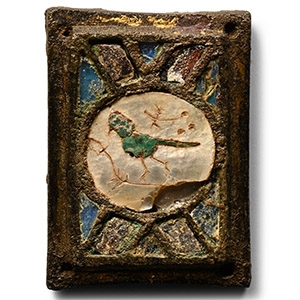
Byzantine Bronze Plaque with Bird Inlay
Circa 10th-11th century A.D.Estimate: £2,000 - 3,000 (‡+bp*)
Opening Bid: £1,000
Sub-rectangular in form with raised rectangular panel to centre, cells forming X-motif inlaid with red glass(?) against a blue field, central nacre(?) roundel engraved with a perched bird with polychrome enamelled detailing; trace remains of gilding to upper and side edges; piercing to each corner. 20.6 grams, 38 mm
Acquired in London, early 1980s. Purchased in Europe before 1992. Private collection, Europe. This lot has been checked against the Interpol Database of stolen works of art and is accompanied by search certificate number no.11811-206495.
The small square plaque was possibly part of the decoration of an Evangeliary, such as the enamels covering the binding of Henry II's Perikopenbuch, or the Siena Evangeliary (11th-13th century). Byzantium brought the enamel and cloisonné technique to its most perfect, refined and skilful expression. Between the 10th and 11th centuries it spreads its forms in the East and West and after some infiltration in the Romanesque-Lombard sphere, precious Eastern Roman cloisonnes were found in Russian art, reaching their apex in the Roman Empire during the 10th-12th centuries, in the decoration of icons and other artworks. -
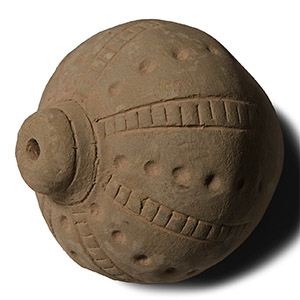
Byzantine 'Greek Fire' Ceramic Fire Bomb or Hand Grenade
9th-11th century A.D.Sold for (Inc. bp): £182
Piriform body with domed filler-hole, segmented bands radiating from the filler hole interspersed with bands of impressed pellets; intended to be filled with explosive liquid and wick, used as a hand grenade. 414 grams, 10.4 cm
From a specialist collection of militaria, London, UK, collected 1990s onwards. Accompanied by an academic paper by military specialist Dr Raffaele D'Amato, dated 15 July 2019 and titled 'Eastern Roman Empire - Greek Fire Bomb or Hand Grenade (μεσαίον kακάβιον) 9th-11th century AD'.
Apart from the use of siphons or manual flame-throwers called cheirosiphona, special corps of Roman soldiers employed terracotta grenades, in the form of small jars, abundantly evidenced in archaeological excavations. They were called μεσαία kακαβιά or κυτροκακάβια where the former had a bulbous shape and the latter a more cylindrical form.
