
Loading, please wait...
LOT 1396
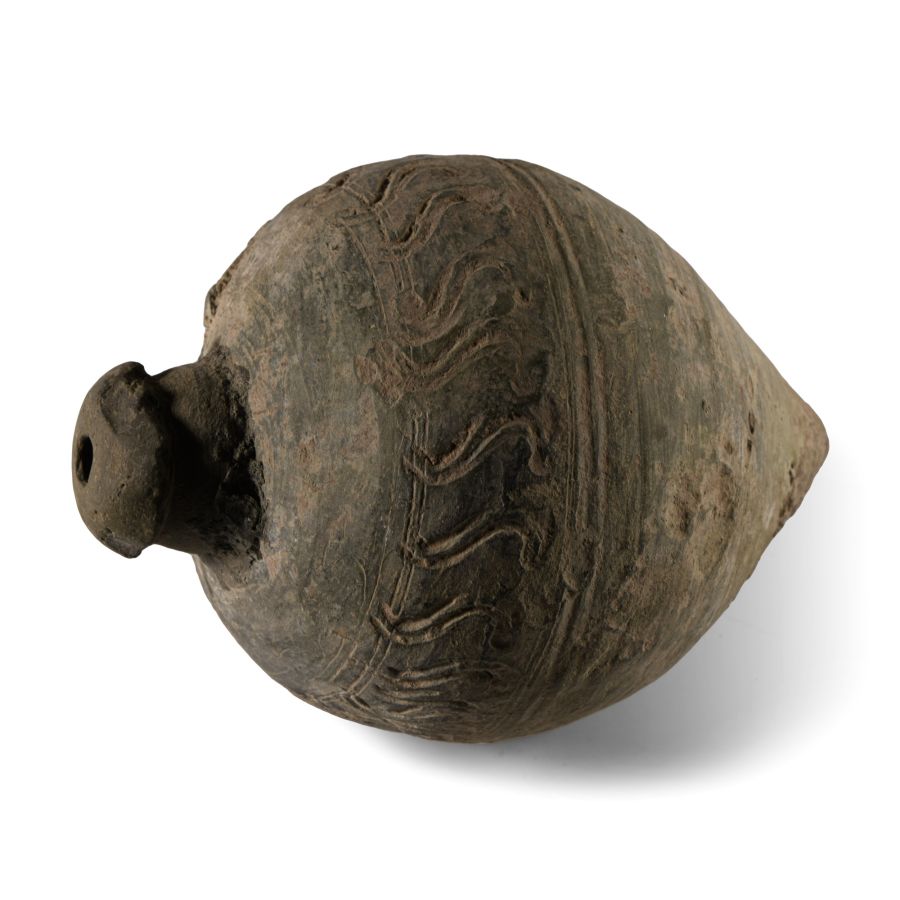
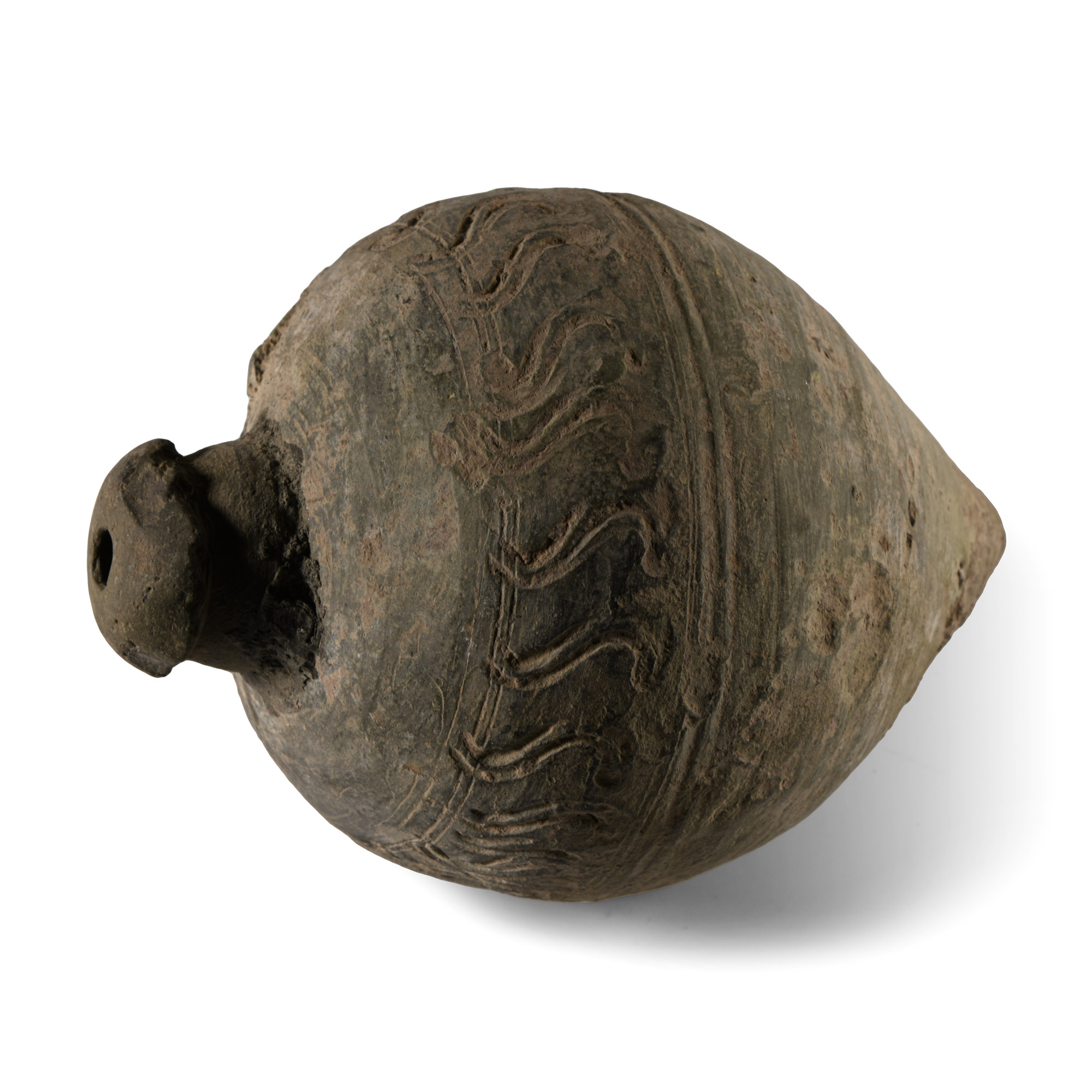
Byzantine 'Greek Fire' Ceramic Fire Bomb or Hand Grenade
9TH-11TH CENTURY A.D.
4 3/4 in. (533 grams, 12 cm).
A piriform ceramic missile with band of S-scrolls to the shoulder, domed filler-hole, intended to be filled with explosive liquid and wick, used as a hand grenade. [No Reserve]
ProvenanceFrom a military inspired collection formed from the 1990s.
Accompanied by an academic paper by military specialist Dr Raffaele D'Amato, dated 15 July 2019 and titled 'Eastern Roman Empire - Greek Fire Bomb or Hand Grenade (μεσαίον kακάβιον) 9th-11th century AD'.
Cf. Arendt, W. I., Granaten des 13-14. Jahrhunderts, die an der Wolga gefunden sind, Zeitschrift fur Historische Waffen-und Kostumkunde, 11 (1926-8), p.42; cf. Arendt, W., Die Spharisch-konischen Gefäße aus Gebranntem Ton, ibid; cf. Ayalon, D., Gunpowder and Firearms in the Mamluk Kingdom, London, 1956, p.16.
FootnotesApart from the use of siphons or manual flame-throwers called cheirosiphona, special corps of Roman soldiers employed terracotta grenades, in the form of small jars, abundantly evidenced in archaeological excavations. They were called μεσαία kακαβιά or κυτροκακάβια where the former had a bulbous shape and the latter a more cylindrical form.
CONDITIONTimeLine Auctions follows a vetting process to ensure the authenticity and legality of all items, reinforcing our commitment to integrity and responsible trading. Each antiquity, antique, and coin lot undergoes thorough examination by a vetting committee of at least ten external specialists, professional trade association members, scientists, and archaeologists: Our Vetting Process
AUCTIONS:
TimeLine is a leading auction house specialising in antiquities, ancient art, collectables, natural history, coins, medals, and books. Our auctions offer museums, collectors, historians, and enthusiasts the opportunity to acquire unique and historically significant pieces.
LOT 1396
Byzantine 'Greek Fire' Ceramic Fire Bomb or Hand Grenade
Sold for (Inc. bp): £91
-
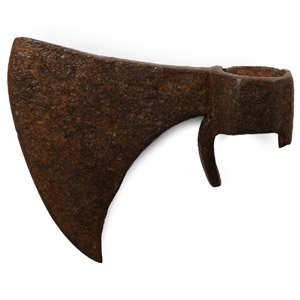
Tudor Period Iron Axehead with Octagonal Socket
16th-17th century A.D.Sold for (Inc. bp): £91
With curved triangular blade, octagonal socket with languets. 246 grams, 11.9 cm
Private collection, UK, formed 1980s-1990s. -
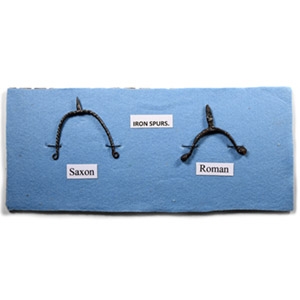
Saxon and Roman Iron Military Spur Display
Circa 2nd-10th century A.D.Sold for (Inc. bp): £286
Comprising a Roman U-shaped spur with lateral lugs and prick spur; an Anglo-Saxon iron spur with barley twist body and small terminals. 254 grams total, 82-83 mm
From the collection of the famous author, writer and speaker, Gordon Bailey, Essex, UK; formed since 1968.
The Romans employed a light spur (calcar) made of bronze or iron, U-shaped and barely covering the heel. To the rear of the spur was a small point, and this form continued to be in use through the early Medieval period. The Saxon spurs were very similar to the Roman examples, although slightly larger and with a more spiked point. -
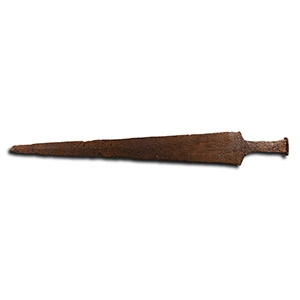
Scythian Iron Akinakes Sword with Decorations
4th century B.C.Estimate: £1,500 - 2,000 (+bp*)
Opening Bid: £750
Of Central Asian typology, strong hilt and narrow ogival guard with Steppe style ornamentation, tipped hilt, triangular tapering blade fitted with a central triangular blood channel with sixteen grooves. 481 grams, 58.5 cm
Ex private collection of Mr M.B., Mainz, Germany, since the 1980s. Acquired from the above, 2004. This lot has been checked against the Interpol Database of stolen works of art and is accompanied by a search certificate number no.12283-214520.
The akinakes was a characteristic Scythian type of weaponry, which was used throughout their history (7th-3rd centuries B.C.). With the departure of the Scythians from the steppe in the 3rd century B.C., and the appearance of the Sarmatian tribes in the Northern Black Sea region in the 2nd-1st centuries B.C., Sarmatian types of bladed weapons spread in the region. This particular shape of akinakes belongs to the nomadic cultures of Central Asia.
