
Loading, please wait...
LOT 1349
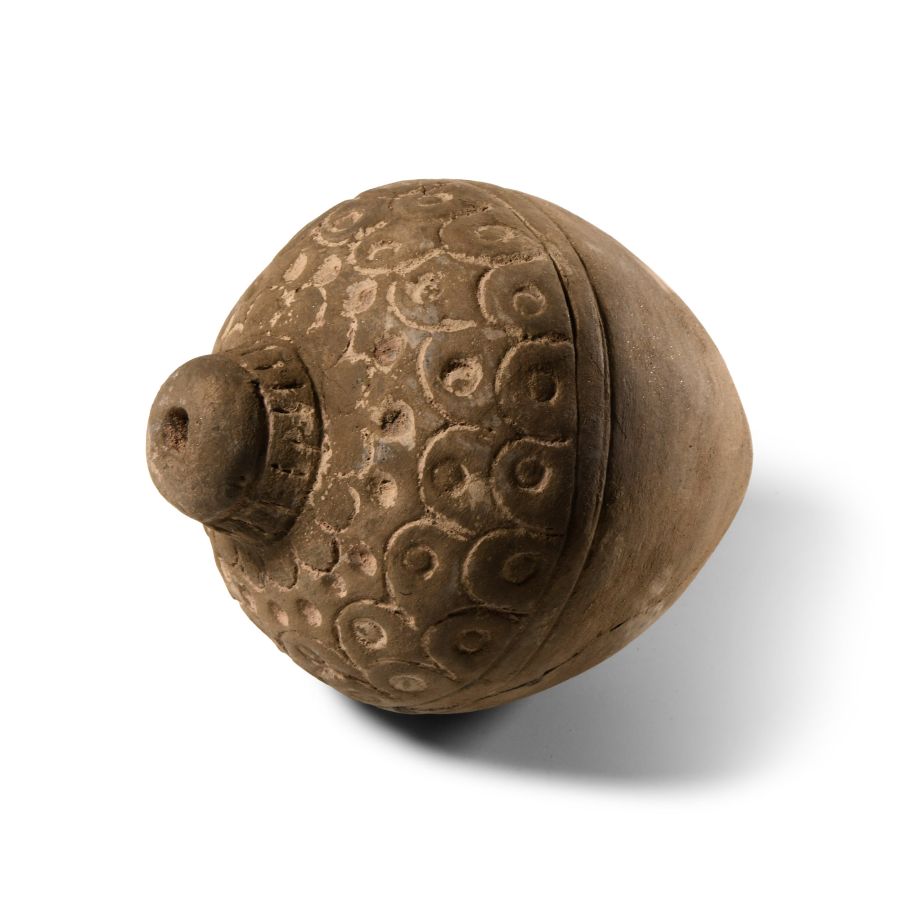
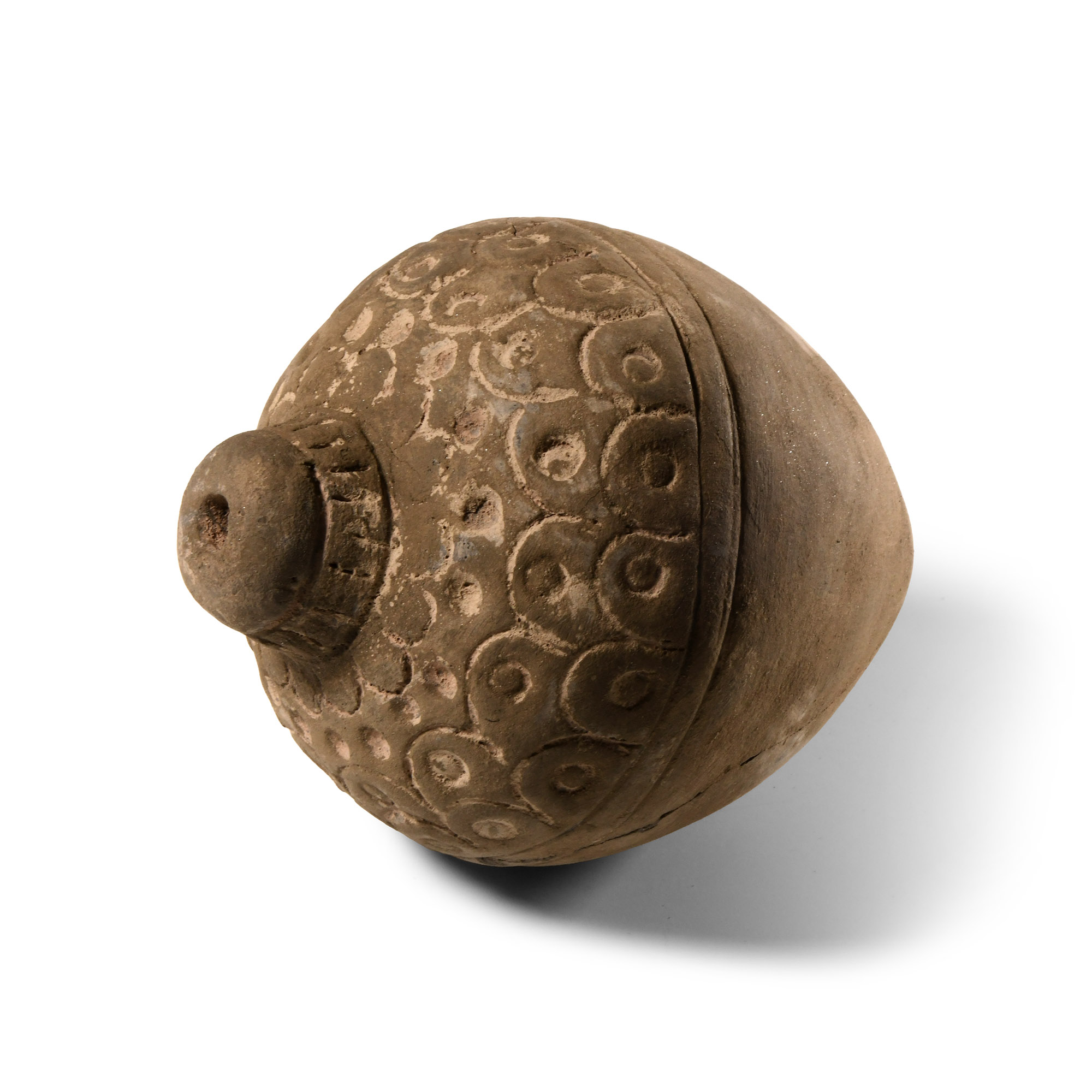
Byzantine 'Greek Fire' Ceramic Fire Bomb or Hand Grenade
9TH-11TH CENTURY A.D.
4 1/4 in. (337 grams, 10.8 cm).
Piriform body with overlapping impressed roundels to the shoulder replicating scale armour, domed filler-hole, intended to be filled with explosive liquid and wick, used as a hand grenade. [No Reserve]
ProvenanceFrom a specialist collection of militaria, London, UK, collected 1990s onwards.
Accompanied by an academic paper by military specialist Dr Raffaele D'Amato, dated 15 July 2019 and titled 'Eastern Roman Empire - Greek Fire Bomb or Hand Grenade (μεσαίον kακάβιον) 9th-11th century AD'.
Cf. Arendt, W. I., Granaten des 13-14. Jahrhunderts, die an der Wolga gefunden sind, Zeitschrift fur Historische Waffen-und Kostumkunde, 11 (1926-8), p.42; cf. Arendt, W., Die Spharisch-konischen Gefäße aus Gebranntem Ton, ibid; cf. Ayalon, D., Gunpowder and Firearms in the Mamluk Kingdom, London, 1956, p.16.
FootnotesApart from the use of siphons or manual flame-throwers called cheirosiphona, special corps of Roman soldiers employed terracotta grenades, in the form of small jars, abundantly evidenced in archaeological excavations. They were called μεσαία kακαβιά or κυτροκακάβια where the former had a bulbous shape and the latter a more cylindrical form.
CONDITIONTimeLine Auctions follows a vetting process to ensure the authenticity and legality of all items, reinforcing our commitment to integrity and responsible trading. Each antiquity, antique, and coin lot undergoes thorough examination by a vetting committee of at least ten external specialists, professional trade association members, scientists, and archaeologists: Our Vetting Process
AUCTIONS:
TimeLine is a leading auction house specialising in antiquities, ancient art, collectables, natural history, coins, medals, and books. Our auctions offer museums, collectors, historians, and enthusiasts the opportunity to acquire unique and historically significant pieces.
LOT 1349
Byzantine 'Greek Fire' Ceramic Fire Bomb or Hand Grenade
Sold for (Inc. bp): £169
-
Phoenician Bronze Arrowhead with Inscription
Circa 12th-11th century B.C.Sold for (Inc. bp): £3,640
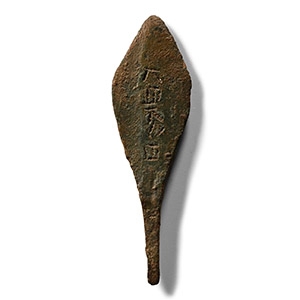
With incised text to the midrib on one face, less well-defined characters to the reverse. 9.2 grams, 63 mm
From the collection of a gentleman, acquired on the London art market in the 1990s.
The arrowhead seems to carry a Proto-Aramaic or Phoenician inscription like many arrows found in the Levant and Israel. They are usually reporting proper names like ‘Suwar, retainer of Abday’. As far as the function of these arrowheads is concerned, we know that the name inscribed on them was the owner's because successive owner's names were incised on two palimpsest examples. The letters engraved upon our arrow seem to be in the Phoenician alphabet and read ḤŞ’Ḥ’ (arrow of…) on the reverse, and ’Š I Š Q (?) (man of…) on the obverse. -
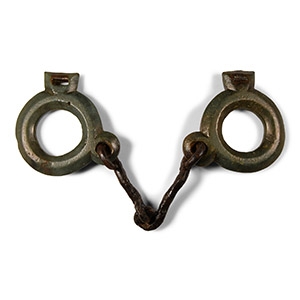
Roman Bronze and Iron Military Horse Bit
2nd-3rd century A.D.Sold for (Inc. bp): £364
Comprising a pair of curved iron bars linked at the centre, loop at each outer end attached to a substantial flat-section ring with lateral lug pierced to accept a strap. 377 grams, 26 cm
From the private collection of a London gentleman, from his grandfather's collection formed before the early 1970s. -
.jpg)
Migration Period Iron Sword with Rock Crystal, Gold and Garnet Sword Bead
5th-6th century A.D.Estimate: £2,000 - 3,000 (+bp*)
Opening Bid: £600
Comprising a double-edged blade with pointed tip, battle nicks to both cutting edges; short bronze guard and a long tang; accompanied by a facetted rock crystal hilt pendant with a granulated gold mount above, set with a garnet cabochon; Eastern Roman or Alano-Gothic. 750 grams, 4-91.5 cm
From the private collection of a London gentleman, from his grandfather's collection formed before the early 1970s. Accompanied by an academic report by Dr Raffaele D’Amato. This lot has been checked against the Interpol Database of stolen works of art and is accompanied by a search certificate number no.12041-216428.
A characteristic type of the Migration period, originally used by nomadic people such as the Alans and Sarmatians. An important element of these swords was the presence (in tombs) of amber or rock crystal fittings, which some authors have identified being part of the pommel (Zasetskaya), and others as pendants hanging from the hilt of the sword. Interestingly the sword of grave 9 from the Necropolis of Novohryhorivka is decorated with a similar pendant, made of amber and fitted with a silver mount decorated with a filigree border.
