
Loading, please wait...
LOT 0943
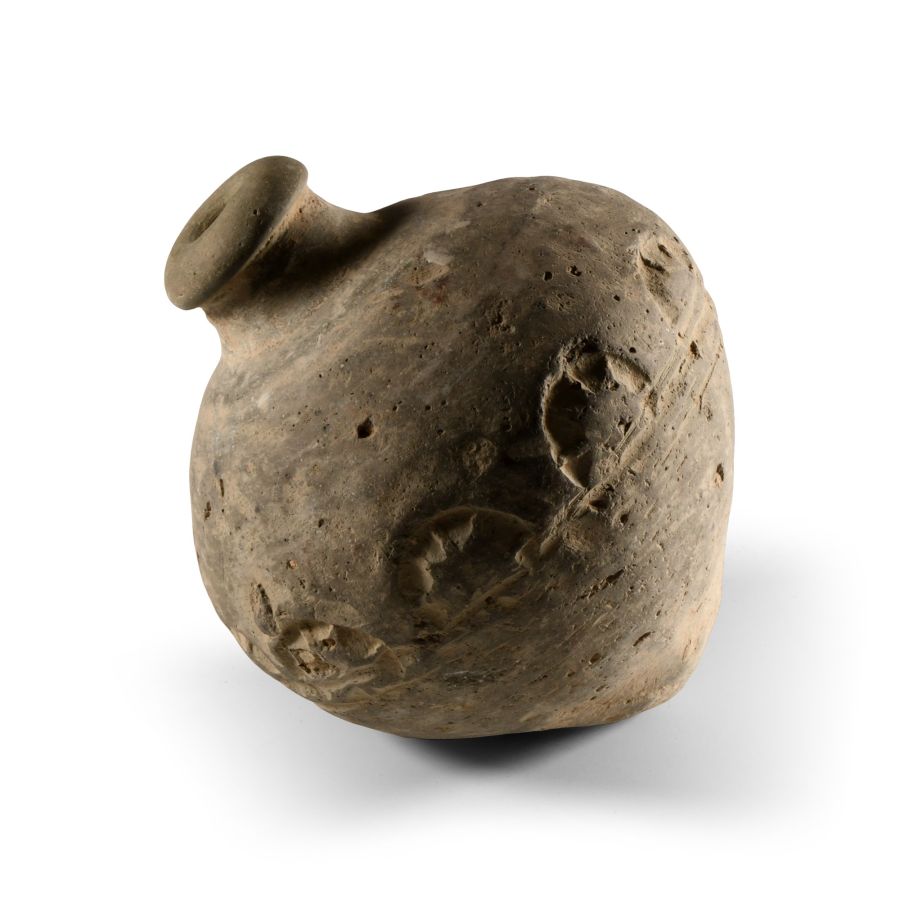
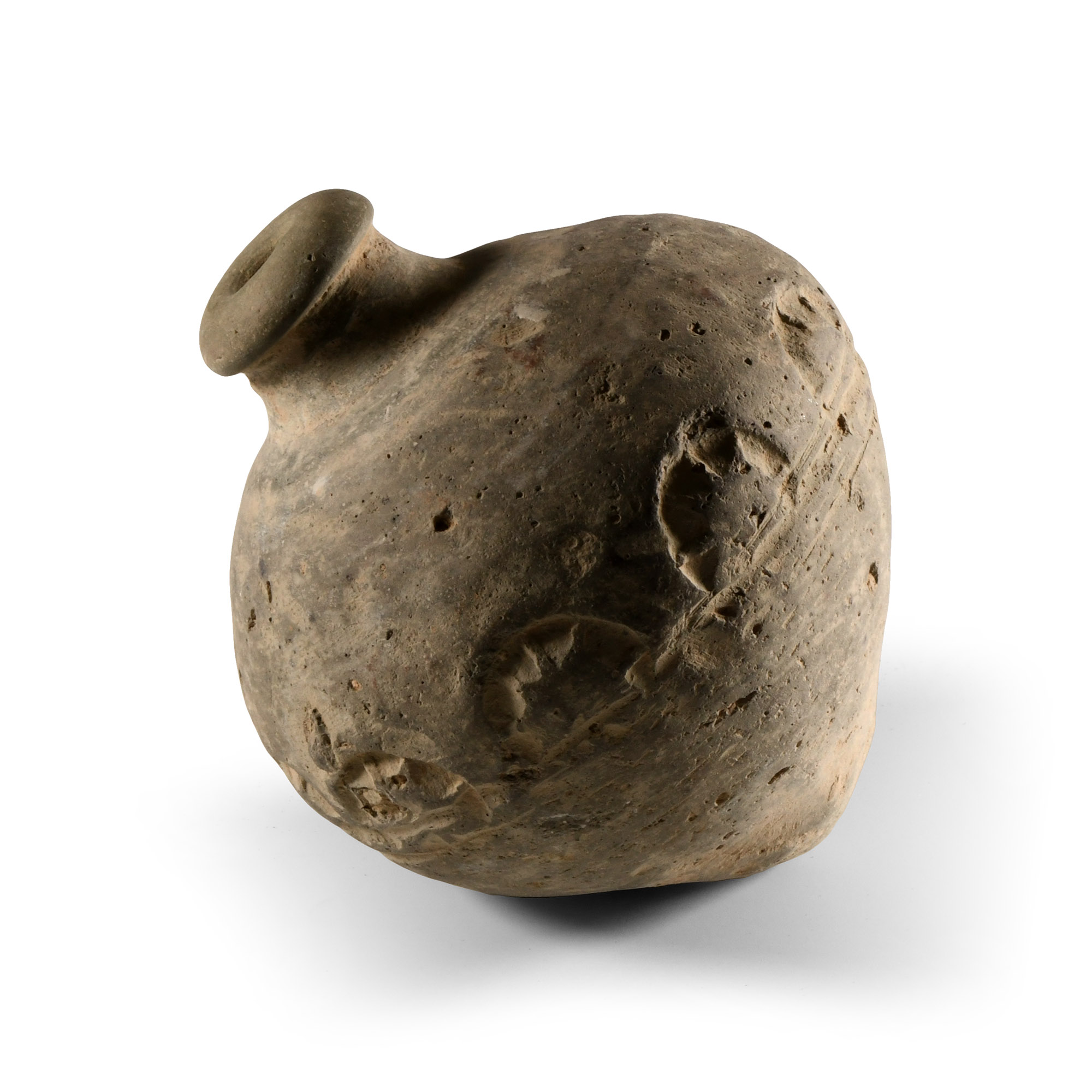
Byzantine 'Greek Fire' Ceramic Fire Bomb or Hand Grenade
9TH-11TH CENTURY A.D.
4 3/8 in. (563 grams, 11 cm).
Piriform body with band of impressed rosettes to the equator, domed filler-hole, intended to be filled with explosive liquid and wick, used as a hand grenade. [No Reserve]
ProvenanceFrom a specialist collection of militaria, London, UK, collected 1990s onwards.
Accompanied by an academic paper by military specialist Dr Raffaele D'Amato, dated 15 July 2019 and titled 'Eastern Roman Empire - Greek Fire Bomb or Hand Grenade (μεσαίον kακάβιον) 9th-11th century AD'.
Cf. Arendt, W. I., Granaten des 13-14. Jahrhunderts, die an der Wolga gefunden sind, Zeitschrift fur Historische Waffen-und Kostumkunde, 11 (1926-8), p.42; cf. Arendt, W., Die Spharisch-konischen Gefäße aus Gebranntem Ton, ibid; cf. Ayalon, D., Gunpowder and Firearms in the Mamluk Kingdom, London, 1956, p.16.
FootnotesApart from the use of siphons or manual flame-throwers called cheirosiphona, special corps of Roman soldiers employed terracotta grenades, in the form of small jars, abundantly evidenced in archaeological excavations. They were called μεσαία kακαβιά or κυτροκακάβια where the former had a bulbous shape and the latter a more cylindrical form.
CONDITIONTimeLine Auctions follows a vetting process to ensure the authenticity and legality of all items, reinforcing our commitment to integrity and responsible trading. Each antiquity, antique, and coin lot undergoes thorough examination by a vetting committee of at least ten external specialists, professional trade association members, scientists, and archaeologists: Our Vetting Process
AUCTIONS:
TimeLine is a leading auction house specialising in antiquities, ancient art, collectables, natural history, coins, medals, and books. Our auctions offer museums, collectors, historians, and enthusiasts the opportunity to acquire unique and historically significant pieces.
LOT 0943
Byzantine 'Greek Fire' Ceramic Fire Bomb or Hand Grenade
Sold for (Inc. bp): £130
-
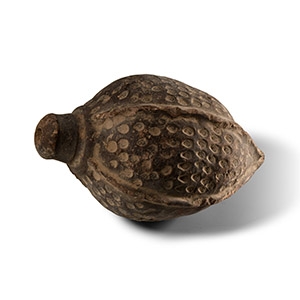
Byzantine 'Greek Fire' Ceramic Fire Bomb or Hand Grenade
9th-11th century A.D.Sold for (Inc. bp): £143
Piriform body with vertical ribs and impressed roundels across the whole surface, domed filler-hole, intended to be filled with explosive liquid and wick, used as a hand grenade. 662 grams, 15.5 cm
From a specialist collection of militaria, London, UK, collected 1990s onwards. Accompanied by an academic paper by military specialist Dr Raffaele D'Amato, dated 15 July 2019 and titled 'Eastern Roman Empire - Greek Fire Bomb or Hand Grenade (μεσαίον kακάβιον) 9th-11th century AD'.
Apart from the use of siphons or manual flame-throwers called cheirosiphona, special corps of Roman soldiers employed terracotta grenades, in the form of small jars, abundantly evidenced in archaeological excavations. They were called μεσαία kακαβιά or κυτροκακάβια where the former had a bulbous shape and the latter a more cylindrical form. -
.jpg)
Byzantine and Post-Byzantine Bronze Cross Group
7th-19th century A.D.Sold for (Inc. bp): £46
Comprising: a cross buckle with pin; the upper plate of a small enkolpion with a praying Virgin or Saint; two orthodox pectoral crosses, both with inscription 'IC' (Iesus) 'XC' (Christos ) 'NIKA' (Christ is victorious); the smallest cross with invocation-prayer engraved on the back. 51.8 grams total, 36-73 mm
Acquired on the UK art market. Property of a Ruislip, UK, gentleman, by inheritance.
The fragment of the simpler Maltese cross mount corresponds to the type E2 of Schulze-Dörrlamm, here with straight arms with rounded corners. It resembles the cross-shaped hinge fittings of the belt buckles from Herrera de Pisuerga and tomb 9 from El Tesorillo from Visigoth Spain, two bronze fittings from Lusitania and the buckle with busts of saints and the Greek inscription 'Light and Life' from Korbous in Tunisia. These kind of buckles were also found in male warrior graves. -
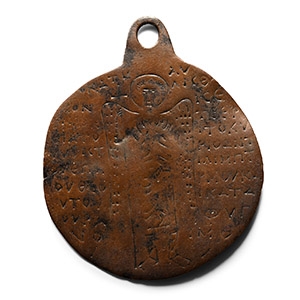
Byzantine 'Psalm 91 Related' Gnostic Bronze Talisman Pendant
Circa 5th-7th century A.D.Sold for (Inc. bp): £975
Discoid in form with integral loop, obverse with low-relief images of mounted Saint Sisinnios killing the demon Gyllou (Lilith), Agnus Dei, a stork, a lion, the holy snake Chnoubis and other symbols with Greek text between; reverse with a standing nimbate angel within a panel of Greek text from Psalm 91. 17.3 grams, 73 mm
From the collection of a gentleman, acquired on the London art market in the 1990s.
The text surrounding the angel recites the verses of Psalm 90 (Heb.91) in the ‘Great Reward Prayer’ (Μεγάλο Απόδειπνο): …Ο κατοικών εν βοηθεία τού Υψίστου, εν σκέπη τού Θεού τού ουρανού αυλισθήσεται. Ερεί τώ Κυρίω, Αντιλήπτωρ μου εί, καί καταφυγή μου… = …He who dwells in the shelter of the Most High will rest in the shadow of the Almighty. I will say of the Lord, 'He is my refuge and my fortress…'
