
Loading, please wait...
LOT 0961
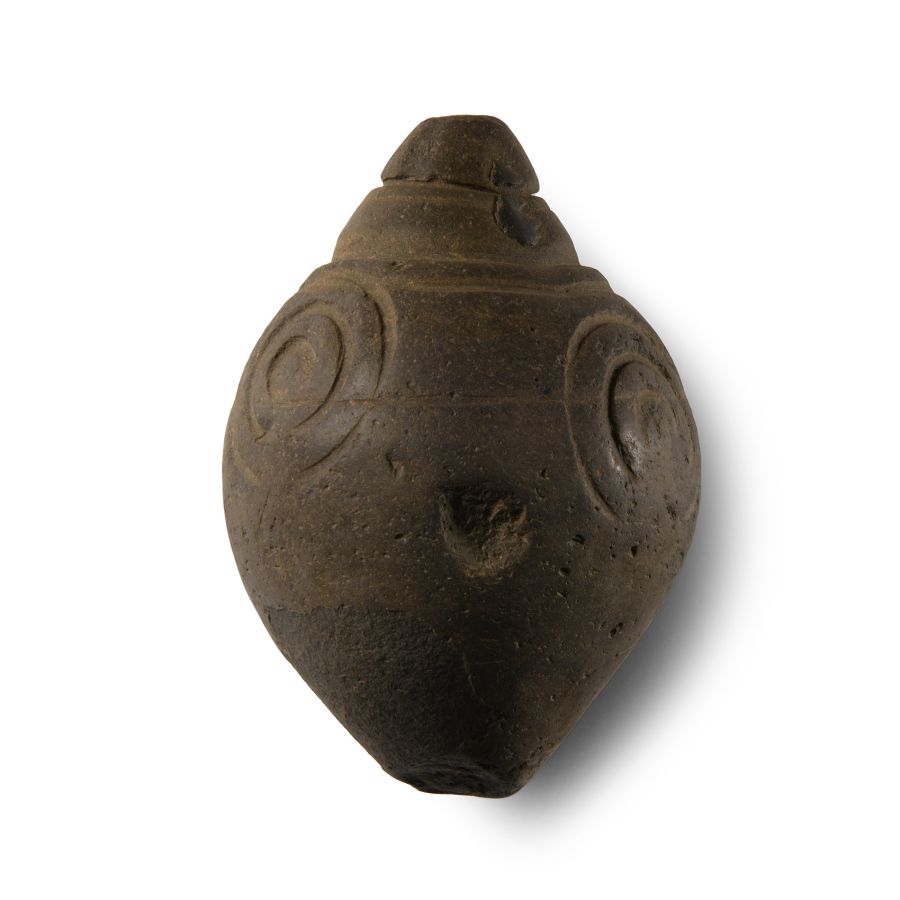
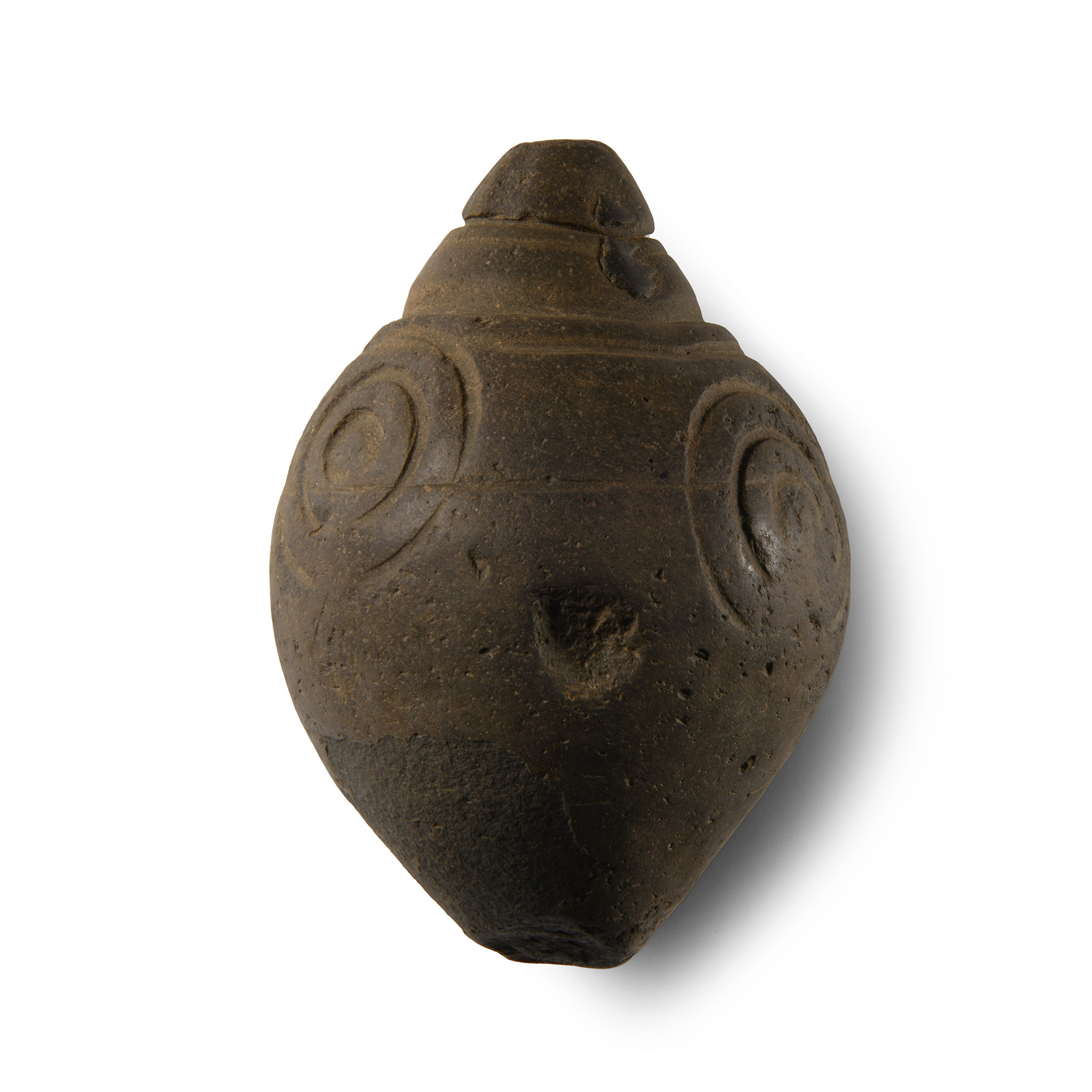
Byzantine 'Greek Fire' Ceramic Fire Bomb or Hand Grenade
10TH-13TH CENTURY A.D.
5 in. (660 grams, 12.8 cm).
Piriform body decorated with concentric circles, with sphero-conical filler-hole, intended to be filled with explosive liquid and wick, used as a hand grenade. [No Reserve]
ProvenanceAcquired 1980-2015.
Ex Abelita family collection.
Accompanied by an academic paper by military specialist Dr Raffaele D'Amato, dated 15 July 2019 and titled 'Eastern Roman Empire - Greek Fire Bomb or Hand Grenade (μεσαίον kακάβιον) 9th-11th century AD'.
Cf. Arendt, W. I., Granaten des 13-14. Jahrhunderts, die an der Wolga gefunden sind, Zeitschrift fur Historische Waffen-und Kostumkunde, 11 (1926-8), p.42; cf. Arendt, W., Die Spharisch-konischen Gefasse aus Gebranntem Ton, ibid; cf. Ayalon, D., Gunpowder and Firearms in the Mamluk Kingdom, London, 1956, p.16; the shape finds correspondence with a fragment of a clay granade from Rhodes (4th EBA storerooms, inv. ПХ 2832), cf. Various, Byzantium and the Arabs,Thessaloniki, 2011, p.64.
FootnotesApart from the use of siphons or manual flame-throwers called cheirosiphona, special corps of Roman soldiers employed terracotta grenades, in the form of small jars, abundantly evidenced in archaeological excavations. They were called μεσαία kακαβιά or κυτροκακάβια where the former had a bulbous shape and the latter a more cylindrical form.
CONDITIONTimeLine Auctions follows a vetting process to ensure the authenticity and legality of all items, reinforcing our commitment to integrity and responsible trading. Each antiquity, antique, and coin lot undergoes thorough examination by a vetting committee of at least ten external specialists, professional trade association members, scientists, and archaeologists: Our Vetting Process
AUCTIONS:
TimeLine is a leading auction house specialising in antiquities, ancient art, collectables, natural history, coins, medals, and books. Our auctions offer museums, collectors, historians, and enthusiasts the opportunity to acquire unique and historically significant pieces.
LOT 0961
Byzantine 'Greek Fire' Ceramic Fire Bomb or Hand Grenade
Sold for (Inc. bp): £156
-
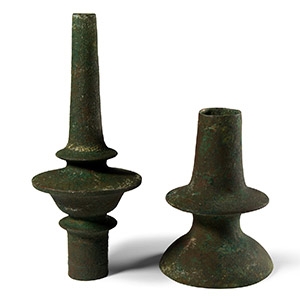
Byzantine Bronze Oil Lamp Stands
6th-7th century A.D.Sold for (Inc. bp): £65
A pair of copper-alloy oil lamp stands with ornamental stems. 1.7 kg total, 16-25.2 cm
UK private collection before 2000. UK art market. Property of a London gentleman.
This kind of stand was destined to support lamp with oval bodies, at the base of which there was a slot that allowed it to be inserted into the lamp stand. The latter was composed of a turned stem and a single, double or even triple curvilinear base, which had the shape of an inverted chalice and carried one, two or three supports which ended with horse hoof ornaments, and feet in the shape of lion's paws. -
.jpg)
Byzantine Gold Ring with Holy Rider
6th-7th century A.D.Sold for (Inc. bp): £5,980
Comprising a round-section hoop with tablet-bezel depicting a military saint on horseback (probably Saint George) advancing right, the nimbate saint holding a large cross in his right hand. 4.00 grams, 21.79 mm overall, 18.33 mm internal diameter (approximate size British O 1/2, USA 7 1/4, Europe 15.61, Japan 15)
Ex Axia Art, London, UK. Property of a North American gallery. Accompanied by a positive scientific statement from Striptwist Limited, a London-based company run by historical precious metal specialist Dr Jack Ogden, reference number 170705. This lot has been checked against the Interpol Database of stolen works of art and is accompanied by search certificate no.12117-214328.
This type of ring belongs to a typical category of the period in question, made with high-quality materials, and decorated with images of saints to invoke their protection. The presence of Saint George on this ring could refer to an owner of high military rank. -
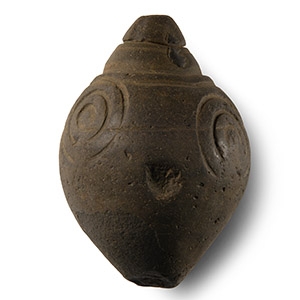
Byzantine 'Greek Fire' Ceramic Fire Bomb or Hand Grenade
10th-13th century A.D.Sold for (Inc. bp): £156
Piriform body decorated with concentric circles, with sphero-conical filler-hole, intended to be filled with explosive liquid and wick, used as a hand grenade. 660 grams, 12.8 cm
Acquired 1980-2015. Ex Abelita family collection. Accompanied by an academic paper by military specialist Dr Raffaele D'Amato, dated 15 July 2019 and titled 'Eastern Roman Empire - Greek Fire Bomb or Hand Grenade (μεσαίον kακάβιον) 9th-11th century AD'.
Apart from the use of siphons or manual flame-throwers called cheirosiphona, special corps of Roman soldiers employed terracotta grenades, in the form of small jars, abundantly evidenced in archaeological excavations. They were called μεσαία kακαβιά or κυτροκακάβια where the former had a bulbous shape and the latter a more cylindrical form.
