
Loading, please wait...
LOT 1386
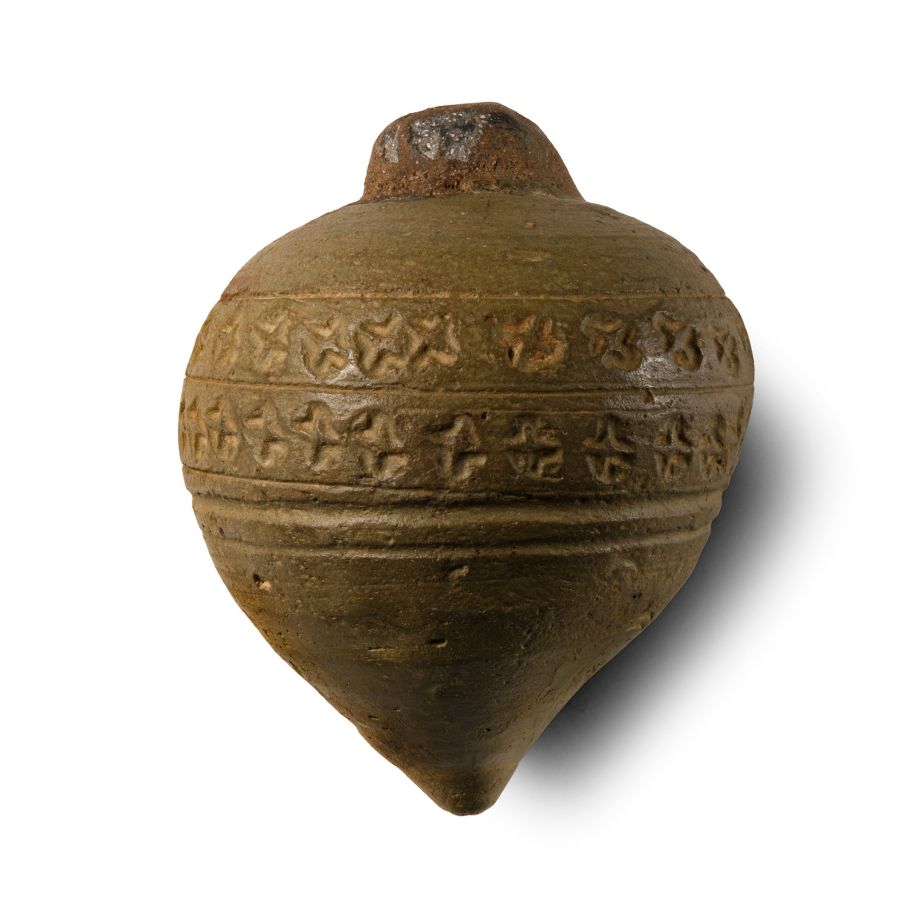
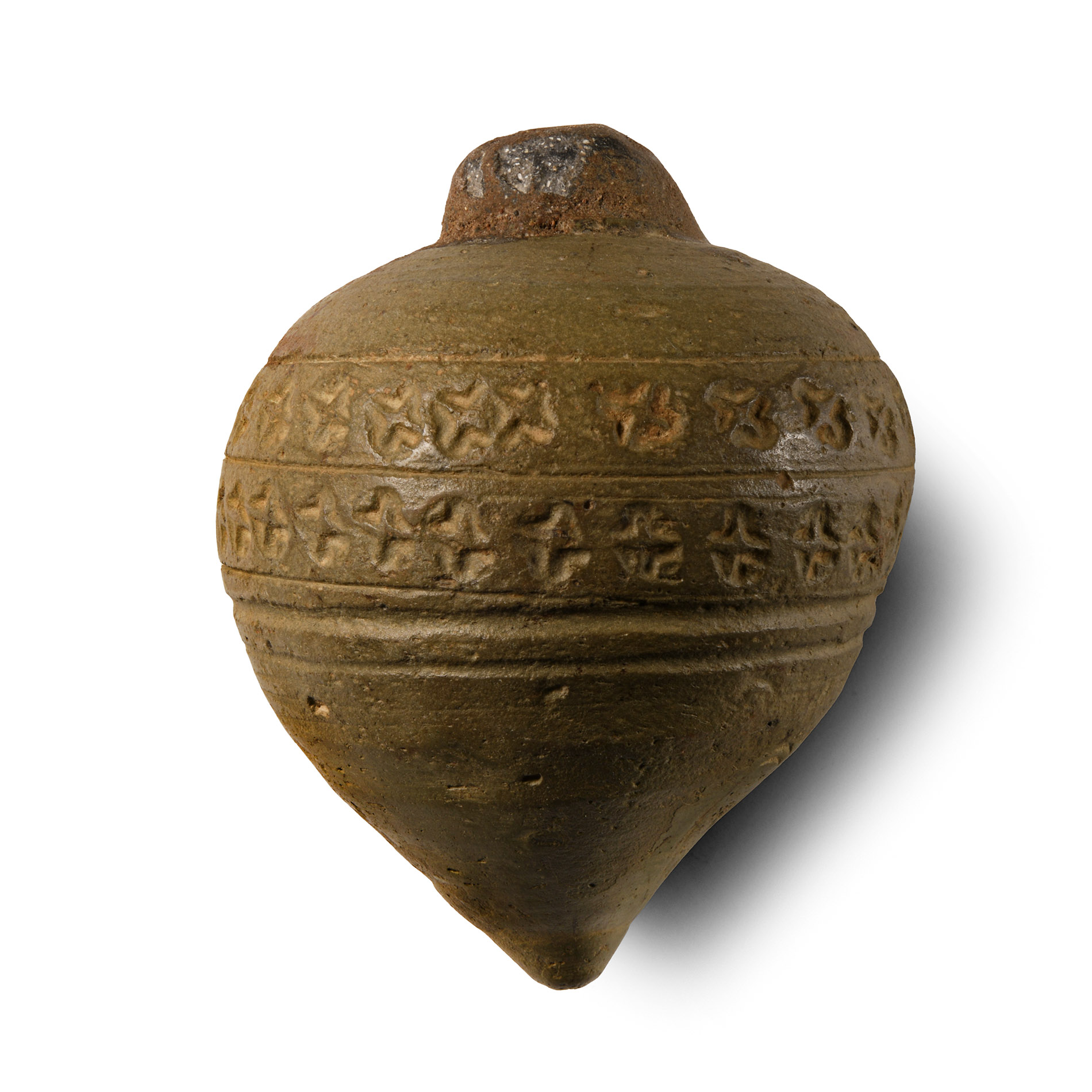
Byzantine 'Greek Fire' Ceramic Fire Bomb or Hand Grenade
10TH-13TH CENTURY A.D.
4 in. (382 grams, 10.2 cm).
Compressed spherical body, the upper part with impressed decoration consisting of two rows of Saint Andreas crossed inside a shield, with domed filler-hole, intended to be filled with explosive liquid and wick, used as a hand grenade. [No Reserve]
ProvenanceAcquired 1980-2015.
Ex Abelita family collection.
Accompanied by an academic paper by military specialist Dr Raffaele D'Amato, dated 15 July 2019 and titled 'Eastern Roman Empire - Greek Fire Bomb or Hand Grenade (μεσαίον kακάβιον) 9th-11th century AD'.
Cf. Arendt, W. I., Granaten des 13-14. Jahrhunderts, die an der Wolga gefunden sind, Zeitschrift fur Historische Waffen-und Kostumkunde, 11 (1926-8), p.42; cf. Arendt, W., Die Spharisch-konischen Gefasse aus Gebranntem Ton, ibid; cf. Ayalon, D., Gunpowder and Firearms in the Mamluk Kingdom, London, 1956, p.16; the shape finds correspondence with a fragment of a clay granade from Rhodes (4th EBA storerooms, inv. ПХ 2833), cf. Various, Byzantium and the Arabs,Thessaloniki, 2011, p.65.
FootnotesApart from the use of siphons or manual flame-throwers called cheirosiphona, special corps of Roman soldiers employed terracotta grenades, in the form of small jars, abundantly evidenced in archaeological excavations. They were called μεσαία kακαβιά or κυτροκακάβια where the former had a bulbous shape and the latter a more cylindrical form.
CONDITIONTimeLine Auctions follows a vetting process to ensure the authenticity and legality of all items, reinforcing our commitment to integrity and responsible trading. Each antiquity, antique, and coin lot undergoes thorough examination by a vetting committee of at least ten external specialists, professional trade association members, scientists, and archaeologists: Our Vetting Process
AUCTIONS:
TimeLine is a leading auction house specialising in antiquities, ancient art, collectables, natural history, coins, medals, and books. Our auctions offer museums, collectors, historians, and enthusiasts the opportunity to acquire unique and historically significant pieces.
LOT 1386
Byzantine 'Greek Fire' Ceramic Fire Bomb or Hand Grenade
Sold for (Inc. bp): £195
-
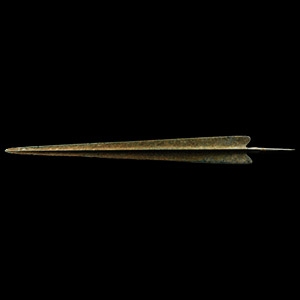
Large North-West Persian Bronze Sword Blade
11th-7th century B.C.Sold for (Inc. bp): £211
With prominently curved guard extending out from the ricasso partly framing the hilt, thick midrib extending slightly above the ricasso. 460 grams, 52 cm
Acquired 1980-2015. Ex Abelita family collection.
The hilt of such swords was made separately and unfortunately is nearly always missing from the archaeological records. Similar daggers have been recorded from the South Caspian area from Tomadjan and Ghalekuti. Their chronology ranges from late 2nd millennium B.C. to 7th century B.C. -
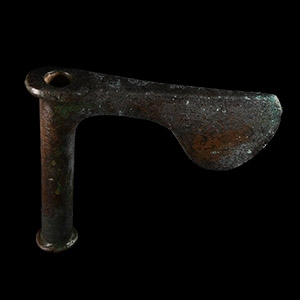
Elamite Bronze Crescentic Axehead
Mid 3rd-early 2nd millennium B.C.Estimate: £150 - 200 (+bp*)
Opening Bid: £80
With slender tubular socket, horizontal upper cheek and curved lower one, scooped profile to blade with convex cutting edge. 333 grams, 12.5 cm
Acquired 1980-2015. Ex Abelita family collection. -
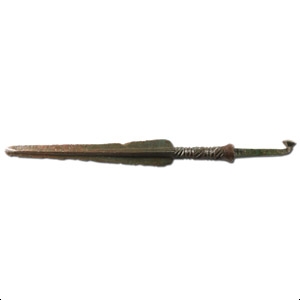
Western Asiatic Bronze Spearhead with Decorative Supports and Blood Channels
2nd millennium B.C.Estimate: £400 - 600 (+bp*)
Opening Bid: £200
With a long triangular blade, strongly marked midrib divided into five grooves, rectangular-section tang; engraved and reinforced shaft with diagonal and horizontal grooves. 474 grams, 43 cm
Acquired 1980-2015. Ex Abelita family collection.
This homogeneous subtype (LF 2a of Gernez) is characterised by a set of morphological particularities which constitute a functional and aesthetic outcome. The tapered blade, triangular (like in our case) or ogival, is reinforced by a strong median bulge. The intermediate part often bears an incised or moulded decoration and the base is with a marked widening or with a stopper disc. The tang, square in section, is curved and widens at the end almost at a right angle.
