
Loading, please wait...
LOT 1383
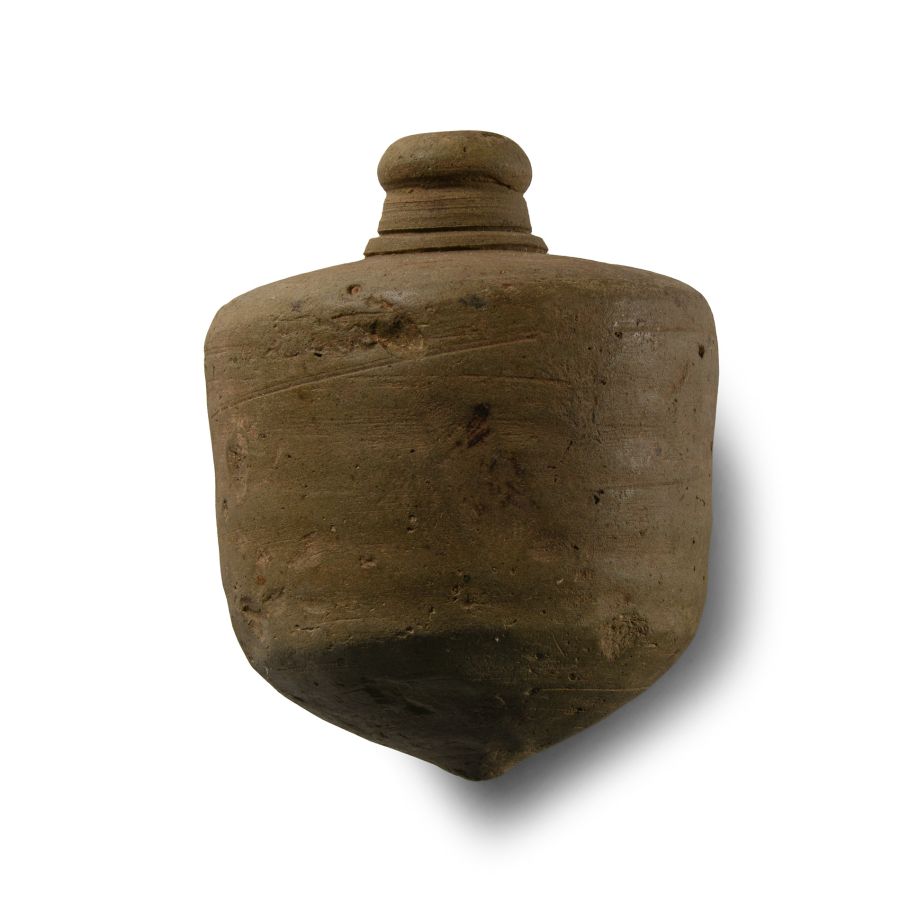
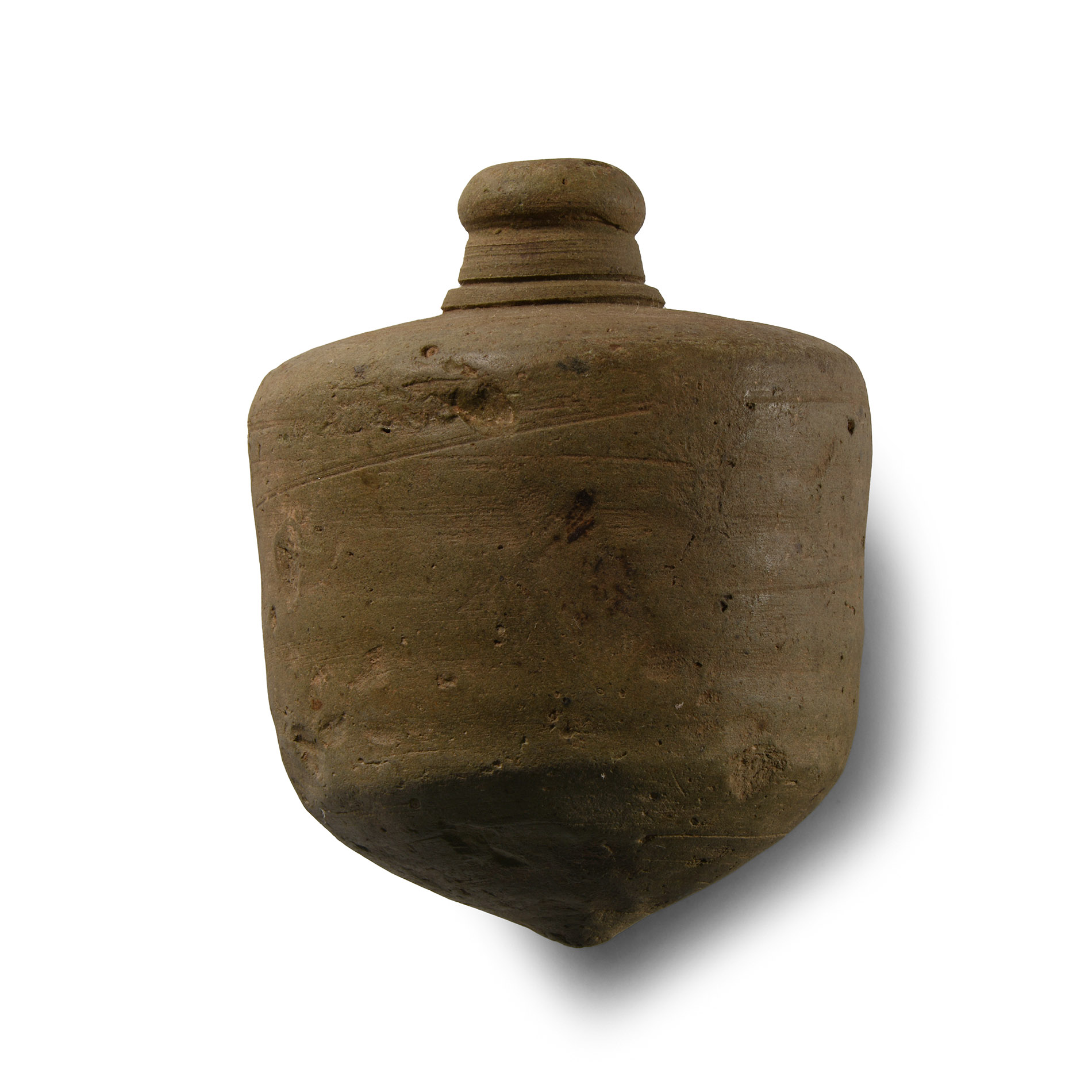
Byzantine 'Greek Fire' Ceramic Fire Bomb or Hand Grenade
9TH-11TH CENTURY A.D.
4 1/4 in. (472 grams, 10.7 cm).
With broad shoulder, short neck, domed square-shaped lip and conical base, broad medial band, intended to be filled with explosive liquid and a wick, and used as a hand grenade. [No Reserve]
ProvenanceAcquired 1980-2015.
Ex Abelita family collection.
Accompanied by an academic paper by military specialist Dr Raffaele D'Amato, dated 15 July 2019 and titled 'Eastern Roman Empire - Greek Fire Bomb or Hand Grenade (μεσαίον kακάβιον) 9th-11th century AD'.
See Arendt, W. I., Granaten des 13-14. Jahrhunderts, die an der Wolga gefunden sind, Zeitschrift fur Historische Waffen-und Kostumkunde, 11 (1926-8), p.42; cf. Arendt, W., Die Spharisch-konischen Gefasse aus Gebranntem Ton, ibid; Ayalon, D., Gunpowder and Firearms in the Mamluk Kingdom, London, 1956, p.16; Raimondo, C., 'Un deposito di granate dal castrum bizantino di Santa Maria del Mare (Catanzaro)' in Mélanges de l'Ecole française de Rome. Moyen-Age, tome 112, n°1, Roma, 2000, pp. 305-310.
FootnotesThe effectiveness of these grenades was much lower than the fire liquid thrown by the siphons. They were thrown by hand as it is evident by the presence of some sort of handle on the body of some of them to better allow the grip of the object (Raimondo, 2000 Plate 11a; fig. 4, c-d). Nothing excludes that they were also launched at more long distance with catapults or other war engines. The presence of a fuse for triggering the explosion is evidenced by the narrow mouth of the largest part of the grenades.
CONDITIONTimeLine Auctions follows a vetting process to ensure the authenticity and legality of all items, reinforcing our commitment to integrity and responsible trading. Each antiquity, antique, and coin lot undergoes thorough examination by a vetting committee of at least ten external specialists, professional trade association members, scientists, and archaeologists: Our Vetting Process
AUCTIONS:
TimeLine is a leading auction house specialising in antiquities, ancient art, collectables, natural history, coins, medals, and books. Our auctions offer museums, collectors, historians, and enthusiasts the opportunity to acquire unique and historically significant pieces.
LOT 1383
Byzantine 'Greek Fire' Ceramic Fire Bomb or Hand Grenade
Sold for (Inc. bp): £221
-
Bactrian Bronze Eye Axehead
3rd-2nd millennium B.C.Estimate: £300 - 400 (+bp*)
Opening Bid: £150
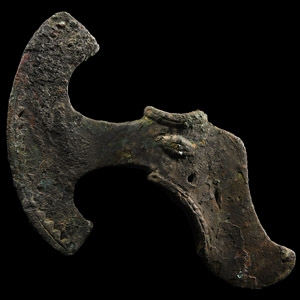
Fan-shaped blade; an apotropaic eye in relief to each side of the socket; wing-shaped extension to the rear. 327 grams, 16 cm
From an old London, UK, collection. Ex London, UK, gallery.
Most of these axes are believed to have originated in Bactria, but some objects come from well documented contexts in Margiane (Gonur), Lut (Shahdad) and Kermanshah (Khinaman). According to Gernez they were made for ceremonial use. -
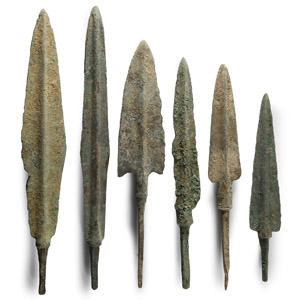
Luristan Bronze Arrowhead Group
12th-9th century B.C.Sold for (Inc. bp): £195
Comprising arrowheads of various types, mainly leaf-shaped and barbed types, with midribs. 216 grams total, 12.2 - 18 cm
Acquired 1990s. From the collection of a late Japanese weaponry collector.
The barbed arrowhead seems to belong to the type V, subcategory type C, according to the classification of Khorasani and Negahban. In the four categories of triangular bronze arrowheads from Luristan, Marlik and Northern Iran individuated by Negahban, subtypes C and D of type V are larger arrow or javelin heads, C large triangular arrowheads with barbed shoulders and D with lanceolate shape and rounded midrib. The straight shoulders recalls a Marlik typology (see Khorasani, 2006, p.307, fig.379). -
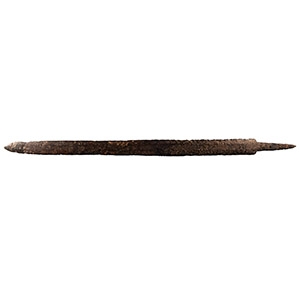
Byzantine Iron Spathion Sword
9th-11th century A.D.Sold for (Inc. bp): £845
An Eastern Roman spathion with long, double-edged parallel blade, a tapering, medium length tang, retaining possible remains of the fabrica mark in the middle, near the rivet hole for the handle. 698 grams, 81cm
Acquired 1970-1980. From the collection of a Surrey gentleman.
