
Loading, please wait...
LOT 1405
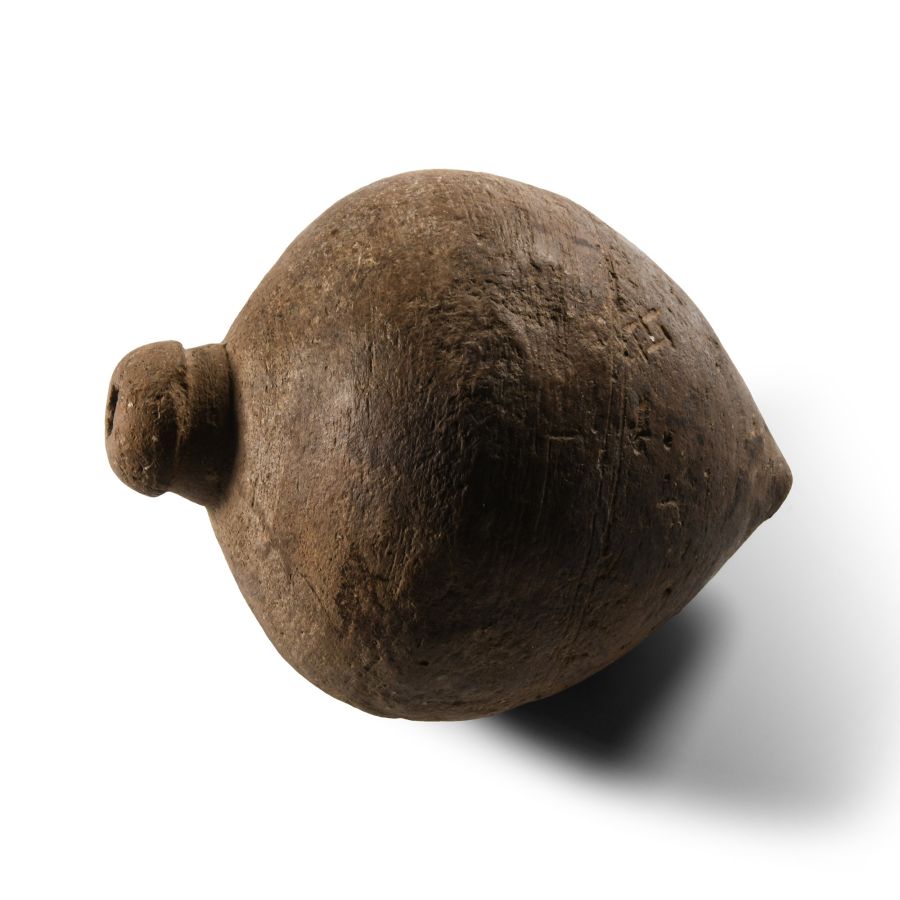
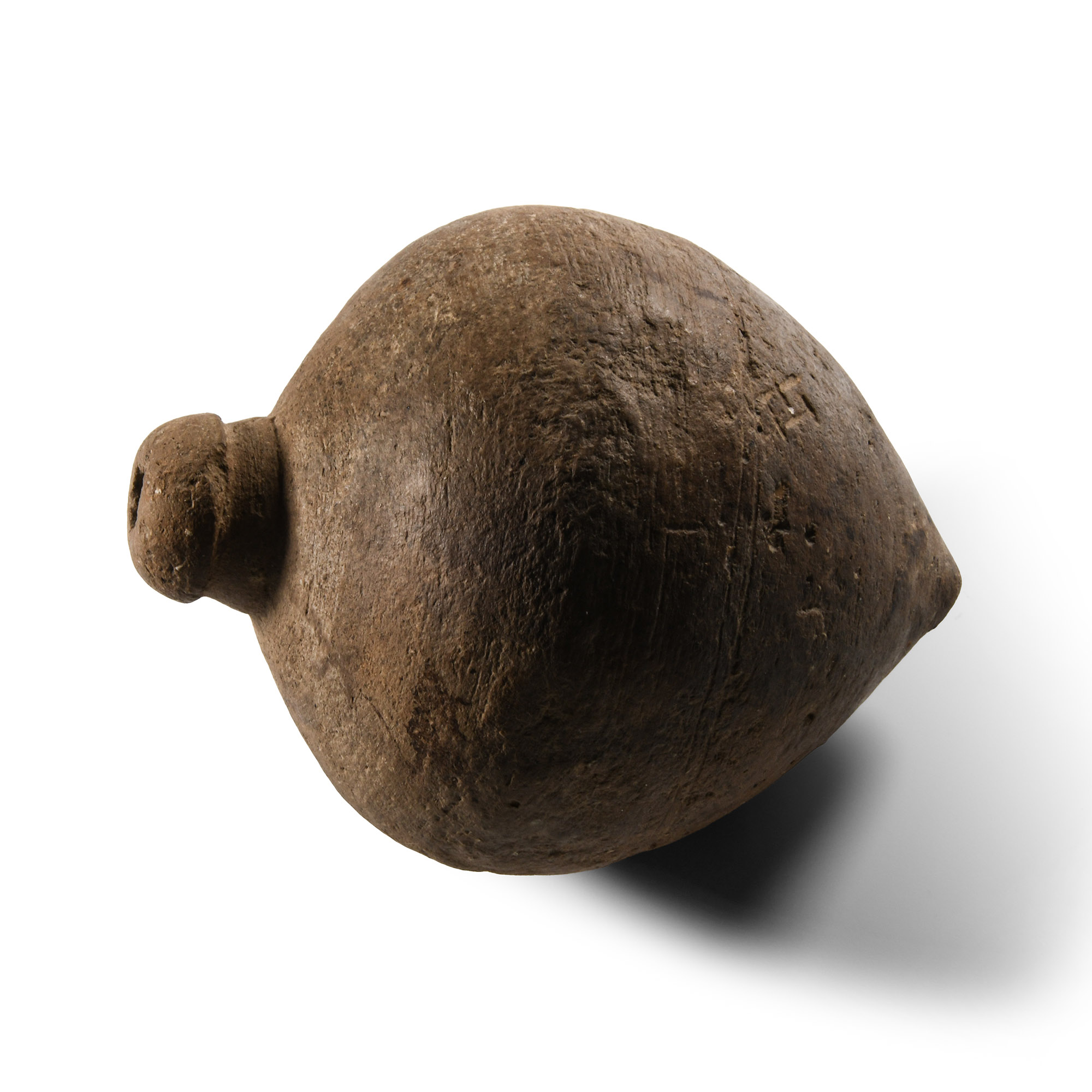
Byzantine 'Greek Fire' Ceramic Fire Bomb or Hand Grenade
9TH-11TH CENTURY A.D.
5 in. (580 grams, 12.5 cm).
Piriform body with domed filler-hole; intended to be filled with explosive liquid and wick, used as a hand grenade. [No Reserve]
ProvenanceFrom a collection acquired on the UK art market from various auction houses and collections mostly before 2000.
From an important Cambridgeshire estate; thence by descent.
Accompanied by an academic paper by military specialist Dr Raffaele D'Amato, dated 15 July 2019 and titled 'Eastern Roman Empire - Greek Fire Bomb or Hand Grenade (μεσαίον kακάβιον) 9th-11th century AD'.
Cf. Arendt, W. I., Granaten des 13-14. Jahrhunderts, die an der Wolga gefunden sind, Zeitschrift fur Historische Waffen-und Kostumkunde, 11 (1926-8), p.42; cf. Arendt, W., Die Spharisch-konischen Gefasse aus Gebranntem Ton, ibid; cf. Ayalon, D., Gunpowder and Firearms in the Mamluk Kingdom, London, 1956, p.16.
FootnotesApart from the use of siphons or manual flame-throwers called cheirosiphona, special corps of Roman soldiers employed terracotta grenades, in the form of small jars, abundantly evidenced in archaeological excavations. Such were the γανωτα, vessels (sometimes also of bronze) used for Greek fire. They were called μεσαία kακαβιά or κυτροκακάβια where the former had a bulbous shape and the latter a more cylindrical form.
CONDITIONTimeLine Auctions follows a vetting process to ensure the authenticity and legality of all items, reinforcing our commitment to integrity and responsible trading. Each antiquity, antique, and coin lot undergoes thorough examination by a vetting committee of at least ten external specialists, professional trade association members, scientists, and archaeologists: Our Vetting Process
AUCTIONS:
TimeLine is a leading auction house specialising in antiquities, ancient art, collectables, natural history, coins, medals, and books. Our auctions offer museums, collectors, historians, and enthusiasts the opportunity to acquire unique and historically significant pieces.
LOT 1405
Byzantine 'Greek Fire' Ceramic Fire Bomb or Hand Grenade
Sold for (Inc. bp): £143
-
Large North-West Persian Bronze Sword Blade
11th-7th century B.C.Sold for (Inc. bp): £211
With prominently curved guard extending out from the ricasso partly framing the hilt, thick midrib extending slightly above the ricasso. 460 grams, 52 cm
Acquired 1980-2015. Ex Abelita family collection.
The hilt of such swords was made separately and unfortunately is nearly always missing from the archaeological records. Similar daggers have been recorded from the South Caspian area from Tomadjan and Ghalekuti. Their chronology ranges from late 2nd millennium B.C. to 7th century B.C. -
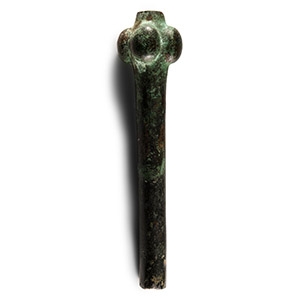
Luristan Sara-Gorz Bronze Macehead
Circa 2000-1300 B.C.Sold for (Inc. bp): £338
With long tubular shank and four hefty bulbs surrounding the shaft. 456 grams, 22.5 cm
Acquired 1980-2015. Ex Abelita family collection. Accompanied by an earlier catalogue identification card.
This rare and unusual mace finds parallels with similar pieces published by Slotta, Vatandust, and Moorey. The dating varies between 21st and 14th century B.C. Western Iranian maces, especially the Luristan ones, were notable for the variety of different forms. According to Dr D. Nicolle the gorz or mace was primarily used as an armour breaking weapon since ancient times, and was very common on the Iranian plateau. -
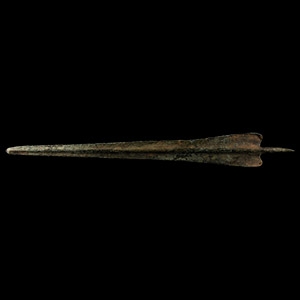
Large Western Asiatic Bronze Rapier Blade
2nd-1st millennium B.C.Sold for (Inc. bp): £234
Composed of a tanged and barbed blade with raised midrib to both faces. 327 grams, 43.5 cm
Acquired 1980-2015. Ex Abelita family collection.
In the last ninety years, many such tanged blades have been considered to be coming from centres of production in Amlash and Marlik. Without context accurate dating is impossible, but the shape recalls the rapiers of the Bronze or Early Iron Age.
