
Loading, please wait...
LOT 1083
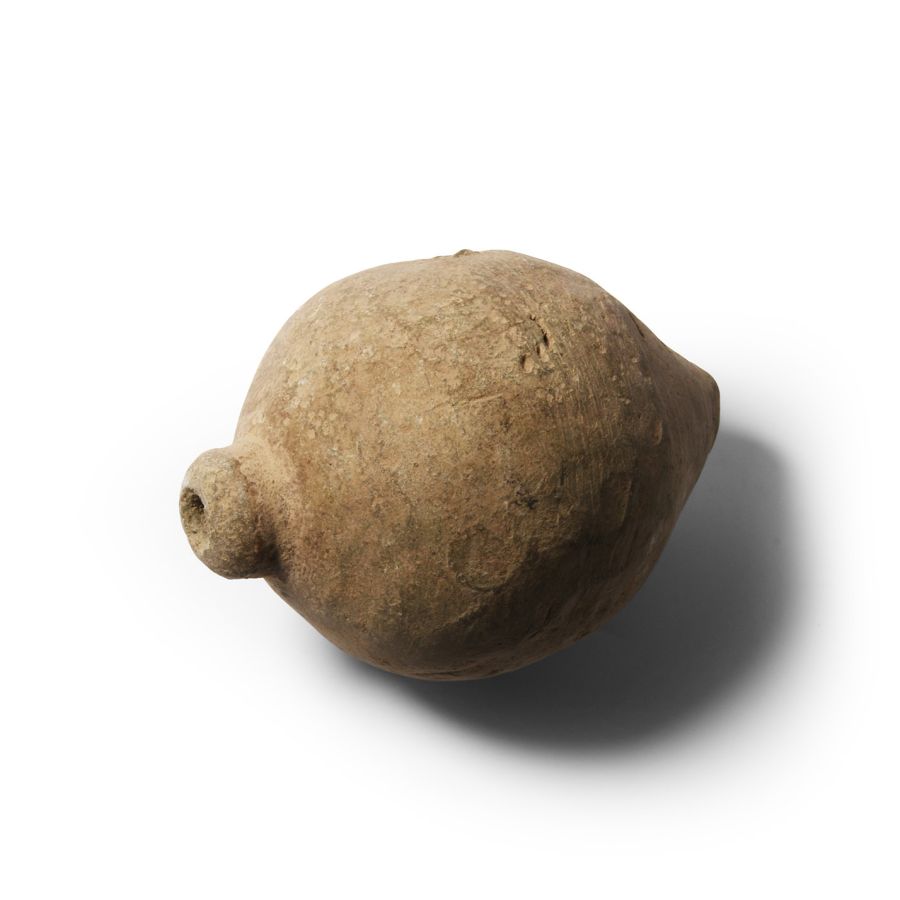
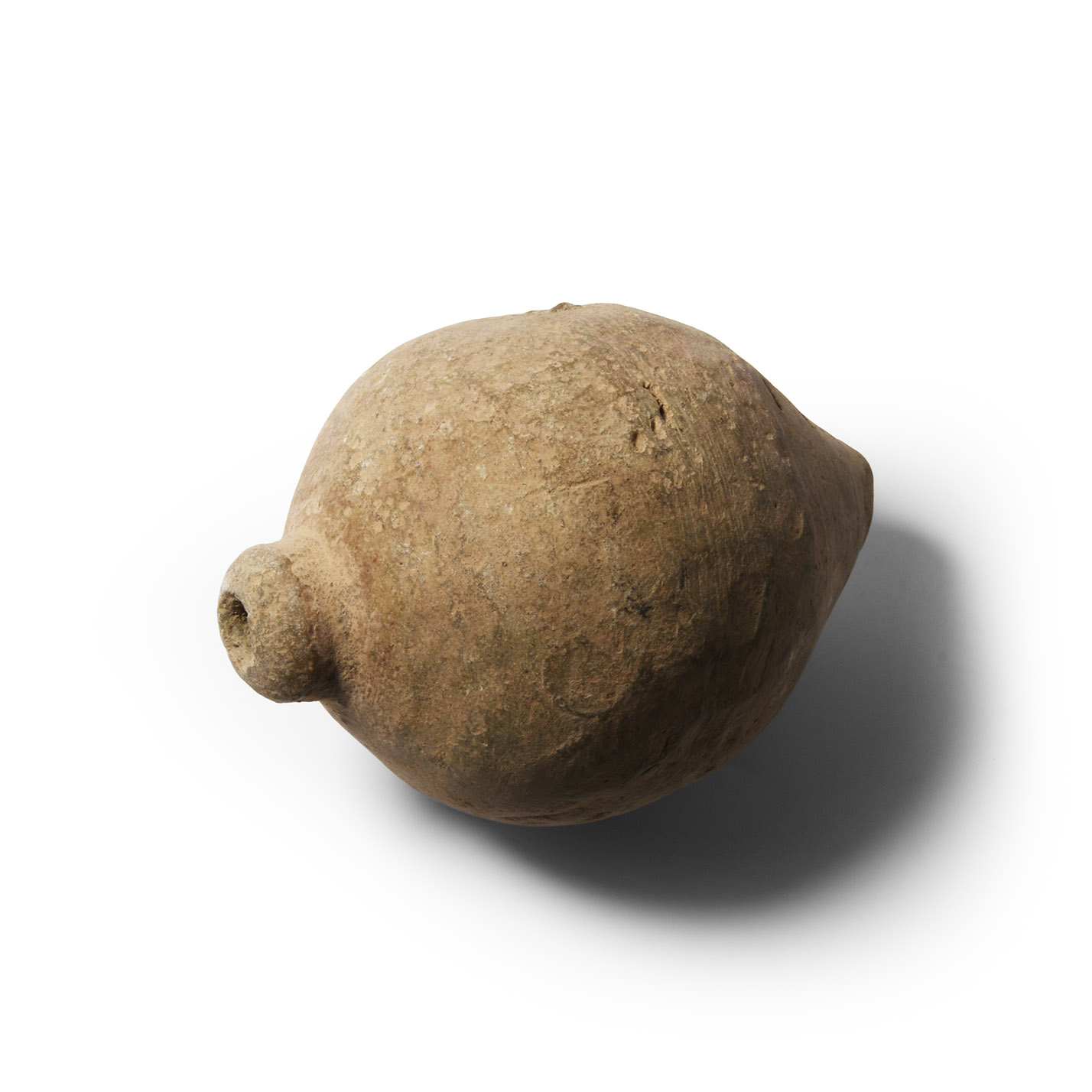
Byzantine 'Greek Fire' Ceramic Fire Bomb or Hand Grenade
9TH-11TH CENTURY A.D.
4 3/4 in. (594 grams, 12 cm).
Pear-shaped ceramic vessel with domed filler-hole; intended to be filled with explosive liquid and wick, used as a hand grenade. [No Reserve]
ProvenanceEx London, UK, collection, 1990s.
Accompanied by an academic paper by military specialist Dr Raffaele D'Amato, dated 15 July 2019 and titled 'Eastern Roman Empire - Greek Fire Bomb or Hand Grenade (μεσαίον kακάβιον) 9th-11th century AD'.
Cf. Arendt, W. I., Granaten des 13-14. Jahrhunderts, die an der Wolga gefunden sind, Zeitschrift fur Historische Waffen-und Kostumkunde, 11 (1926-8), p.42; cf. Arendt, W., Die Spharisch-konischen Gefasse aus Gebranntem Ton, ibid; cf. Ayalon, D., Gunpowder and Firearms in the Mamluk Kingdom, London, 1956, p.16.
FootnotesApart from the use of siphons or manual flame-throwers called cheirosiphona, special corps of Roman soldiers employed terracotta grenades, in the form of small jars, abundantly evidenced in archaeological excavations. Such were the γανωτα, vessels (sometimes also of bronze) used for Greek fire. They were called μεσαία kακαβιά or κυτροκακάβια where the former had a bulbous shape and the latter a more cylindrical form.
CONDITIONTimeLine Auctions follows a vetting process to ensure the authenticity and legality of all items, reinforcing our commitment to integrity and responsible trading. Each antiquity, antique, and coin lot undergoes thorough examination by a vetting committee of at least ten external specialists, professional trade association members, scientists, and archaeologists: Our Vetting Process
AUCTIONS:
TimeLine is a leading auction house specialising in antiquities, ancient art, collectables, natural history, coins, medals, and books. Our auctions offer museums, collectors, historians, and enthusiasts the opportunity to acquire unique and historically significant pieces.
LOT 1083
Byzantine 'Greek Fire' Ceramic Fire Bomb or Hand Grenade
Sold for (Inc. bp): £111
-
.jpg)
German WWII Stick Grenade Group
1914-1945 A.D.Estimate: £200 - 300 (+bp*)
Opening Bid: £94
German practice stick grenade group including: a WWII model 24 Stielhandgranate with pierced red-coloured head; together with a restored relic head of WWI date. 684 grams, 44.5 cm
Acquired from The Lanes Armoury, Brighton, and Graham Currie Militaria. The Kusmirek Collection, UK. Accompanied by copies of the listings.
The brb-code name for Richard Rinker GmbH, was used for training German armed forced during WWII. Its distinctive appearance lead to it being dubbed the stick grenade' or 'potato masher' in British army slang. It used a friction igniter, with a pull cord running through the hollow wooden handle terminating in a porcelain ball. -
Luristan Bronze Dagger
2nd-1st millennium B.C.Estimate: £300 - 400 (+bp*)
Opening Bid: £160
Comprising a narrow double-edged blade, triangular in profile with raised midrib, rectangular guard with flanges, rectangular grip with lateral flanges to accept an organic grip, curved integral finial. 312 grams, 43 cm
Ex German collection, Cologne, 1980-1990s.
This weapon is typical of the cemeteries dating to the local Late Bronze Age (1300-1000 B.C.). The blade is still triangular but the crescentic pommel is reduced and flanged to be filled with organic material such as bone or wood. -
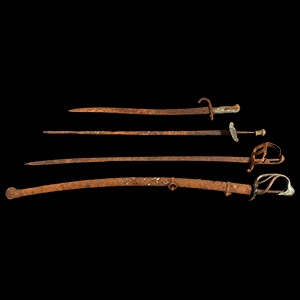
Post Medieval Iron Sword Group
18th-19th century A.D.Sold for (Inc. bp): £169
Comprising mostly military weapons: a bayonet; sabre; two swords. 3.5 kg total, 89-110 cm
Acquired 1990s-early 2000s. East Anglian private collection.
One of the swords shows analogies with post-1846 Wilkinson types, regulation steel hilt and steel scabbard with two loose rings. The Wilkinson style officers' blade was a compromise cut and thrust sabre blade with a fuller (groove), found on huge numbers of antique British military officers' swords. It replaced the pipeback blade previously used on officers' swords.
