
Loading, please wait...
_900x900.jpg "Byzantine Gold Ring with Holy Rider")
_200x200.jpg "Byzantine Gold Ring with Holy Rider")
.jpg "Byzantine Gold Ring with Holy Rider")
LOT 0215
Byzantine Gold Ring with Holy Rider
6TH-7TH CENTURY A.D.
3/4 in. (4.00 grams, 21.79 mm overall, 18.33 mm internal diameter (approximate size British O 1/2, USA 7 1/4, Europe 15.61, Japan 15)).
Comprising a round-section hoop with tablet-bezel depicting a military saint on horseback (probably Saint George) advancing right, the nimbate saint holding a large cross in his right hand. [No Reserve]
ProvenanceEx Axia Art, London, UK.
Property of a North American gallery.
Accompanied by a positive scientific statement from Striptwist Limited, a London-based company run by historical precious metal specialist Dr Jack Ogden, reference number 170705.
This lot has been checked against the Interpol Database of stolen works of art and is accompanied by search certificate no.12117-214328.
Cf. Papanikola-Bakirtzi, D. (ed.), Everyday life in Byzantium. Byzantine Hours. Works and days in Byzantium, Exhibition catalogue, Thessaloniki, White Tower, October 2001-January 2002, Athens, 2002, no.573, for the type.
FootnotesThis type of ring belongs to a typical category of the period in question, made with high-quality materials, and decorated with images of saints to invoke their protection. The presence of Saint George on this ring could refer to an owner of high military rank.
CONDITIONTimeLine Auctions follows a vetting process to ensure the authenticity and legality of all items, reinforcing our commitment to integrity and responsible trading. Each antiquity, antique, and coin lot undergoes thorough examination by a vetting committee of at least ten external specialists, professional trade association members, scientists, and archaeologists: Our Vetting Process
AUCTIONS:
TimeLine is a leading auction house specialising in antiquities, ancient art, collectables, natural history, coins, medals, and books. Our auctions offer museums, collectors, historians, and enthusiasts the opportunity to acquire unique and historically significant pieces.
-
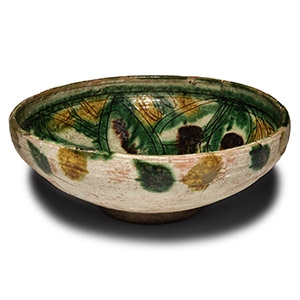
Byzantine Green Glazed Sgraffito-Ware Bowl
12th-14th century A.D.Sold for (Inc. bp): £715
With inturned rim and three-colour (yellow, brown and green) glaze, incised foliage design. 343 grams, 18 cm
with Cuvreau Expertise Encheres S.A.S, Vente No.60, 21 June 2009, no.149. European private collection. -
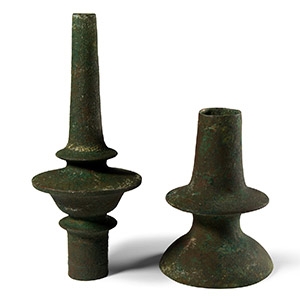
Byzantine Bronze Oil Lamp Stands
6th-7th century A.D.Sold for (Inc. bp): £65
A pair of copper-alloy oil lamp stands with ornamental stems. 1.7 kg total, 16-25.2 cm
UK private collection before 2000. UK art market. Property of a London gentleman.
This kind of stand was destined to support lamp with oval bodies, at the base of which there was a slot that allowed it to be inserted into the lamp stand. The latter was composed of a turned stem and a single, double or even triple curvilinear base, which had the shape of an inverted chalice and carried one, two or three supports which ended with horse hoof ornaments, and feet in the shape of lion's paws. -
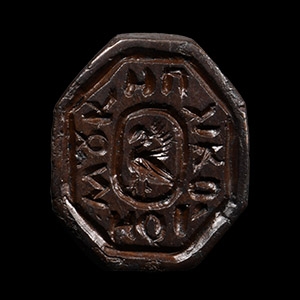
Large Byzantine Inscribed Bronze Glove Ring with Swan
Circa 15th century A.D.Sold for (Inc. bp): £312
With facetted shoulders and octagonal bezel, central swan motif surrounded by enigmatic Greek text 'IOHMOK HΠ[.]IKO'. 12.22 grams, 25.54 mm overall, 21.20 mm internal diameter (approximate size British X 1/2, USA 11 3/4, Europe 26.92, Japan 25)
Private collection formed since the 1940s. UK art market. Property of an Essex gentleman.
Similar rings have been found in the area of Vojvodina, where the military and ecclesiastical presence of Byzantium was still strong until the 13th century. The signet ring shows a Greek inscription probably made by Slavonic people using Greek letters as an 'imitation' of earlier Eastern Roman rings.
