
Loading, please wait...
_900x900.jpg "Byzantine Gilt Bronze Bowl with Religious Scenes")
_200x200.jpg "Byzantine Gilt Bronze Bowl with Religious Scenes")
_900x900.jpg "Byzantine Gilt Bronze Bowl with Religious Scenes")
_200x200.jpg "Byzantine Gilt Bronze Bowl with Religious Scenes")
.jpg "Byzantine Gilt Bronze Bowl with Religious Scenes")
.jpg "Byzantine Gilt Bronze Bowl with Religious Scenes")
LOT 0207
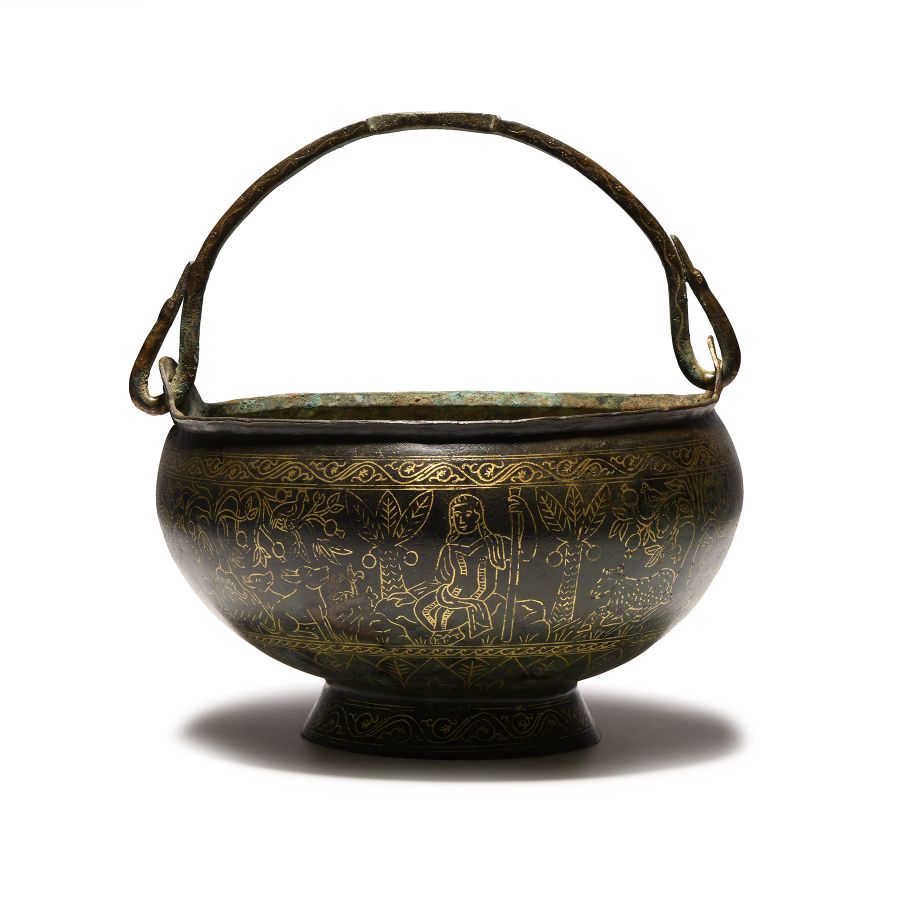
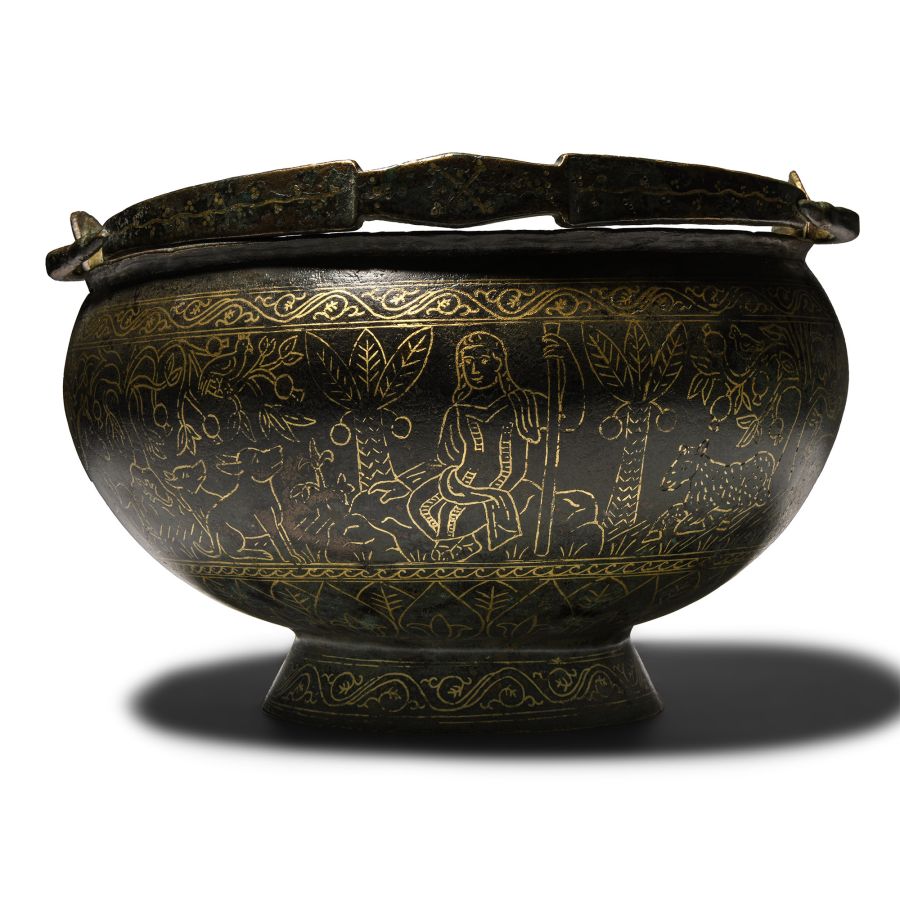
Byzantine Gilt Bronze Bowl with Religious Scenes
CIRCA 5TH-6TH CENTURY A.D.
9 in. (1.02 kg, 23 cm wide).
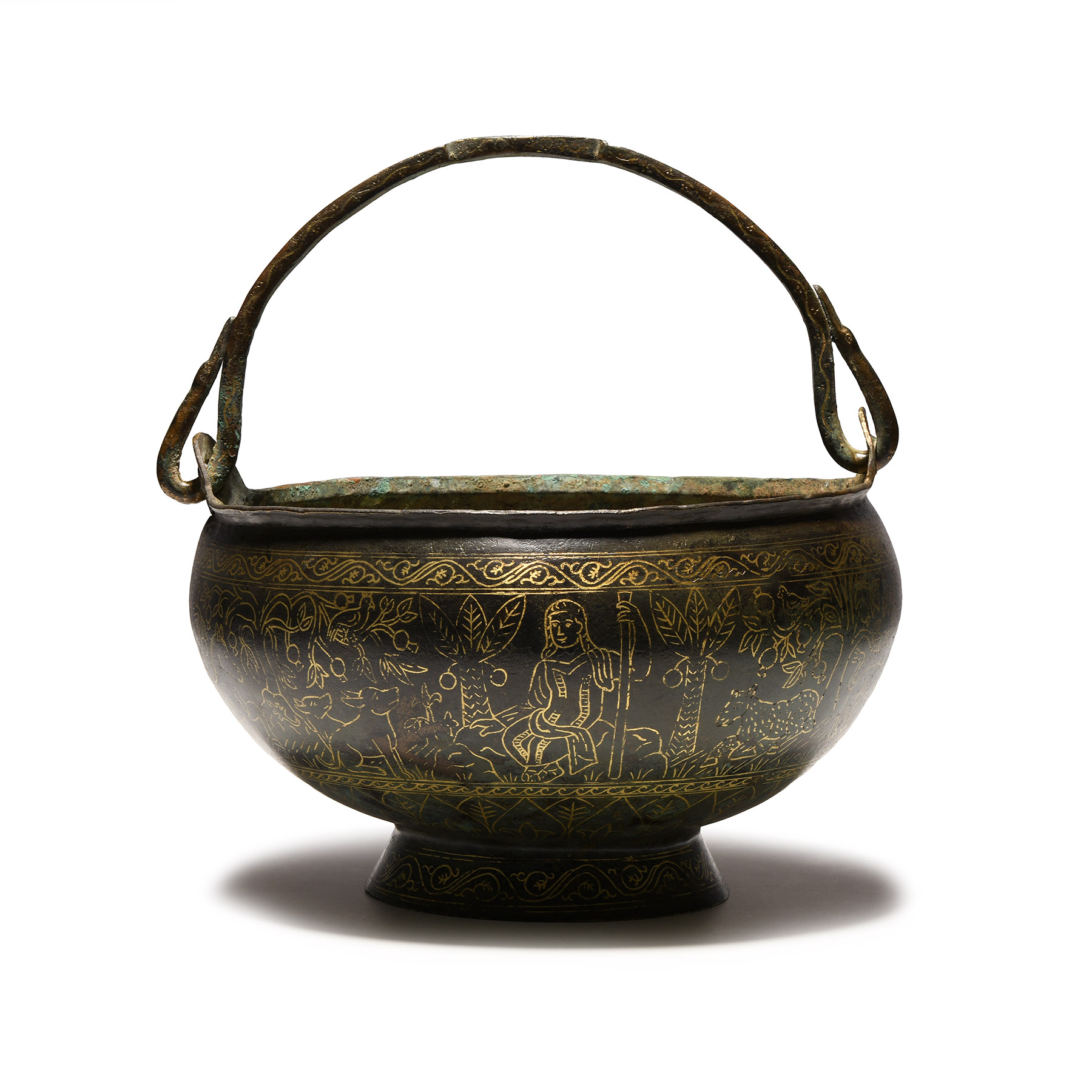
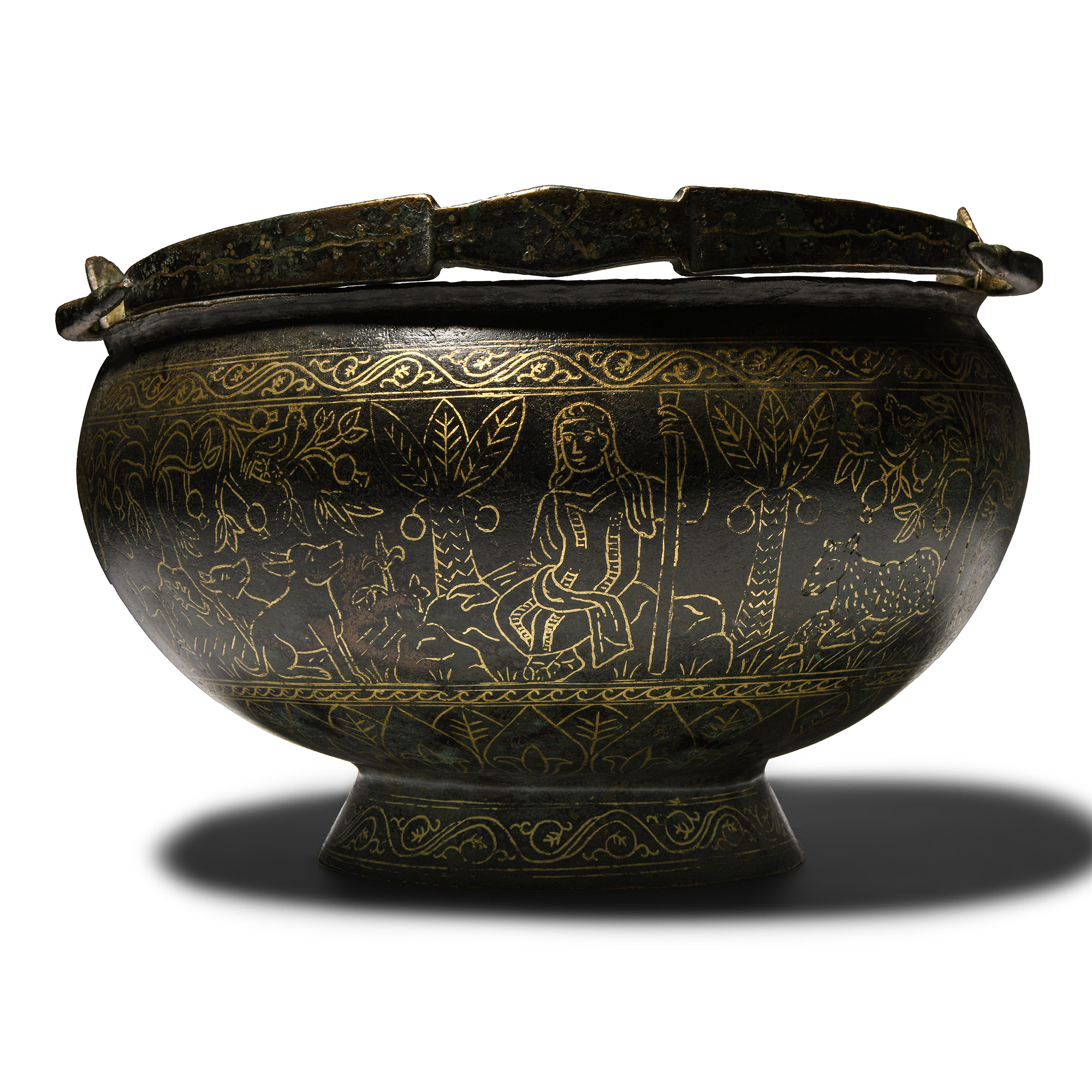
Of squat profile with flared base and drop handle; running tendril bands to the shoulder and base, gilt-inlaid frieze depicting the seated robed figure of Christ holding a staff between two palm trees in a landscape inhabited by a bear, leaping goat, frog, cockerel, hen, eagle, horse, hounds, sheep, lioness, snake, rabbit, duck, boar cow; trees in the background with birds perching on the branches; central roundel with Chi-Rho, alpha and omega; handle with vine tendrils flanked by pellet clusters, saltire to the centre.
ProvenanceFrom the family collection of Mr E.L. (1915-1991), who collected antiquities from the 1940s, thence by descent.
Ex J.L. collection, Surrey, UK.
This lot has been checked against the Interpol Database of stolen works of art and is accompanied by search certificate no.12059-213551.
Cf. comparable examples in the Vrap treasure in the Metropolitan Museum of Art, accession no. 17.190.1707; Aimone, M., The Wyvern collection, Byzantine and Sasanian Silver, Enamels and Works of Art, London, 2020, cat.no.28, pp.112-113.
FootnotesThe frieze is full of Christian symbolism, mainly concentrated on the image of the good shepherd (Christ) depicted according to the model visible in the Mausoleum of Galla Placidia in Ravenna and shown on the opposite side of the central roundel. Jesus is represented in a landscape suffused with peace, full of plants and flowers; he has a serene expression and is depicted beardless and surrounded by six sheep. Its clear allusive meaning is that only through Christ can eternal peace be achieved. Another part probably represents the Tree of Life with an array of animals. The vessel probably had a liturgical use, perhaps for the ritual washing of feet during the Easter celebrations or for the blessing of the faithful.
CONDITIONTimeLine Auctions follows a vetting process to ensure the authenticity and legality of all items, reinforcing our commitment to integrity and responsible trading. Each antiquity, antique, and coin lot undergoes thorough examination by a vetting committee of at least ten external specialists, professional trade association members, scientists, and archaeologists: Our Vetting Process
AUCTIONS:
TimeLine is a leading auction house specialising in antiquities, ancient art, collectables, natural history, coins, medals, and books. Our auctions offer museums, collectors, historians, and enthusiasts the opportunity to acquire unique and historically significant pieces.
LOT 0207
Byzantine Gilt Bronze Bowl with Religious Scenes
Estimate £10,000 - 14,000€11,600 - 16,240 (for guidance only)$13,500 - 18,900 (for guidance only)
-
Byzantine Belt Mount with Lion Combat Scene
Circa 6th-7th century A.D.Sold for (Inc. bp): £59
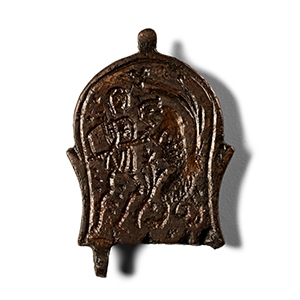
Belt buckle plate with loops, lateral spurs and knop finial; low-relief scene of a man grappling with a beast in a landscape with tree and flowers; mounting lugs to the reverse; old collector's envelop with handwritten text 'sceau / Carthage / combat Homme et Lion / [..] Jardin' (seal / Carthage / fight between man and lion / [..] garden). 18.5 grams, 47 mm
Found in Carthage. From a 19th century collection based on the handwritten package. From the collection of a London antiquarian. Accompanied by an old hand written collector's envelope. -
Byzantine 'Greek Fire' Ceramic Fire Bomb or Hand Grenade
10th-13th century A.D.Sold for (Inc. bp): £163
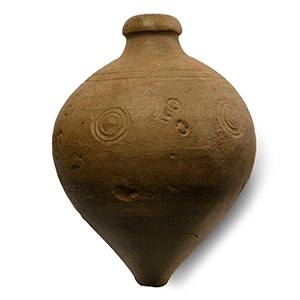
Piriform body decorated with concentric circles alternated to round patterns, with domed filler-hole, intended to be filled with explosive liquid and wick, used as a hand grenade. 545 grams, 12.5 cm
Acquired 1980-2015. Ex Abelita family collection. Accompanied by an academic paper by military specialist Dr Raffaele D'Amato, dated 15 July 2019 and titled 'Eastern Roman Empire - Greek Fire Bomb or Hand Grenade (μεσαίον kακάβιον) 9th-11th century AD'.
Apart from the use of siphons or manual flame-throwers called cheirosiphona, special corps of Roman soldiers employed terracotta grenades, in the form of small jars, abundantly evidenced in archaeological excavations. They were called μεσαία kακαβιά or κυτροκακάβια where the former had a bulbous shape and the latter a more cylindrical form. -
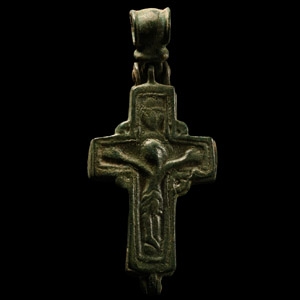
Byzantine Bronze Reliquary Cross Pendant
Circa 12th century A.D.Sold for (Inc. bp): £312
Two-piece enkolpion with hinged suspension loop, to each face a low-relief Corpus Christi with facing mask above. 29.7 grams, 62 mm
Acquired on the London art market in the late 1980s-1990s. From the family collection of an East London, UK, gentleman.
