
Loading, please wait...
LOT 0181
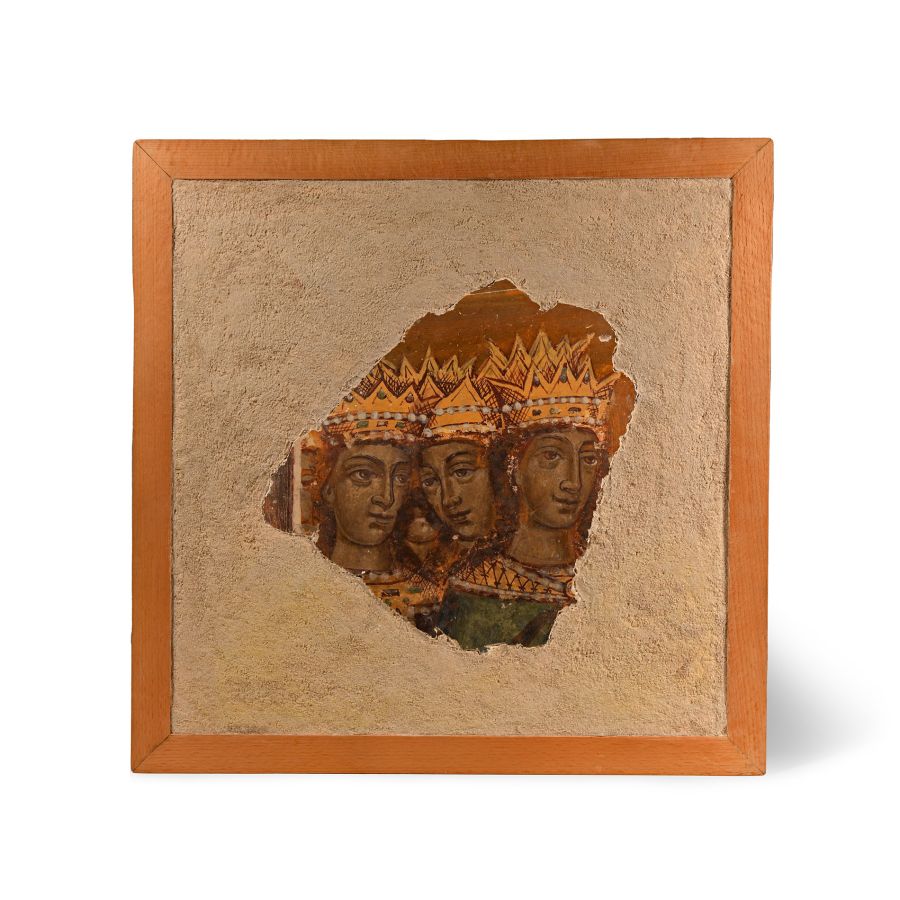
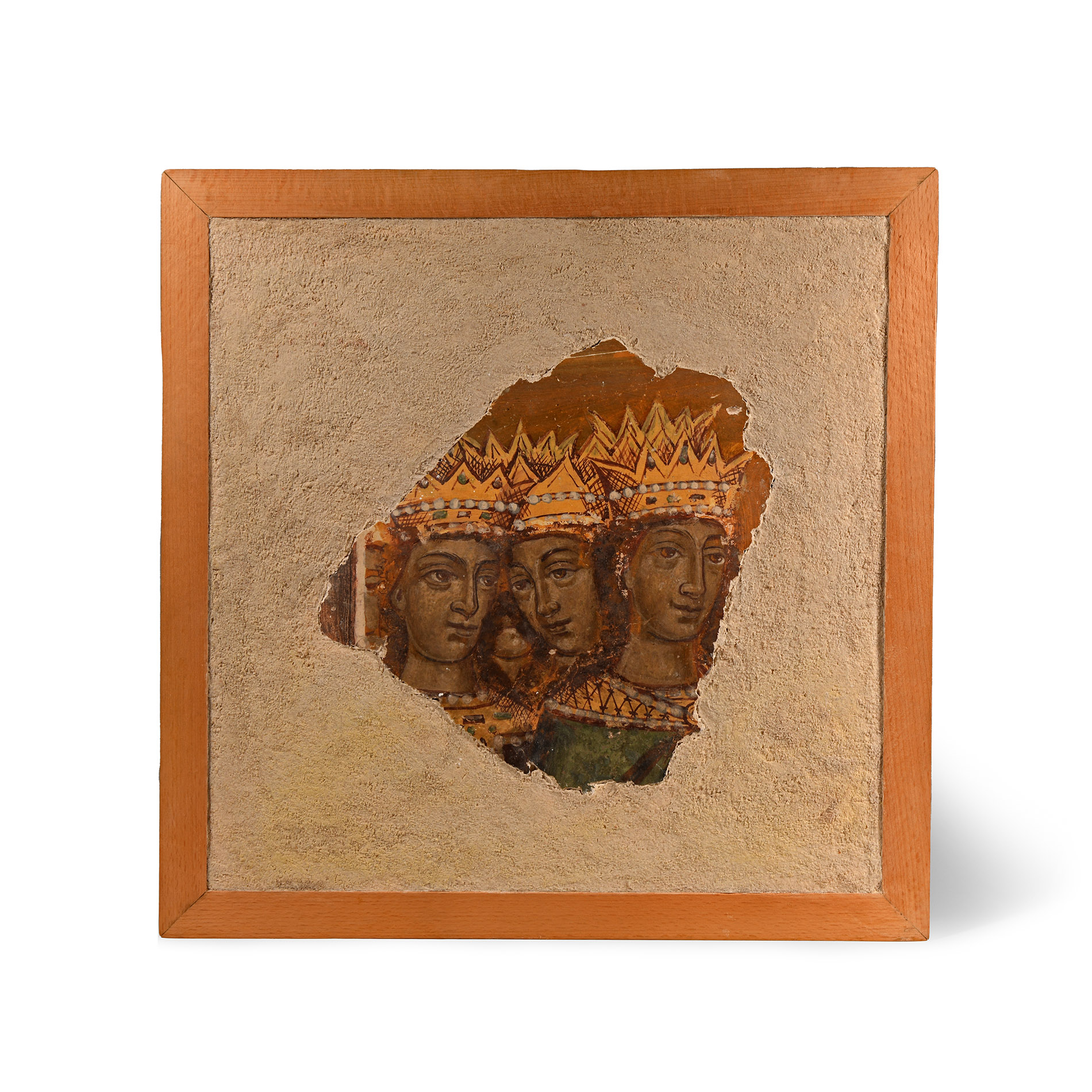
Byzantine Fresco Panel of Crowned Women
14TH CENTURY A.D.
15 3/4 x 15 3/4 in. (5.08 kg, 40 x 40 cm).
Fragment of a fresco panel depicting a group of young women wearing crowns, possibly depicting queens or wise virgins, three in the foreground with suggestion of others behind them; a vertical line to the left marking the border of the painting; two outer women's eyes turning towards a point high on the right, and the middle one lowering her eyes; wearing clothes richly decorated with precious stones and pearls, and crowns consisting of a band encrusted with gems and bordered with pearls, topped with points adorned with coloured stones in the style of Western European crowns.
ProvenanceAcquired in the early 1980s.
Ex old German private collection.
From the private collection of Mr S.A., before 1992.
Thence by descent.
Accompanied by a copy of an Art Loss Register certificate no.PHO00064.
Accompanied by an academic report by Dr Raffaele D'Amato.
This lot has been checked against the Interpol Database of stolen works of art and is accompanied by a search certificate number no.12115-218166.
This painting possibly comes from a representation of the Last Judgment including the representation of the crowned men and women mentioned in the Apocalypse (chapter IV, verse 4). The crowned women present the signs of adoration specific to this type of representation, their eyes turned or lowered as a sign of respect towards a point where Christ seated on a throne was painted in glory. Perhaps attributable to the Balkans in the 14th century, a region divided among the realms of Hungary, Venice, Greater Serbia and others. Another possibility is that the panel represents the five wise virgins of the parable of Matthew 25, who are crowned brides by Christ.
CONDITIONTimeLine Auctions follows a vetting process to ensure the authenticity and legality of all items, reinforcing our commitment to integrity and responsible trading. Each antiquity, antique, and coin lot undergoes thorough examination by a vetting committee of at least ten external specialists, professional trade association members, scientists, and archaeologists: Our Vetting Process
AUCTIONS:
TimeLine is a leading auction house specialising in antiquities, ancient art, collectables, natural history, coins, medals, and books. Our auctions offer museums, collectors, historians, and enthusiasts the opportunity to acquire unique and historically significant pieces.
LOT 0181
Byzantine Fresco Panel of Crowned Women
Estimate £30,000 - 40,000€34,800 - 46,400 (for guidance only)$40,500 - 54,000 (for guidance only)
-
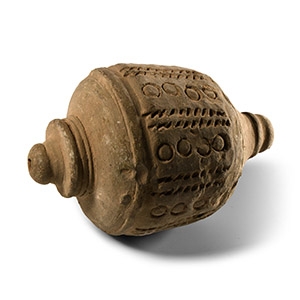
Turco-Mongol 'Greek Fire' Ceramic Fire Bomb or Hand Grenade
14th century A.D.Sold for (Inc. bp): £260
Piriform body with vertical bands of pellets and roundels, knop finial, tiered and domed filler-hole, intended to be filled with explosive liquid and wick, used as a hand grenade. 755 grams, 15 cm
From a specialist collection of militaria, London, UK, collected 1990s onwards.
Apart from the use of siphons or manual flame-throwers called cheirosiphona, special corps of Roman soldiers employed terracotta grenades, in the form of small jars, abundantly evidenced in archaeological excavations. They were called μεσαία kακαβιά or κυτροκακάβια where the former had a bulbous shape and the latter a more cylindrical form. -
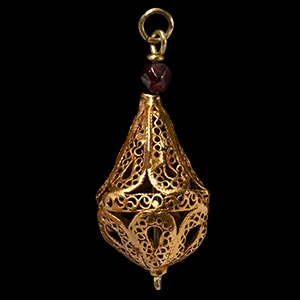
Byzantine Gold Openwork Pendant
12th-14th century A.D. or earlierSold for (Inc. bp): £546
Composed of two opposing flowers forming a teardrop-shape, the panels with intricate loop design; facetted garnet bead above and a separately made suspension bar, possibly a later addition. 3.78 grams, 40 mm
Ex property of a late Japanese collector, 1970-2000s. -
.jpg)
Byzantine Bronze Horse Harness Boss Pendant
15th century A.D.Sold for (Inc. bp): £33
Large domed centre with low-relief sun wheel design, pellets to the rim and suspension loop above. 28.6 grams, 75 mm
From the collection of a North American gentleman, formed in the 1990s.
In the late Byzantium period, round-shaped buckles and horse harness mounts were often decorated with beaded edges and with floral embossed ornaments, under the influence of the Ottoman Turks. They have the shape of a small shield and impressed decoration of a rose. Belt appliques have an extra boss for attachment, instead of a loop which is usually attached to the horse harness pendants.
