
Loading, please wait...
LOT 0168
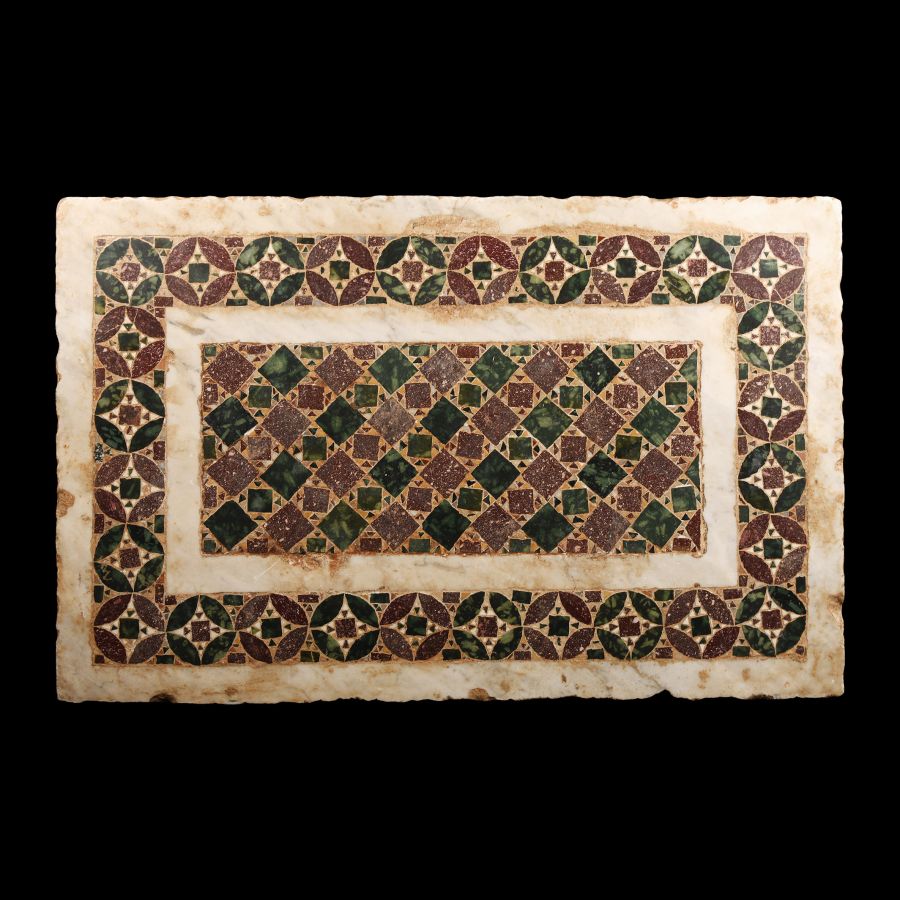
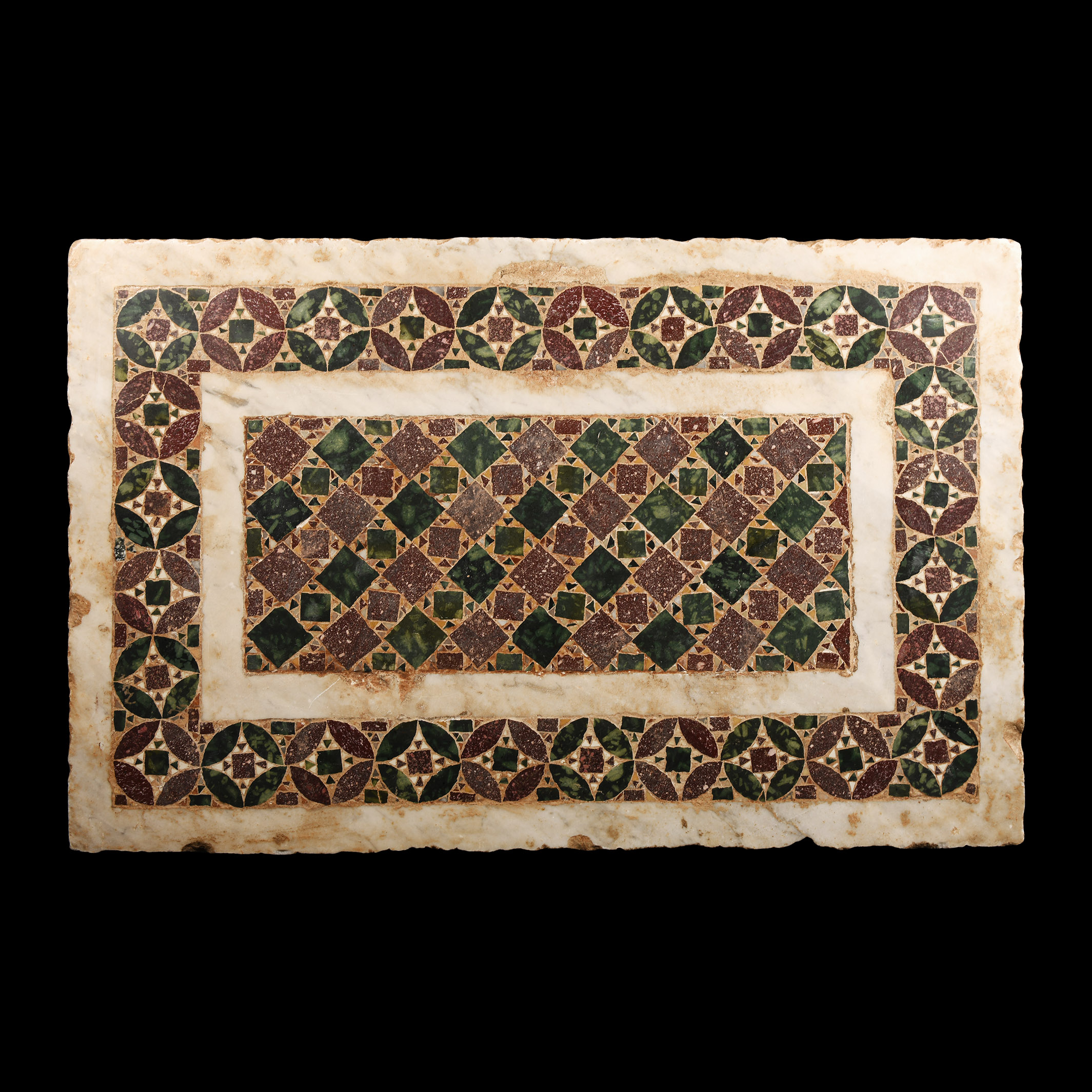
Byzantine Cosmatesque Marble Mosaic Panel
12TH-13TH CENTURY A.D.
21 3/4 in. (23.5 kg, 53.5 cm).
Recalling workmanship similar to that found in the floor of the Sistine Chapel, comprising a large central panel with a design of alternating green and speckled porphyry lozenges, with interstitial green and porphyry squares flanked by a green or porphyry triangle on each edge; border of plain marble and outer band of green and porphyry roundels made up from vesica-shaped panels with inset squares and triangles.
ProvenanceFrench gallery, Paris, 1990s.
From a family collection.
Accompanied by an academic report by Dr Raffaele D'Amato.
This lot has been checked against the Interpol Database of stolen works of art and is accompanied by search certificate number no.203555.
See Boito, C., Architettura Cosmatesca, Torino, 1860; Hutton, E., The Cosmati, The Roman Marble Workers of the XIIth and XIIIth Centuries, London, 1950; Tosca, P., Storia dell’Arte Italiana, il medioevo, vol. III, Torino, 1965; Matthiae, G., 'Componenti del gusto decorativo cosmatesco,' in Rivista dell'Istituto Nazionale di Archeologia e Storia dell'Arte, vol. I, 1952, pp.249-281; Cigola, M., 'Mosaici pavimentali cosmateschi. Segni, disegni e simboli,' in Palladio, Nuova serie, anno VI n. 11, giugno 1993, pp.101-110; Grant, L. & Mortimer, R. (eds.) Westminster Abbey. The Cosmati Pavements Courtauld Research Papers no.3, 2002.
FootnotesThe Cosmatesque style was a characteristic type of ornamentation of Eastern Roman origin (opus alexandrinum) used by post-Roman marble makers of the 12th and 13th centuries A.D. It embellishes the floors, ciboria and cloisters of churches by means of polychrome marble inlays of varied and imaginative geometric shapes. The wider use of this decoration began in the 12th century, at which time techniques were improved: the Cosmati floors were made with pieces of stone cut in various shapes and sizes, a property quite different from the mosaics in opus tessellatum, in which the motifs were made from small units all having the same size and shape, or from the opus sectile, intended to create representations with pieces of multi-coloured marble cut out and arranged for this purpose. The stones used by Cosmati artists were often material salvaged from the ruins of ancient Roman buildings. The composition of such mosaics recalls the floors of the most important churches of Rome; in addition to the floor of the Sistine Chapel (created probably in the 14th century for the previous building or Cappella Maggiore), one can cite that of Santa Maria Maggiore (1145-1153 A.D.), San Giovanni in Laterano (14th century A.D.), Saint Clement (1099-1120 A.D.), Santi Quattro Coronati (13th century A.D.), Santa Croce in Gerusalemme (12th century A.D.) and many others.
The same technique (but differing in its design, materials and motifs) was used to create the Cosmati pavement in Westminster Abbey, where the king rests during the coronation ceremony. The pavement has undergone a major cleaning and conservation programme and was re-dedicated by the Dean at a service on 21st May 2010.
TimeLine Auctions follows a vetting process to ensure the authenticity and legality of all items, reinforcing our commitment to integrity and responsible trading. Each antiquity, antique, and coin lot undergoes thorough examination by a vetting committee of at least ten external specialists, professional trade association members, scientists, and archaeologists: Our Vetting Process
AUCTIONS:
TimeLine is a leading auction house specialising in antiquities, ancient art, collectables, natural history, coins, medals, and books. Our auctions offer museums, collectors, historians, and enthusiasts the opportunity to acquire unique and historically significant pieces.
-
Byzantine Period Bronze Weight Collection
8th-12th century A.D.Sold for (Inc. bp): £20
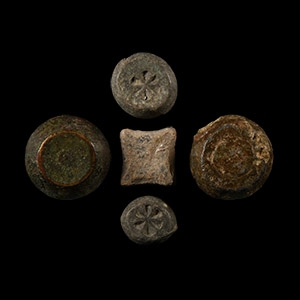
Composed of weights of different types and sizes, including examples stamped with rosette motifs. 179 grams total, 16-24 mm
From the collection of H.N., Milton Keynes, 1980s-1990s. -
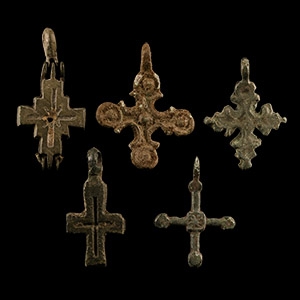
Byzantine Bronze Cross Collection
10th-15th century A.D.Sold for (Inc. bp): £156
Including one miniature enkolpion with articulated suspension loop, four of various types with integral loop. 17.2 grams total, 29-37 mm
English collection, early 2000s. Ex central London gallery. -
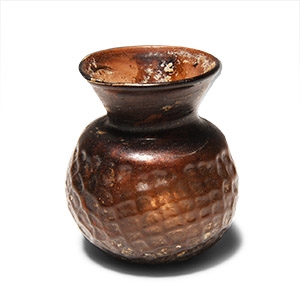
Byzantine Mould-Blown Aubergine Glass Jar
5th-8th century A.D.Estimate: £600 - 800 (+bp*)
Opening Bid: £333
Or flask with bulbous body featuring a 'net' design and trumpet-style neck and rim; shallow kick-up to base; iridescent surfaces. 58 grams, 69 mm high
Fine condition.
Acquired 1969-1999. London collection of the late Mr S.M., thence by descent.
