
Loading, please wait...
_900x900.jpg "Byzantine Bronze Lamp with Stand")
_200x200.jpg "Byzantine Bronze Lamp with Stand")
.jpg "Byzantine Bronze Lamp with Stand")
LOT 0196
Byzantine Bronze Lamp with Stand
5TH-7TH CENTURY A.D.
4 7/8 - 7 5/8 in. (870 grams total, 12.5-19.5 cm).
Comprising a squat nozzle with recessed disc finial, hinged lid shaped as a hare looking over its tail, basal disc with square hole to accept a stand, curled arms at the rear forming the handle with thumb-pad formed as a perching bird (one partly absent); separate stand with tripod legs and spike finial.
ProvenanceUK private collection before 2000.
Acquired on the UK art market.
Private collection, London.
This lot has been checked against the Interpol Database of stolen works of art and is accompanied by a search certificate number no.12688-236229.
This lot has been cleared against the Art Loss Register database, and is accompanied by an illustrated lot declaration signed by the Head of the Antiquities Department, Dr Raffaele D'Amato.
TimeLine Auctions follows a vetting process to ensure the authenticity and legality of all items, reinforcing our commitment to integrity and responsible trading. Each antiquity, antique, and coin lot undergoes thorough examination by a vetting committee of at least ten external specialists, professional trade association members, scientists, and archaeologists: Our Vetting Process
AUCTIONS:
TimeLine is a leading auction house specialising in antiquities, ancient art, collectables, natural history, coins, medals, and books. Our auctions offer museums, collectors, historians, and enthusiasts the opportunity to acquire unique and historically significant pieces.
LOT 0196
Byzantine Bronze Lamp with Stand
Estimate £1,800 - 2,400€2,090 - 2,780 (for guidance only)$2,430 - 3,240 (for guidance only)
-
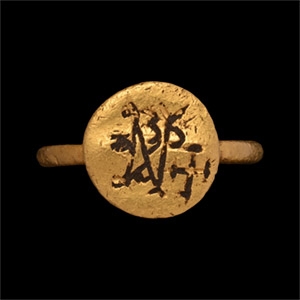
Byzantine Gold Ring with Monogram
6th-7th century A.D.Sold for (Inc. bp): £1,300
Round-section hoop supporting a disc bezel with engraved monogram incorporating a cross potent and the letters N, O, P, E, Z and others. 3.29 grams, 17.57 mm overall, 15.91 mm internal diameter (approximate size British I 1/2, USA 4 1/2, Europe 8.07, Japan 7)
From an early 20th century collection based on the collector's ticket. Property of a Californian, USA, collector. This lot is accompanied by an illustrated lot declaration signed by the Head of the Antiquities Department, Dr Raffaele D'Amato. -
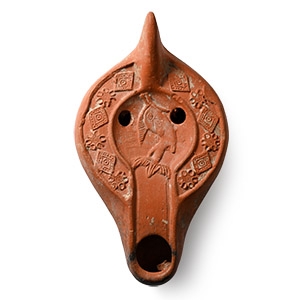
Byzantine Terracotta Oil Lamp with Dolphin
5th-7th century A.D.Sold for (Inc. bp): £468
Central figure of a stylised dolphin in low-relief with two filling holes on each side, horseshoe-shaped decorative band of flowers and lozenges on the rim; low basal ring and rounded nozzle. 175 grams, 14.3 cm
Private collection, Switzerland. Acquired by Galerie Rhéa, Zurich, from the above in 2011. This lot is accompanied by an illustrated lot declaration signed by the Head of the Antiquities Department, Dr Raffaele D'Amato. -
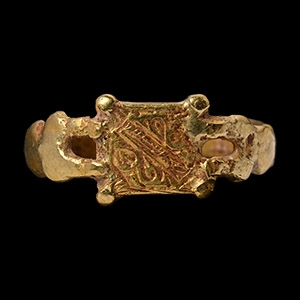
Byzantine Gold Ring with Foliate Motifs
Circa 11th-12th century A.D.Estimate: £700 - 900 (+bp*)
Opening Bid: £389
Comprising a flat-section hoop with a starburst motif to the base; openwork shoulders and a square bezel with a pellet to each corner, the bezel engraved with foliate motifs. 3.65 grams, 19.99 mm overall, 18.00 mm internal diameter (approximate size British L, USA 5 3/4, Europe 11.24, Japan 10)
Acquired from London galleries during the 1990s. From the jewellery collection of a London, UK, gentleman. Accompanied by a previous typed cataloguing card. This lot is accompanied by an illustrated lot declaration signed by the Head of the Antiquities Department, Dr Raffaele D’Amato. This lot is accompanied by an illustrated lot declaration signed by the Head of the Antiquities Department, Dr Raffaele D'Amato.
Some rings from the Balkan territories of the Eastern Empire (for example the ring from Dobrača) bear a square thickened bezel engraved with schematic representations. What sets them apart are the widened shoulders emphasised by a plastic rib and the raised and flattened head, which places them in the group of rings which dates mainly to the 11th century (from the end of the 10th to the first decades of the 12th century).
