
Loading, please wait...
LOT 0963
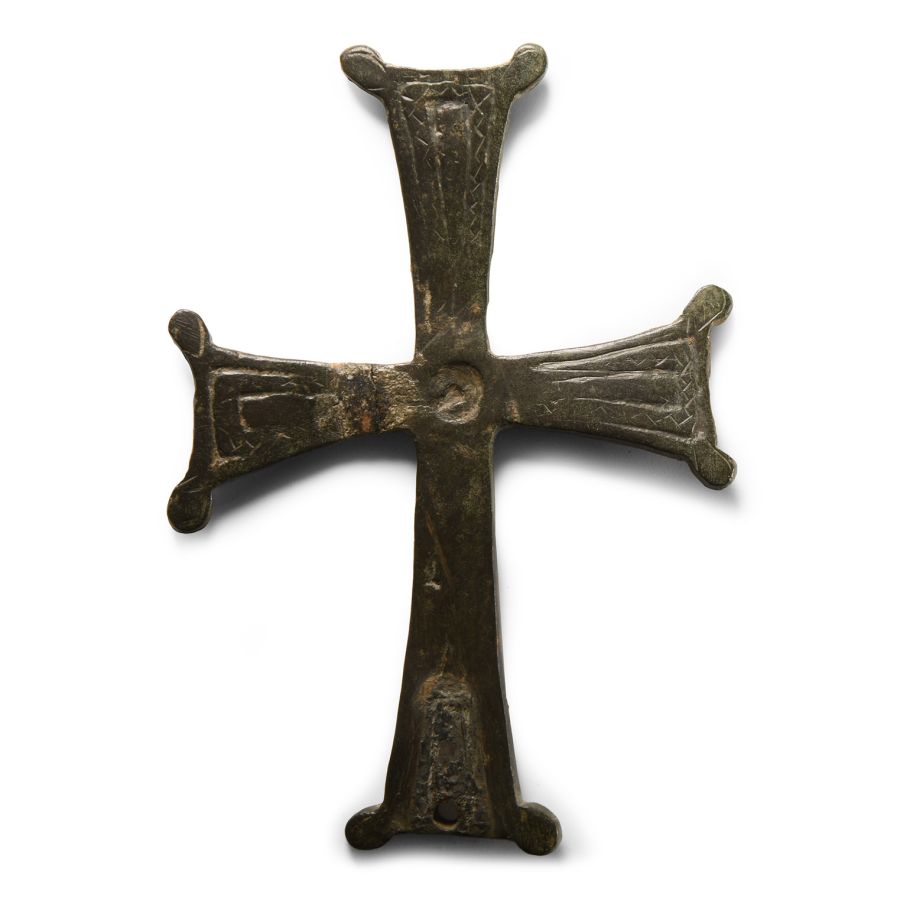
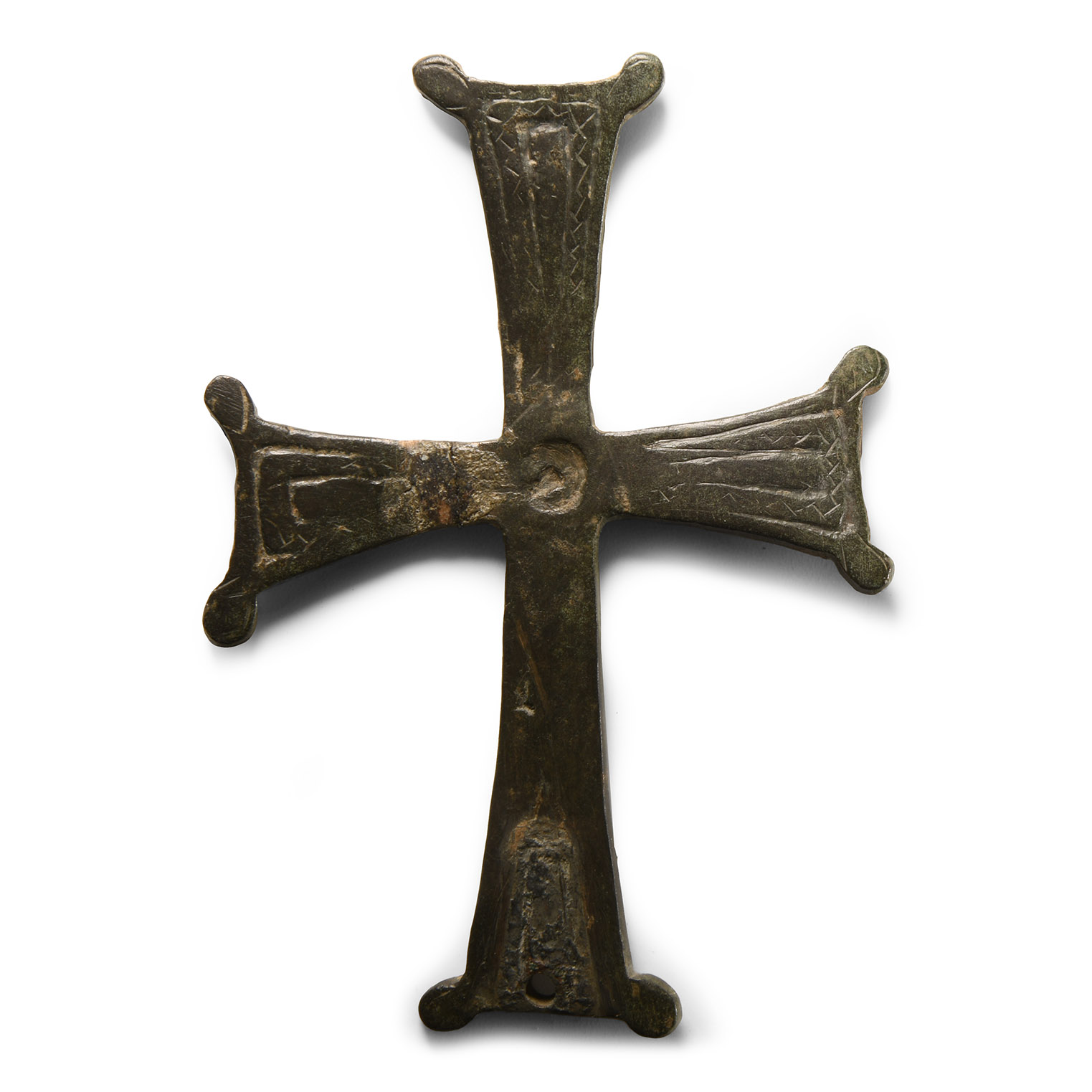
Byzantine Bronze Expanding-Arm Cross Mount
6TH-7TH CENTURY A.D.
3 7/8 in. (56.4 grams, 98 mm).
Finial from a processional or altar cross, with incised guilloche bands to the obverse and central socket for a cabochon, lobes to the angles; pierced lower arm with attachment scars to both faces. [No Reserve]
ProvenanceBelgium collection, 1980s.
From the collection of an London antiquarian.
Cf. Wamser, L., Die Welt von Byzanz - Europas Östliches Erbe, München, 2004, item 543, for type.
FootnotesThese kind of crosses were mainly used for religious purposes. However, in 6th and 7th centuries A.D., they could be fixed at the top of the standards of the Roman Christian Army, as clearly described from the Arab sources speaking about the battle of Yarmouk. For this battle the Arab sources give a detailed description of the Roman standards, with at the top a golden cross, a golden cross tied to a silver chain, a cross with glittering jewels, a golden cross encrusted with jewels. The cross at the top of the standards, also of small dimensions like this one, is visible on miniature statuette of Roman Cavalrymen/Military Saints from Roman Egypt.
CONDITIONTimeLine Auctions follows a vetting process to ensure the authenticity and legality of all items, reinforcing our commitment to integrity and responsible trading. Each antiquity, antique, and coin lot undergoes thorough examination by a vetting committee of at least ten external specialists, professional trade association members, scientists, and archaeologists: Our Vetting Process
AUCTIONS:
TimeLine is a leading auction house specialising in antiquities, ancient art, collectables, natural history, coins, medals, and books. Our auctions offer museums, collectors, historians, and enthusiasts the opportunity to acquire unique and historically significant pieces.
-
.jpg)
Byzantine Gold Ring with Holy Rider
6th-7th century A.D.Sold for (Inc. bp): £5,980
Comprising a round-section hoop with tablet-bezel depicting a military saint on horseback (probably Saint George) advancing right, the nimbate saint holding a large cross in his right hand. 4.00 grams, 21.79 mm overall, 18.33 mm internal diameter (approximate size British O 1/2, USA 7 1/4, Europe 15.61, Japan 15)
Ex Axia Art, London, UK. Property of a North American gallery. Accompanied by a positive scientific statement from Striptwist Limited, a London-based company run by historical precious metal specialist Dr Jack Ogden, reference number 170705. This lot has been checked against the Interpol Database of stolen works of art and is accompanied by search certificate no.12117-214328.
This type of ring belongs to a typical category of the period in question, made with high-quality materials, and decorated with images of saints to invoke their protection. The presence of Saint George on this ring could refer to an owner of high military rank. -
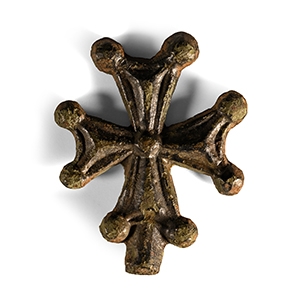
Byzantine Bronze Expanding-Arm Cross
6th-7th century A.D.Sold for (Inc. bp): £85
Each arm with raised Y-shaped median panels and two bulb finials; shank below broken. 20.2 grams, 51 mm
Belgium collection, 1980s. From the collection of an London antiquarian. -
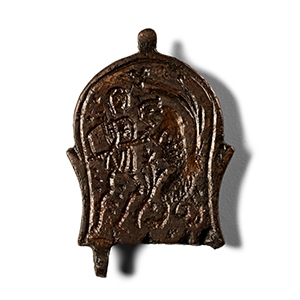
Byzantine Belt Mount with Lion Combat Scene
Circa 6th-7th century A.D.Sold for (Inc. bp): £59
Belt buckle plate with loops, lateral spurs and knop finial; low-relief scene of a man grappling with a beast in a landscape with tree and flowers; mounting lugs to the reverse; old collector's envelop with handwritten text 'sceau / Carthage / combat Homme et Lion / [..] Jardin' (seal / Carthage / fight between man and lion / [..] garden). 18.5 grams, 47 mm
Found in Carthage. From a 19th century collection based on the handwritten package. From the collection of a London antiquarian. Accompanied by an old hand written collector's envelope.
