
Loading, please wait...
_900x900.jpg "Byzantine Bronze Cross Pendant")
_200x200.jpg "Byzantine Bronze Cross Pendant")
.jpg "Byzantine Bronze Cross Pendant")
LOT 0949
Byzantine Bronze Cross Pendant
6TH-7TH CENTURY A.D.
1 1/2 in. (2.58 grams, 38 mm).
With remains of notch detailing to the outer edges of the arms, two links of the suspension chain. [No Reserve]
ProvenanceEx DRG Coins and Antiquities, Essex, UK.
Ex private Merseyside, UK, collection.
Cf. Wamser, L., Die Welt von Byzanz - Europas Östliches Erbe, München, 2004, item 555, for type.
FootnotesThe example of a bronze cross corresponds, in shape and style, to a typology also known in organic material, specifically in wood. Dating this typology is difficult, as it is not easy to identify its place of origin or the context with which these crosses were associated.
CONDITIONTimeLine Auctions follows a vetting process to ensure the authenticity and legality of all items, reinforcing our commitment to integrity and responsible trading. Each antiquity, antique, and coin lot undergoes thorough examination by a vetting committee of at least ten external specialists, professional trade association members, scientists, and archaeologists: Our Vetting Process
AUCTIONS:
TimeLine is a leading auction house specialising in antiquities, ancient art, collectables, natural history, coins, medals, and books. Our auctions offer museums, collectors, historians, and enthusiasts the opportunity to acquire unique and historically significant pieces.
-
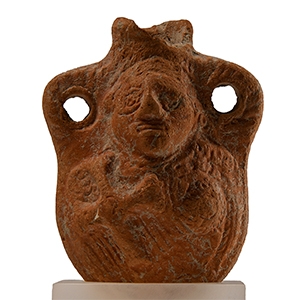
Byzantine Terracotta Pilgrim Flask with a Saint
6th century A.D.Estimate: £1,800 - 2,400 (‡+bp*)
Opening Bid: £750
Piriform in profile with two thick lug handles to the shoulder, obverse with low-relief facing figure holding a large cross and orb, reverse with facing figure with hand held up in the orans posture; with a display stand. 47.2 grams, 77 mm (71.4 grams total, 91 mm including stand)
Ex private collection, Mrs L.S., 1990s. Acquired from the above, 2001. Private European collection. This lot has been checked against the Interpol Database of stolen works of art and is accompanied by a search certificate number no.12110-218216. -
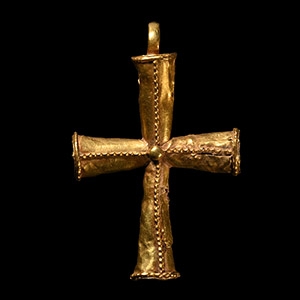
Byzantine Gold Cross Pendant
5th-6th century A.D.Estimate: £1,800 - 2,400 (‡+bp*)
Opening Bid: £1,000
Hollow-formed sheet gold cruciform pendant with filigree ropework to the end of each expanding tubular arm, band of beading to the upper face of each arm and central pellet; bale to the upper end. 3.67 grams, 40 mm
Acquired in the mid 1980s-1990s. From the family collection of Mr S.A., Switzerland, thence by descent. Private collection since the late 1990s. This lot has been checked against the Interpol Database of stolen works of art and is accompanied by a search certificate number no.12114-218167. -
.jpg)
Byzantine Silver-Gilt Ring with Saint
Circa 6th-8th century A.D.Estimate: £400 - 600 (+bp*)
Opening Bid: £200
With round-section hoop and integral discoid plaque, tondo with intaglio of a robed nimbate figure with one arm raised facing a similar figure, all between fronds. 3.13 grams, 24.45 mm overall, 20.03 mm internal diameter (approximate size British T, USA 9 1/2, Europe 21.26, Japan 20)
Ex M.N. London collection, 2000s.
