
Loading, please wait...
LOT 0973
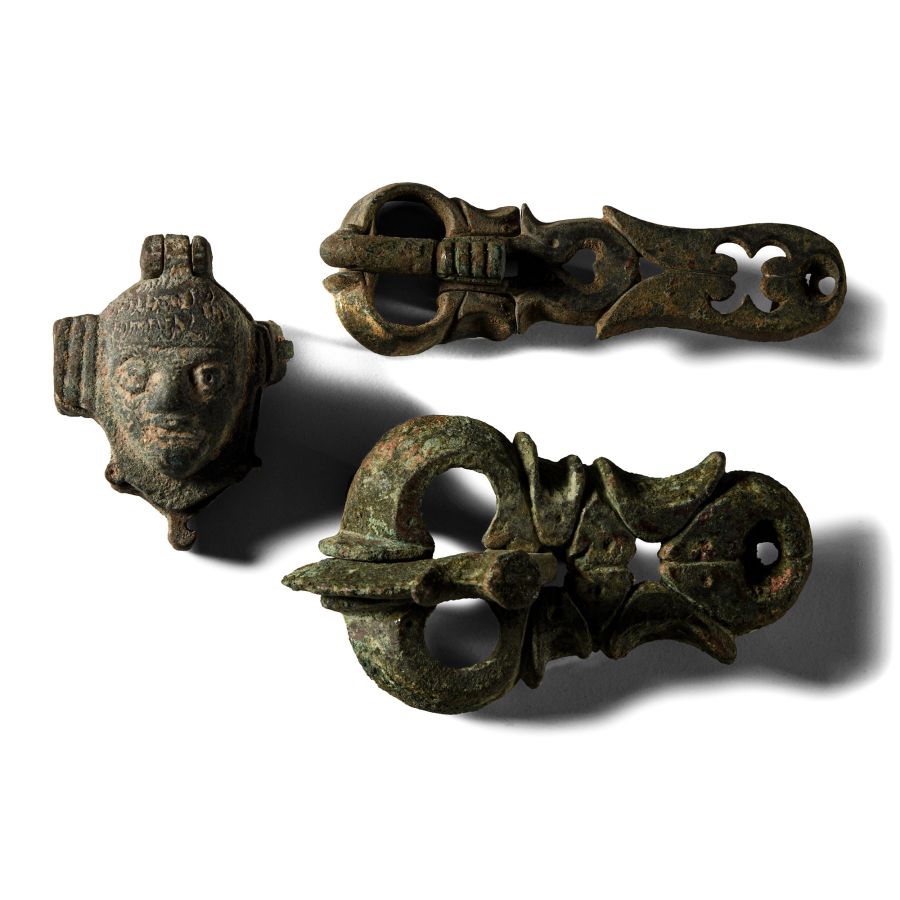
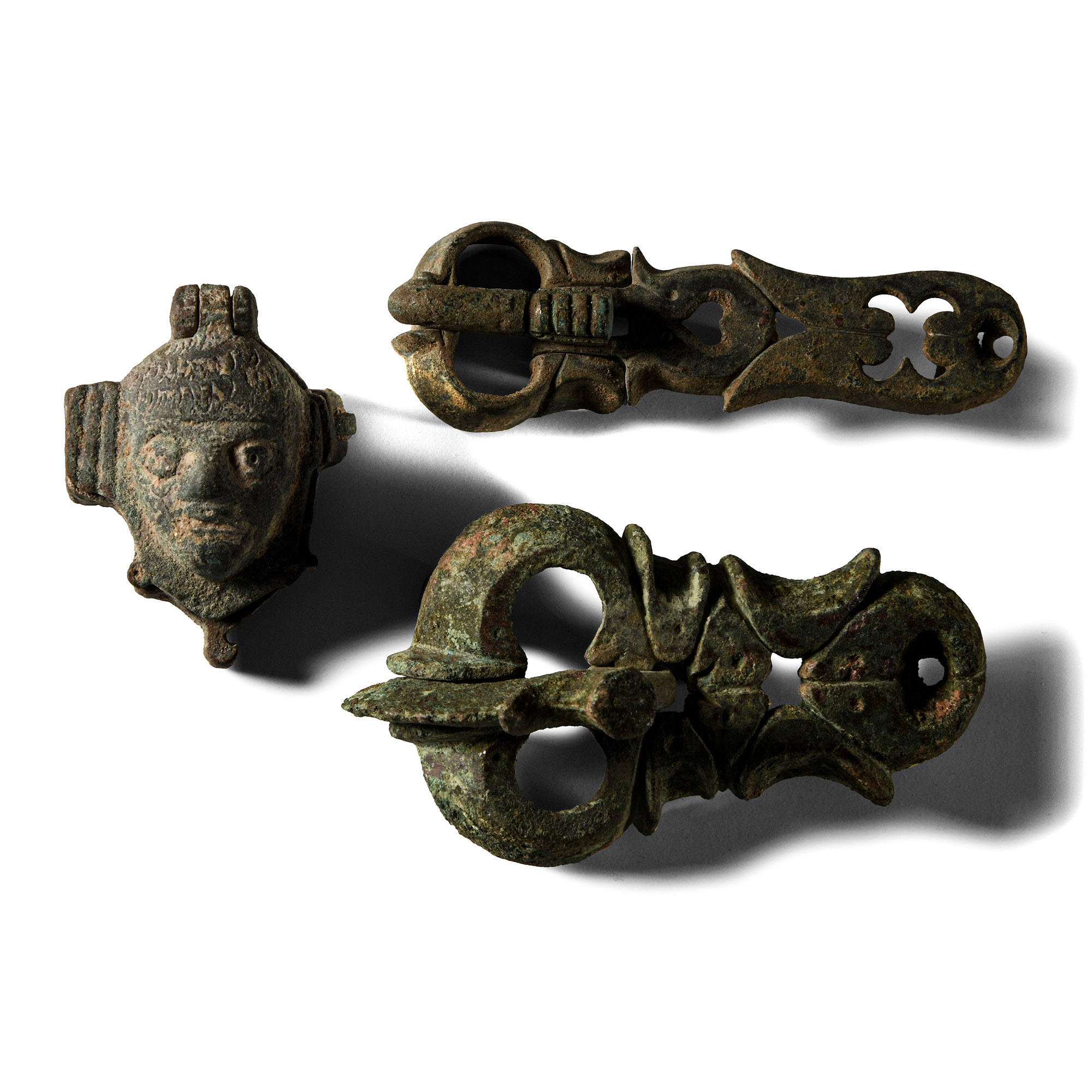
Byzantine Bronze Artefact Group
6TH-7TH CENTURY A.D.
1 1/2 - 2 5/8 in. (107 grams total, 39-68 mm).
Comprising: a large bronze buckle with thick round-section loop, ribbed tongue with acanthus-leaf design in-high relief, two pierced lugs to the reverse; a smaller buckle with long plate decorated with openwork geometric forms; a small seal box shaped as a youthful head with details on hair and face, open catch at the top. [3]
ProvenanceAcquired in Europe in 1992.
European private collection.
Cf. Baldini Lippolis, I., L'Oreficeria nell'Impero di Costantinopoli tra IV e VII secolo (the Jewellery in the Empire of Constantinople between IV and VII century, in Italian), Bari, 1999, pp.229ff, for the type of buckle.
FootnotesThis type of belt elements, although present in the Avar graves of the second half of the 7th century, were most likely produced in the workshops of the Eastern Roman Empire, from where they reached the Avar lands as imperial gifts or spoils of war. They could be simple fastenings for belts, or part of multiple belts, to which sabres and knives were attached, commonly used among Avars, Bulgars and Romans during the 6th -7th centuries A.D.
CONDITIONTimeLine Auctions follows a vetting process to ensure the authenticity and legality of all items, reinforcing our commitment to integrity and responsible trading. Each antiquity, antique, and coin lot undergoes thorough examination by a vetting committee of at least ten external specialists, professional trade association members, scientists, and archaeologists: Our Vetting Process
AUCTIONS:
TimeLine is a leading auction house specialising in antiquities, ancient art, collectables, natural history, coins, medals, and books. Our auctions offer museums, collectors, historians, and enthusiasts the opportunity to acquire unique and historically significant pieces.
-
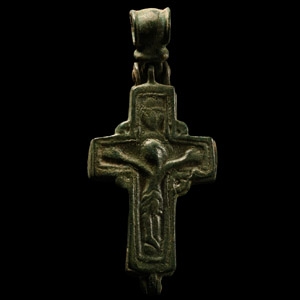
Byzantine Bronze Reliquary Cross Pendant
Circa 12th century A.D.Sold for (Inc. bp): £312
Two-piece enkolpion with hinged suspension loop, to each face a low-relief Corpus Christi with facing mask above. 29.7 grams, 62 mm
Acquired on the London art market in the late 1980s-1990s. From the family collection of an East London, UK, gentleman. -
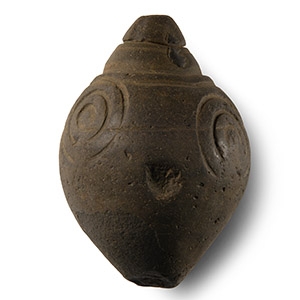
Byzantine 'Greek Fire' Ceramic Fire Bomb or Hand Grenade
10th-13th century A.D.Sold for (Inc. bp): £156
Piriform body decorated with concentric circles, with sphero-conical filler-hole, intended to be filled with explosive liquid and wick, used as a hand grenade. 660 grams, 12.8 cm
Acquired 1980-2015. Ex Abelita family collection. Accompanied by an academic paper by military specialist Dr Raffaele D'Amato, dated 15 July 2019 and titled 'Eastern Roman Empire - Greek Fire Bomb or Hand Grenade (μεσαίον kακάβιον) 9th-11th century AD'.
Apart from the use of siphons or manual flame-throwers called cheirosiphona, special corps of Roman soldiers employed terracotta grenades, in the form of small jars, abundantly evidenced in archaeological excavations. They were called μεσαία kακαβιά or κυτροκακάβια where the former had a bulbous shape and the latter a more cylindrical form. -
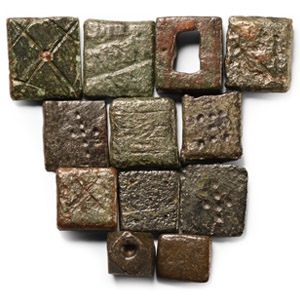
Byzantine Bronze Trade Weight Collection
Circa 6th-12th century A.D.Sold for (Inc. bp): £65
Mixed group of square trade weights with punched and incised detailing. 36.4 grams total, 7-14 mm
Acquired since the 1970s. From the private collection of a Surrey, UK, gentleman.
