
Loading, please wait...
_900x900.jpg "Byzantine Bronze Archer's Thumb Ring Group")
_200x200.jpg "Byzantine Bronze Archer's Thumb Ring Group")
.jpg "Byzantine Bronze Archer's Thumb Ring Group")
LOT 1433
Byzantine Bronze Archer's Thumb Ring Group
10TH-15TH CENTURY A.D.
1 1/8 - 1 1/4 in. (17.4 grams total, 28-30 mm).
Comprising three variously sized rings, one with floral decoration. [3]
ProvenanceEx German art market, 2000s.
Acquired from an EU collector living in London.
From the collection of a Surrey, UK, gentleman.
TimeLine Auctions follows a vetting process to ensure the authenticity and legality of all items, reinforcing our commitment to integrity and responsible trading. Each antiquity, antique, and coin lot undergoes thorough examination by a vetting committee of at least ten external specialists, professional trade association members, scientists, and archaeologists: Our Vetting Process
AUCTIONS:
TimeLine is a leading auction house specialising in antiquities, ancient art, collectables, natural history, coins, medals, and books. Our auctions offer museums, collectors, historians, and enthusiasts the opportunity to acquire unique and historically significant pieces.
-
.jpg)
Byzantine Bronze Archer's Thumb Ring Group
10th-15th century A.D.Sold for (Inc. bp): £117
Comprising three variously sized rings, one with floral decoration. 17.4 grams total, 28-30 mm
Ex German art market, 2000s. Acquired from an EU collector living in London. From the collection of a Surrey, UK, gentleman. -
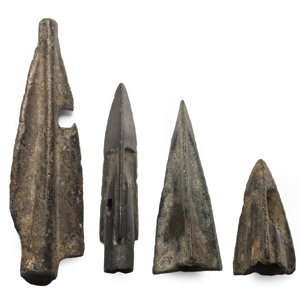
Greek Bronze Arrowhead Group
5th-3rd century B.C.Sold for (Inc. bp): £33
Triangular-section, barbed-and-socketted, and other types. 8.93 grams total, 16-38 mm
From a private Tyneside collection, formed since the early 2000s. -
.jpg)
Greek Lead Slingshot
3rd-1st century B.C.Sold for (Inc. bp): £195
Biconical in profile with casting seam and reserved legend 'ΑΛ[EXANΔΡΟ]Υ.', the club of Herakles on the other side. 29.4 grams, 30 mm
Acquired on the German art market before 2000. Private collection, Munich, Germany.
The presence of the club of Hercules connects the slingshot with ruling dynasty of Macedonia. Similar slingshots were found in Miletos.
