
Loading, please wait...
_900x900.jpg "Byzantine Bead Bracelet with Cross")
_200x200.jpg "Byzantine Bead Bracelet with Cross")
.jpg "Byzantine Bead Bracelet with Cross")
LOT 0948
Byzantine Bead Bracelet with Cross
15TH CENTURY A.D. OR EARLIER
7 1/8 in. (4.28 grams, 18 cm long).
Restrung; composed of annular and biconvex carnelian beads, together with a bronze Christian cross with the Five Wounds of Christ represented as ring-and-dot ornament. [No Reserve]
ProvenanceAcquired 1980-2015.
Ex Abelita family collection.
TimeLine Auctions follows a vetting process to ensure the authenticity and legality of all items, reinforcing our commitment to integrity and responsible trading. Each antiquity, antique, and coin lot undergoes thorough examination by a vetting committee of at least ten external specialists, professional trade association members, scientists, and archaeologists: Our Vetting Process
AUCTIONS:
TimeLine is a leading auction house specialising in antiquities, ancient art, collectables, natural history, coins, medals, and books. Our auctions offer museums, collectors, historians, and enthusiasts the opportunity to acquire unique and historically significant pieces.
-
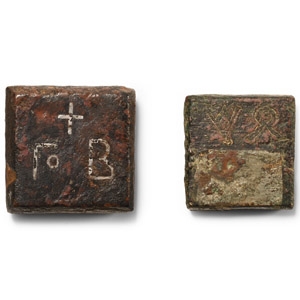
Byzantine Silver Inlaid Bronze Trade Weight Group
6th century A.D.Sold for (Inc. bp): £72
One with silver-inlaid '+ / Γο B' and the other with incised 'Αω'. 78 grams total, 24-27 mm
Acquired on the European art market. Property of a European gentleman. -
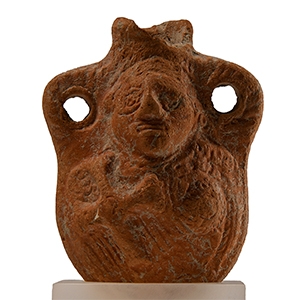
Byzantine Terracotta Pilgrim Flask with a Saint
6th century A.D.Estimate: £1,800 - 2,400 (‡+bp*)
Opening Bid: £750
Piriform in profile with two thick lug handles to the shoulder, obverse with low-relief facing figure holding a large cross and orb, reverse with facing figure with hand held up in the orans posture; with a display stand. 47.2 grams, 77 mm (71.4 grams total, 91 mm including stand)
Ex private collection, Mrs L.S., 1990s. Acquired from the above, 2001. Private European collection. This lot has been checked against the Interpol Database of stolen works of art and is accompanied by a search certificate number no.12110-218216. -
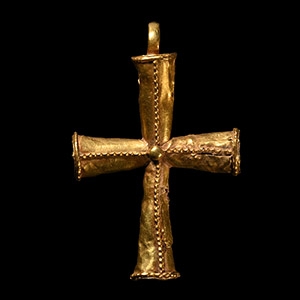
Byzantine Gold Cross Pendant
5th-6th century A.D.Estimate: £1,800 - 2,400 (‡+bp*)
Opening Bid: £1,000
Hollow-formed sheet gold cruciform pendant with filigree ropework to the end of each expanding tubular arm, band of beading to the upper face of each arm and central pellet; bale to the upper end. 3.67 grams, 40 mm
Acquired in the mid 1980s-1990s. From the family collection of Mr S.A., Switzerland, thence by descent. Private collection since the late 1990s. This lot has been checked against the Interpol Database of stolen works of art and is accompanied by a search certificate number no.12114-218167.
