
Loading, please wait...
_900x900.jpg "Byzantine and Post-Byzantine Bronze Cross Group")
_200x200.jpg "Byzantine and Post-Byzantine Bronze Cross Group")
.jpg "Byzantine and Post-Byzantine Bronze Cross Group")
LOT 0940
Byzantine and Post-Byzantine Bronze Cross Group
7TH-19TH CENTURY A.D.
1 3/8 - 2 7/8 in. (51.8 grams total, 36-73 mm).
Comprising: a cross buckle with pin; the upper plate of a small enkolpion with a praying Virgin or Saint; two orthodox pectoral crosses, both with inscription 'IC' (Iesus) 'XC' (Christos ) 'NIKA' (Christ is victorious); the smallest cross with invocation-prayer engraved on the back. [4, No Reserve]
ProvenanceAcquired on the UK art market.
Property of a Ruislip, UK, gentleman, by inheritance.
Cf. Schulze-Dörrlamm, M., Byzantinische Gürtelschnallen und Gürtelbeschläge im Römisch-Germanischen Zentralmuseum. Teil 2. Die Schnallen mit Scharnierbeschläg und Schnallen mit angegossenem Riemendurchzug des 7. bis 10. Jahrhunderts, Mainz, 2009, pp.9ff, fig.227.
FootnotesThe fragment of the simpler Maltese cross mount corresponds to the type E2 of Schulze-Dörrlamm, here with straight arms with rounded corners. It resembles the cross-shaped hinge fittings of the belt buckles from Herrera de Pisuerga and tomb 9 from El Tesorillo from Visigoth Spain, two bronze fittings from Lusitania and the buckle with busts of saints and the Greek inscription 'Light and Life' from Korbous in Tunisia. These kind of buckles were also found in male warrior graves.
CONDITIONTimeLine Auctions follows a vetting process to ensure the authenticity and legality of all items, reinforcing our commitment to integrity and responsible trading. Each antiquity, antique, and coin lot undergoes thorough examination by a vetting committee of at least ten external specialists, professional trade association members, scientists, and archaeologists: Our Vetting Process
AUCTIONS:
TimeLine is a leading auction house specialising in antiquities, ancient art, collectables, natural history, coins, medals, and books. Our auctions offer museums, collectors, historians, and enthusiasts the opportunity to acquire unique and historically significant pieces.
-
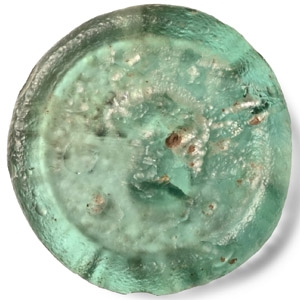
Byzantine Glass Weight with Eparches Inscription
Circa 6th-8th century A.D.Sold for (Inc. bp): £169
Discoid weight with low-relief portrait bust, Greek legend. 2.36 grams, 23 mm
From the property of late Mr SM, London, UK, 1969-1999. -
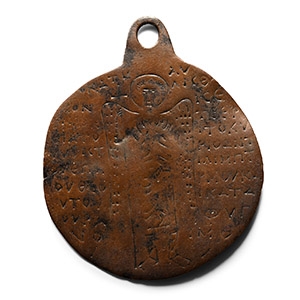
Byzantine 'Psalm 91 Related' Gnostic Bronze Talisman Pendant
Circa 5th-7th century A.D.Sold for (Inc. bp): £975
Discoid in form with integral loop, obverse with low-relief images of mounted Saint Sisinnios killing the demon Gyllou (Lilith), Agnus Dei, a stork, a lion, the holy snake Chnoubis and other symbols with Greek text between; reverse with a standing nimbate angel within a panel of Greek text from Psalm 91. 17.3 grams, 73 mm
From the collection of a gentleman, acquired on the London art market in the 1990s.
The text surrounding the angel recites the verses of Psalm 90 (Heb.91) in the ‘Great Reward Prayer’ (Μεγάλο Απόδειπνο): …Ο κατοικών εν βοηθεία τού Υψίστου, εν σκέπη τού Θεού τού ουρανού αυλισθήσεται. Ερεί τώ Κυρίω, Αντιλήπτωρ μου εί, καί καταφυγή μου… = …He who dwells in the shelter of the Most High will rest in the shadow of the Almighty. I will say of the Lord, 'He is my refuge and my fortress…' -
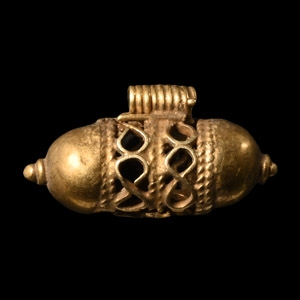
Byzantine Gold Filigree Pendant
6th-8th century A.D.Estimate: £180 - 240 (+bp*)
Opening Bid: £100
Capsule pendant with domed ends and openwork filigree bands between, ribbed suspension tube, granule finials. 0.91 grams, 15 mm
From a late Japanese specialist collector, 1970-2000s.
