
Loading, please wait...
LOT 1944
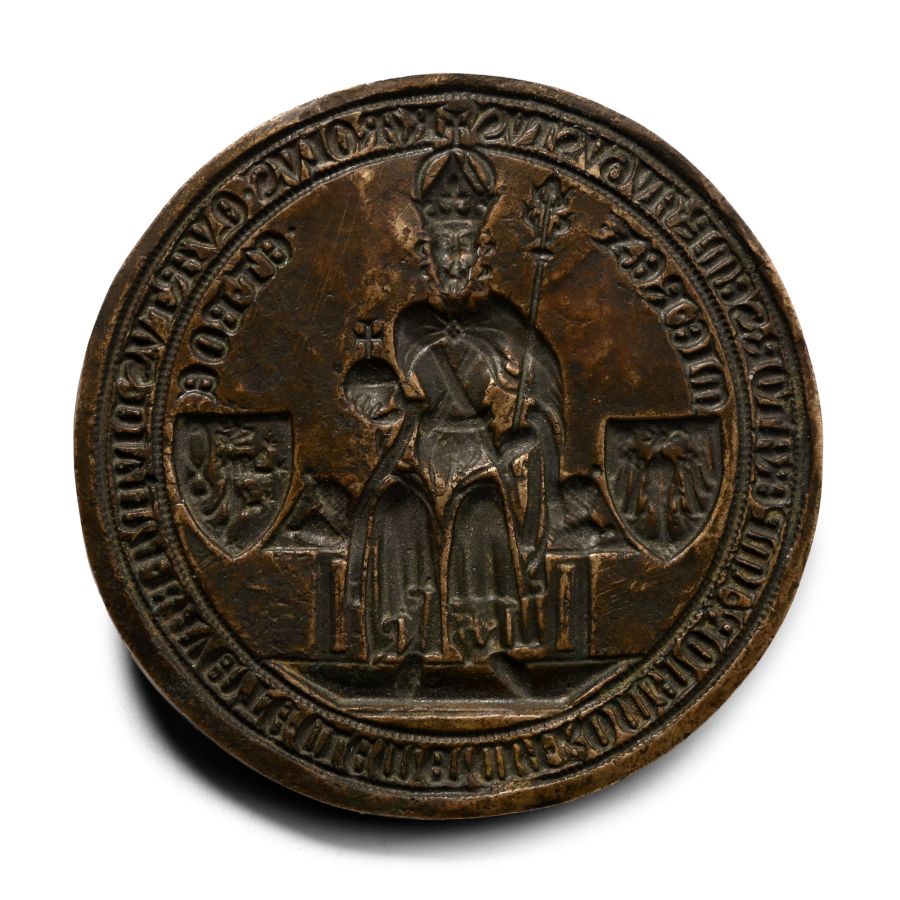
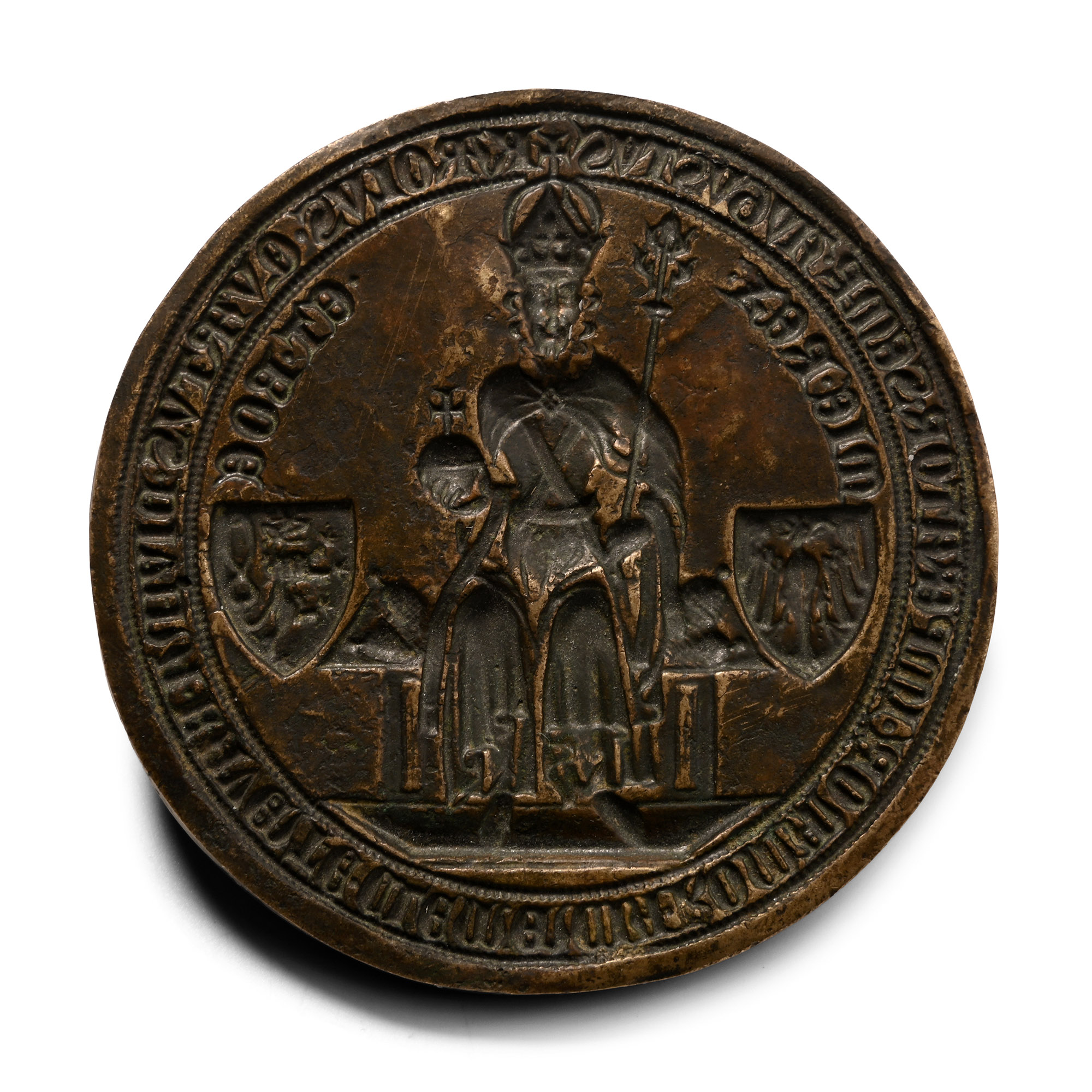
Bronze Seal Matrix with Emperor Charles IV
18TH CENTURY A.D.
2 3/8 in. (143 grams, 62 mm).
Discoid in plan with pierced flange handle to reverse; incuse image of a facing enthroned monarch with orb and sceptre in his hands, crown topped by a cross, two heater shields to the sides, on with a lion rampant and the other with a spread eagle; legend 'MIE.REZ', 'ET. BOE'; outer band with Lombardic legend 'AVGVSTVS. KAROLVS . QVARTVS . DIVINAE.FAVENTE . MEME[...]' referring to Holy Roman Emperor Charles IV.
ProvenancePrivate collection, UK.
CONDITIONTimeLine Auctions follows a vetting process to ensure the authenticity and legality of all items, reinforcing our commitment to integrity and responsible trading. Each antiquity, antique, and coin lot undergoes thorough examination by a vetting committee of at least ten external specialists, professional trade association members, scientists, and archaeologists: Our Vetting Process
AUCTIONS:
TimeLine is a leading auction house specialising in antiquities, ancient art, collectables, natural history, coins, medals, and books. Our auctions offer museums, collectors, historians, and enthusiasts the opportunity to acquire unique and historically significant pieces.
LOT 1944
Bronze Seal Matrix with Emperor Charles IV
Estimate £200 - 300€230 - 350 (for guidance only)$270 - 410 (for guidance only)
-

Russian Bronze Travel Icon with Madonna and Child
Circa 18th century A.D.Sold for (Inc. bp): £52
Depicting the Mother of God of Kazan with the Divine Child; the head of Mary slightly turned left towards infant Jesus extending his right hand in blessing; both figures with large haloes and identifying Greek inscriptions 'ΜΡ ΘΥ' (Mother of God) and 'O Ѡ N' (I am); three flowers in the nimbus of the Virgin; knop at the top for the suspension. 34.3 grams, 59 mm
Acquired from Chris Martin-Zakheim, Iconastas, 5 Piccadilly Arcade, London SW1. From the private collection of a West London, UK, gentleman, formed since the early 2000s.
The original icon prototype of these smaller icons, also known as the Theotokos of Kazan, is thought to have originated in Constantinople in the 13th century before it was taken to Russia. When the Turks took over Kazan in 1438, the icon was most probably hidden to keep it safe. Ivan the Terrible liberated Kazan in 1552, and the town was destroyed by fire in 1579, after which the icon was found and brought to the Church of Saint Nicholas. It was subsequently stolen in 1904 and never found again, though there are many copies in existence. -

Lapis Lazuli Bead Necklace String
20th century A.D.Sold for (Inc. bp): £52
Restrung group of tabular, annular and other types with D-shaped pendant centrepiece. 44.2 grams, 35 cm
London, UK, collection, 2000s. -

George III Gold Memento Mori Ring with Skull
Dated 13 February 1783 A.D.Sold for (Inc. bp): £715
Hoop with stylised skull to the outer face and incised copperplate legend 'In memory R F obt 13 Feb 83' to the inner with indistinct maker's mark '?.S'. 3.23 grams, 20.3 mm overall, 18.1 mm internal diameter (approximate size British P 1/2, USA 7 3/4, Europe 16.86, Japan 16)
Found Shrewton, Wiltshire, UK.
