
Loading, please wait...
LOT 1539
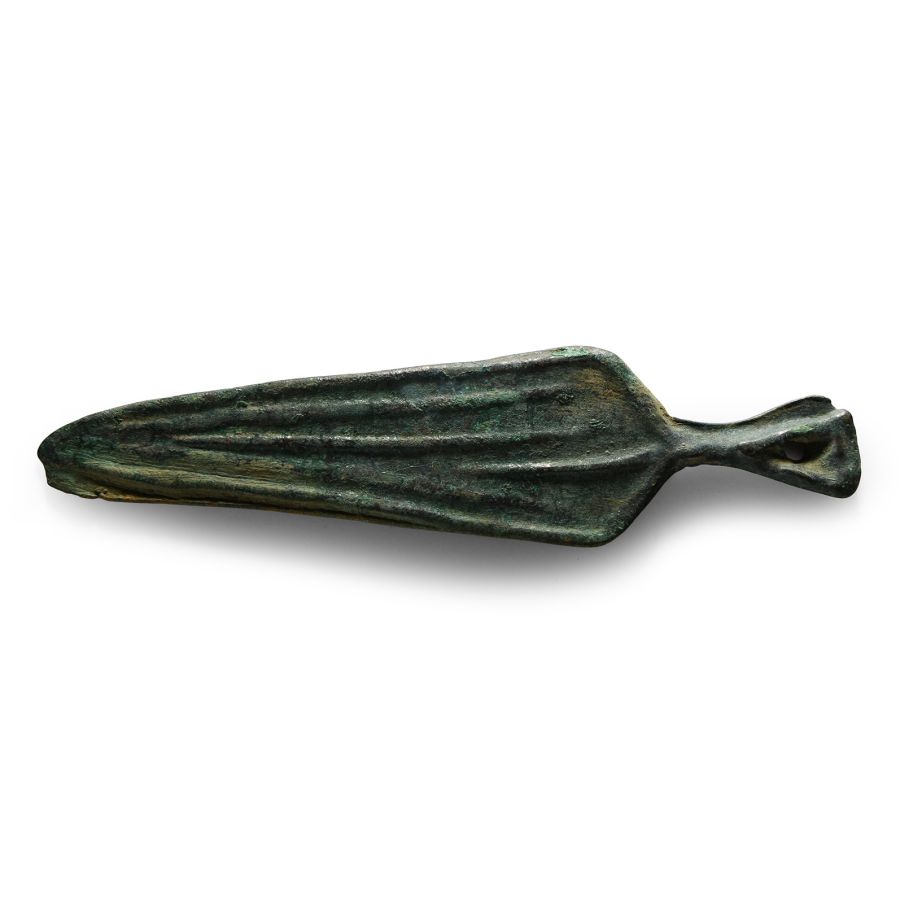
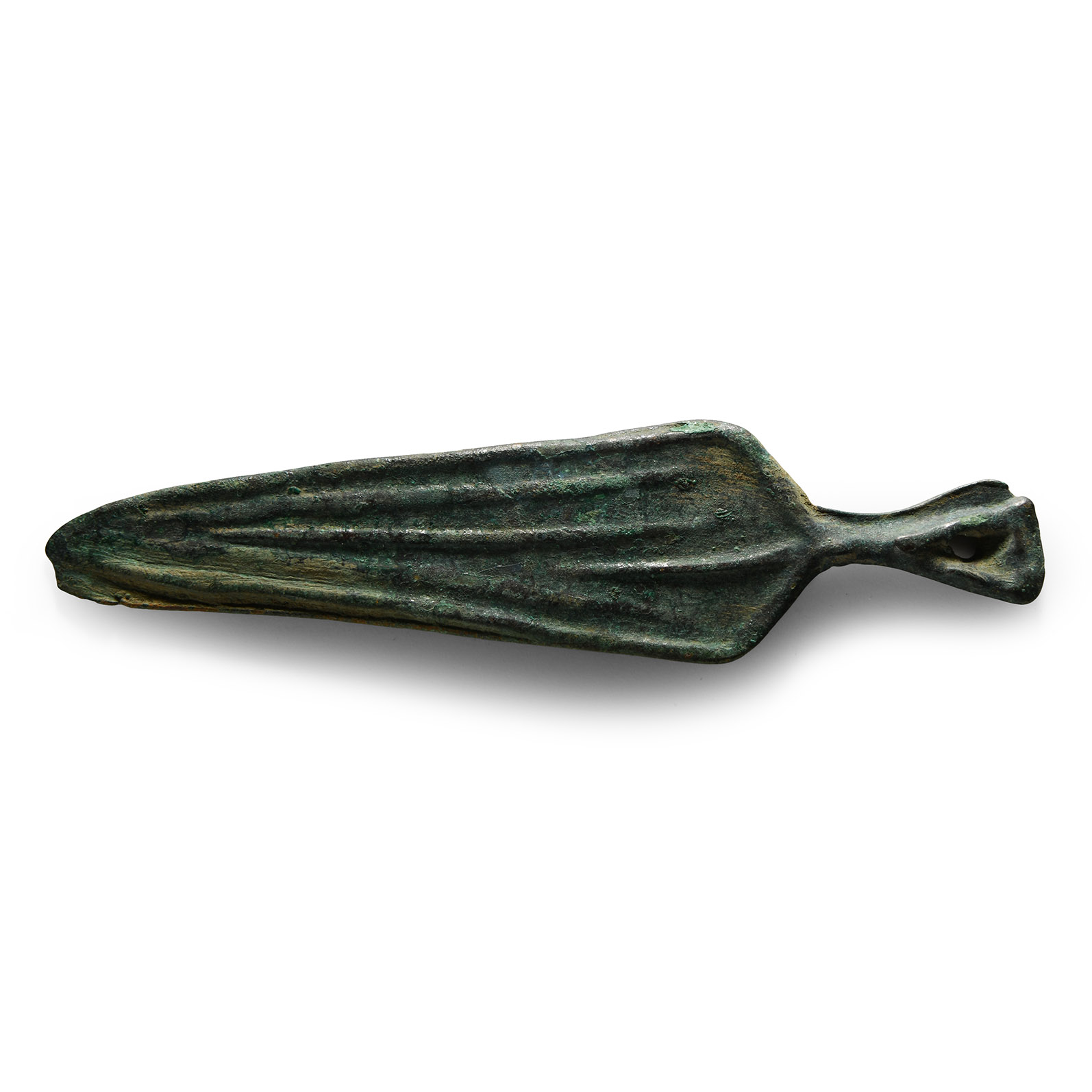
Bronze Age Votive Sword Amulet
2ND-1ST MILLENNIUM B.C.
7/8 in. (37.5 grams, 12.3 cm).
A dagger-shaped pendant with pierced pommel, broad ribbed blade. [No Reserve]
ProvenancePrivate collection formed in the 1990s.
Acquired from a London gallery.
Property of an Essex gentleman.
TimeLine Auctions follows a vetting process to ensure the authenticity and legality of all items, reinforcing our commitment to integrity and responsible trading. Each antiquity, antique, and coin lot undergoes thorough examination by a vetting committee of at least ten external specialists, professional trade association members, scientists, and archaeologists: Our Vetting Process
AUCTIONS:
TimeLine is a leading auction house specialising in antiquities, ancient art, collectables, natural history, coins, medals, and books. Our auctions offer museums, collectors, historians, and enthusiasts the opportunity to acquire unique and historically significant pieces.
-
.jpg)
Bronze Age Ritual Limestone Slab with Drillings
Circa 2nd millennium B.C.Sold for (Inc. bp): £364
Rectangular worked stone block with one irregular edge; the thicker, dressed edge with a group of five drilled holes, possibly cup-marks, in a V-shaped formation. 65.7 kg, 65.5 cm
From a collection acquired on the UK art market from various auction houses and collections mostly before 2000. From an important Cambridgeshire estate; thence by descent.
Cup-marks, with or without surrounding rings, are among the most enigmatic signs which can be found widely across ancient European landscapes, most often in association with running water. Circular arrangements are one notable and recurrent feature, while straight lines and parallel rows are less frequently represented. The present stone most closely resembles the kind of feature found at e.g. Østergård, Risehøj, Østermarie on the island of Bornholm in the Baltic Sea (Milstreu & Dodd, 2018, fig.15). -
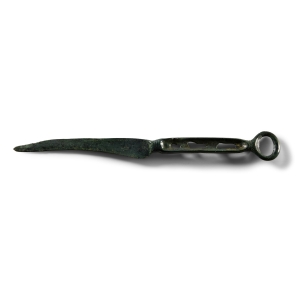
Bronze Age Knife with Looped Pommel
Circa 800-100 B.C.Estimate: £800 - 1,000 (+bp*)
Opening Bid: £425
Comprising a flat, gently curving single-edged blade with pointillé decoration to the upper edge, the flat ridge with hatched panels extending to the integral openwork handle, a loop to the end, the handle recessed to accept organic inserts. 49.1 grams, 21.5 cm
Numisart collection, Munich, Germany, circa 1995. Acquired in the 2000s. From the private collection of John Lawton, Surrey, UK. Accompanied by a copy of a previous catalogue information page.
The knife is reminiscent of the late Bronze Age- early Iron Age sickle blades, which developed in the falcata blade, a type of short sword used by the Celts in the Iberian peninsula. A falcata was a single-edged blade with an inward curve, allowing both momentum and thrust when used. -
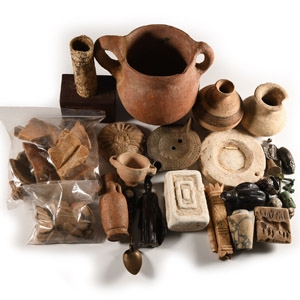
Group of Antiquities and Other Objects
2nd millennium B.C.-20th century A.D.Sold for (Inc. bp): £338
Comprising a Middle Bronze Age Cypriot vessel circa 2000-1600 B.C.; a Bronze Age two-handled vessel from the Holy Land; a votive mirror frame; a bronze statuette of Victory, and other items; some items after the antique. 2 kg total, 1.9-12 cm
The Cypriot pot ex Leto Severis collection; the fragmentary pot ex Donald Simmonds collection; the bronze of Victory ex Michaelides collection. with Roseberys, London, 26 October 2021, the majority of no.13. Accompanied by a copy of the Roseberys catalogue listing.
