
Loading, please wait...
_900x900.jpg "Bronze Age to Roman Bronze Artefact Collection")
_200x200.jpg "Bronze Age to Roman Bronze Artefact Collection")
.jpg "Bronze Age to Roman Bronze Artefact Collection")
LOT 0724
Bronze Age to Roman Bronze Artefact Collection
11TH CENTURY B.C.-3RD CENTURY A.D.
1 3/8 - 4 1/4 in. (45 grams total, 3.6-10.8 cm).
Comprising two arrowheads with foliate head and square-sectioned tang and three awls. [5, No Reserve]
ProvenanceAcquired prior to 2000.
Ex private collection, Cambridgeshire, UK.
Cf. Khorasani, M.M., Arms and Armour from Iran - The Bronze Age to the End of the Qajar Period, Tuebingen, 2006, cat.460, for the arrowheads.
FootnotesThe two arrowheads are similar to specimens found in Luristan. They belong to the type V of the Khorasani classification. The bow was widely used by the Luristan people. The shape of the blade is often flat or ovate in the cross section with lanceolate profile and two cutting edges.
CONDITIONTimeLine Auctions follows a vetting process to ensure the authenticity and legality of all items, reinforcing our commitment to integrity and responsible trading. Each antiquity, antique, and coin lot undergoes thorough examination by a vetting committee of at least ten external specialists, professional trade association members, scientists, and archaeologists: Our Vetting Process
AUCTIONS:
TimeLine is a leading auction house specialising in antiquities, ancient art, collectables, natural history, coins, medals, and books. Our auctions offer museums, collectors, historians, and enthusiasts the opportunity to acquire unique and historically significant pieces.
-
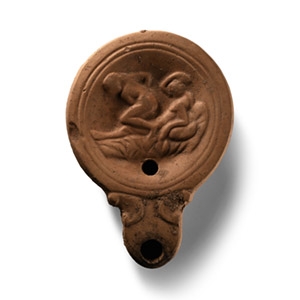
Roman Terracotta Oil Lamp with Erotic Scene
2nd century A.D.Sold for (Inc. bp): £1,235
With broad discus and long nozzle flanked by volute scrolls, low-relief scene with two lovers on a bed. 44 grams, 95 mm
From a London collection of erotica, formerly in the collection of the late Mr S.M., London, UK. -
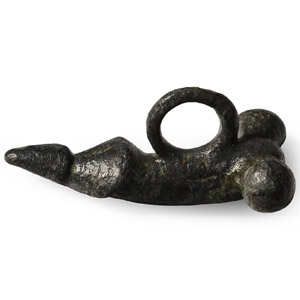
Roman Bronze Phallic Pendant
1st-4th century A.D.Sold for (Inc. bp): £104
Formed as a stylised phallus with lateral testes, suspension loop above. 16.9 grams, 40 mm
Ex German art market, 2000s. Acquired from an EU collector living in London. From the collection of Surrey, UK, gentleman. -
.jpg)
Larger Than Life-Size Roman Bronze Foot Insert From a Statue
1st-3rd century A.D.Estimate: £4,000 - 6,000 (‡+bp*)
Opening Bid: £1,556
Hollow-formed front left sandaled foot with draped hem of a vestis talaris across the rear edge and tiered sole to the footwear, traces of gilding; supplied with a custom-made wooden stand. 847 grams total, 14 cm
Acquired in Germany in 2001. Acquired by the present owner from the above. Accompanied by an academic report by Dr Raffaele D’Amato. This lot has been checked against the Interpol Database of stolen works of art and is accompanied by search certificate number no.12192-222323.
The detailed bronze foot exhibits an incredible rendering of the smallest details; its dimensions suggest that the statue to which it belonged was nearly a human size sculpture, possibly a goddess, based on the footwear. Statues of the gods and goddesses were usually gilded.
