
Loading, please wait...
_900x900.jpg "Bronze Age Socketted Spearhead")
_200x200.jpg "Bronze Age Socketted Spearhead")
.jpg "Bronze Age Socketted Spearhead")
LOT 0339
Bronze Age Socketted Spearhead
1ST MILLENNIUM B.C.
5 3/4 in. (112 grams, 14.5 cm).
With flared socket developing to a midrib with lateral step, leaf-shaped blade with stepped profile; opposed lateral holes to accept attachment pegs.
ProvenanceEx Surrey, UK, collection, 1980s.
LiteratureCf. Ehrenberg, M., Bronze Spearheads from Berks, Bucks and Oxon, BAR 34, Oxford, 1977, item 37, for type.
CONDITIONTimeLine Auctions follows a vetting process to ensure the authenticity and legality of all items, reinforcing our commitment to integrity and responsible trading. Each antiquity, antique, and coin lot undergoes thorough examination by a vetting committee of at least ten external specialists, professional trade association members, scientists, and archaeologists: Our Vetting Process
AUCTIONS:
TimeLine is a leading auction house specialising in antiquities, ancient art, collectables, natural history, coins, medals, and books. Our auctions offer museums, collectors, historians, and enthusiasts the opportunity to acquire unique and historically significant pieces.
-
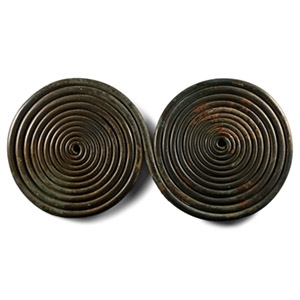
Large Bronze Age Spectacle Brooch
1st millennium B.C.Estimate: £600 - 800 (+bp*)
Opening Bid: £300
Formed as two large tightly-wound coils; similar verso with pin absent. 497 grams, 20.2 cm
Ex Surrey, UK, collection, 1980s. -
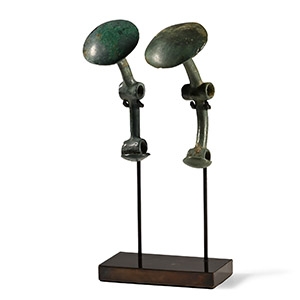
Bronze Age Horse Cheek Piece Pair
1st millennium B.C.Sold for (Inc. bp): £715
Comprising two matched cheek pieces, each with a domed disc to each end, three tubular sockets to accepts leather straps and the mouth piece; accompanied by a custom-made display stand. 220 grams total, 10.6-10.8 cm (325 grams total, 19.7 cm high including stand)
Ex Surrey, UK, collection, 1980s. -
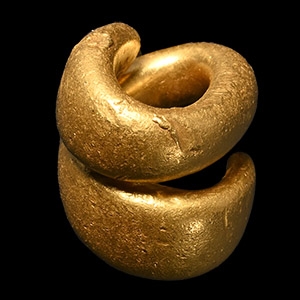
Bronze Age Gold Spiral Hair Ring
Circa 1000 B.C.Sold for (Inc. bp): £1,170
Formed as an ellipsoid-section tapering rod with the ends flattened. 17.2 grams, 17 mm
Acquired in the mid 1980s-1990s. Private collection, Switzerland, thence by descent. Private collection, since the late 1990s.
