
Loading, please wait...
LOT 1411
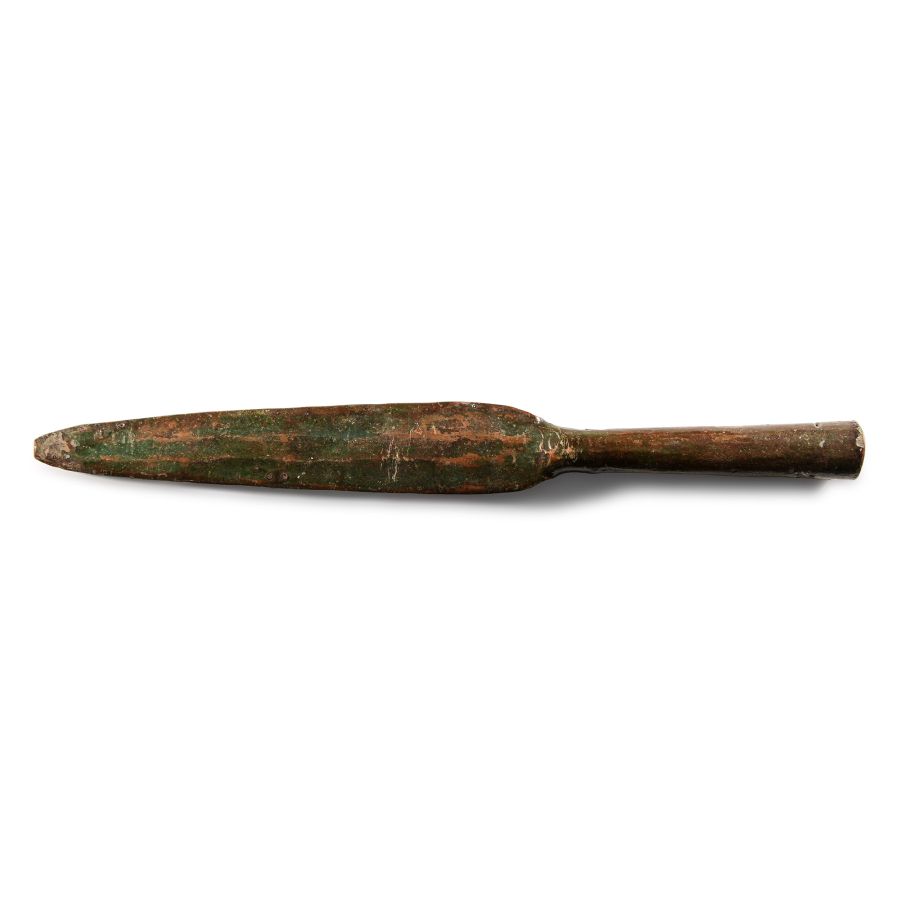
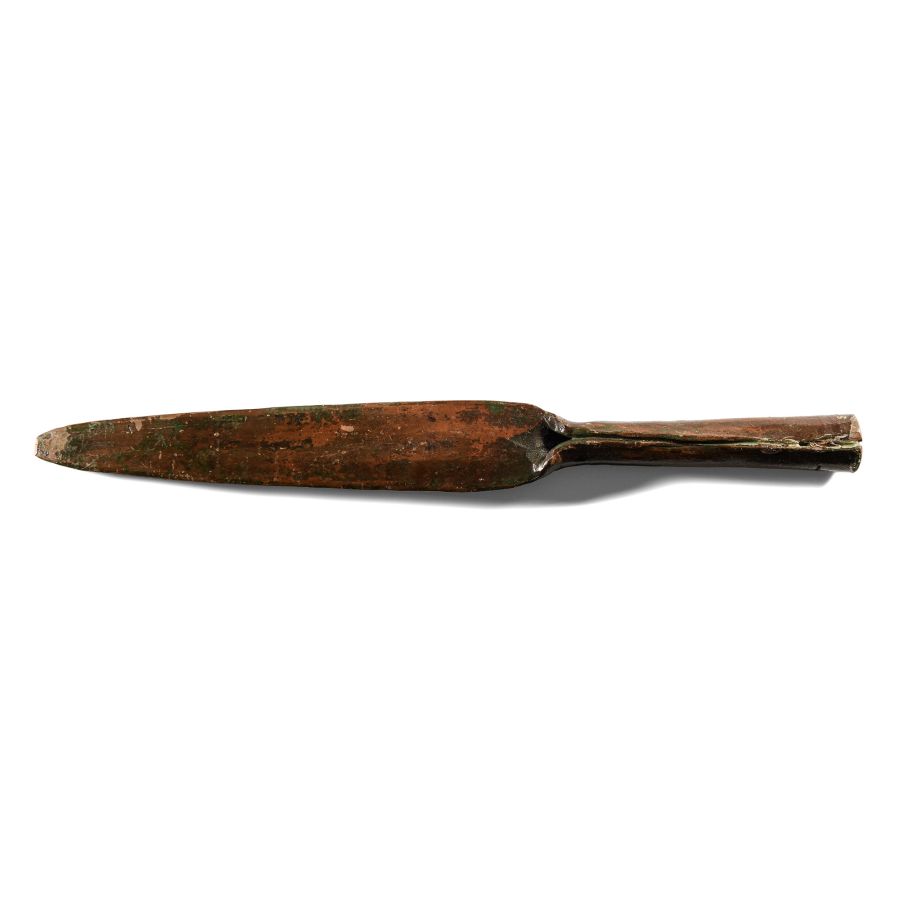
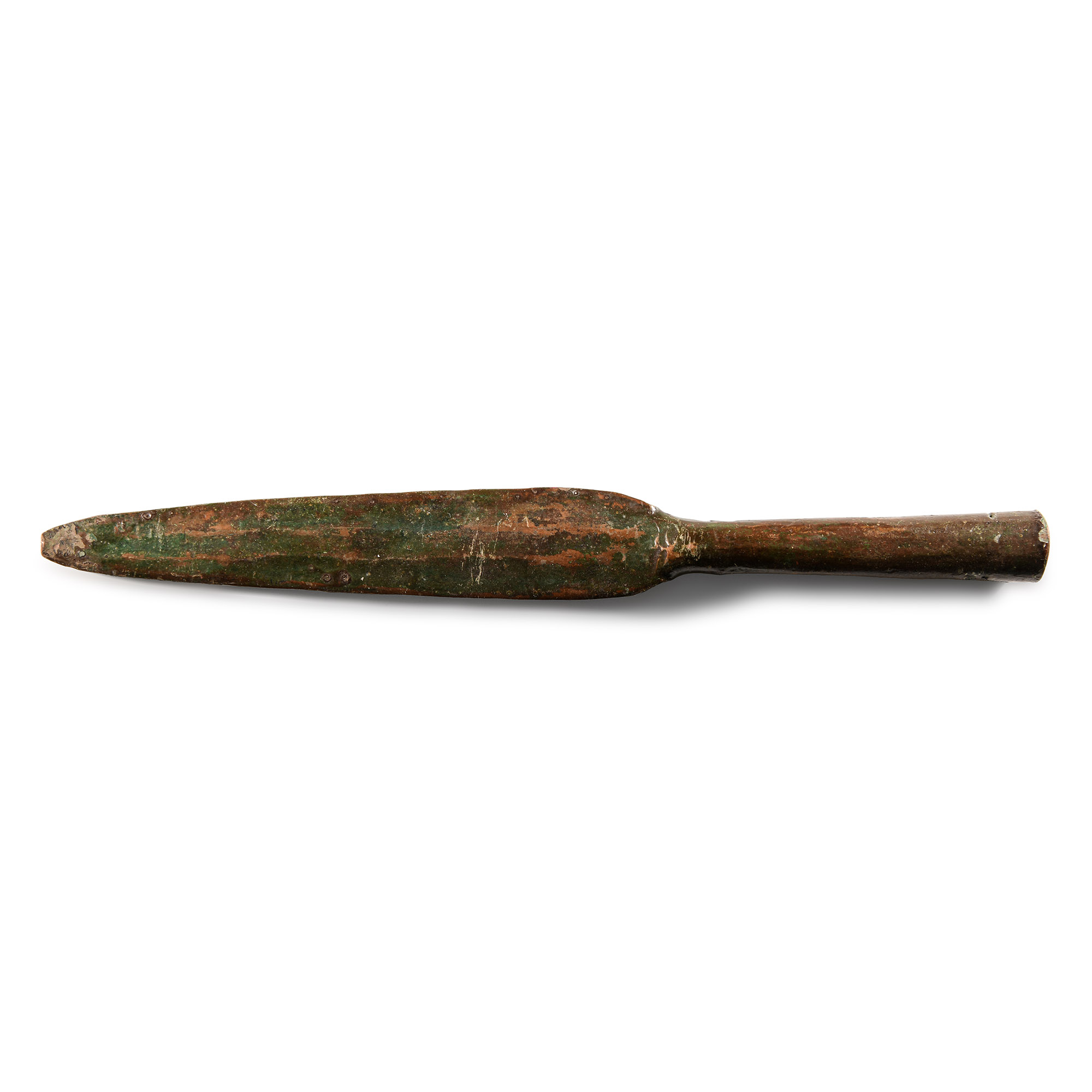
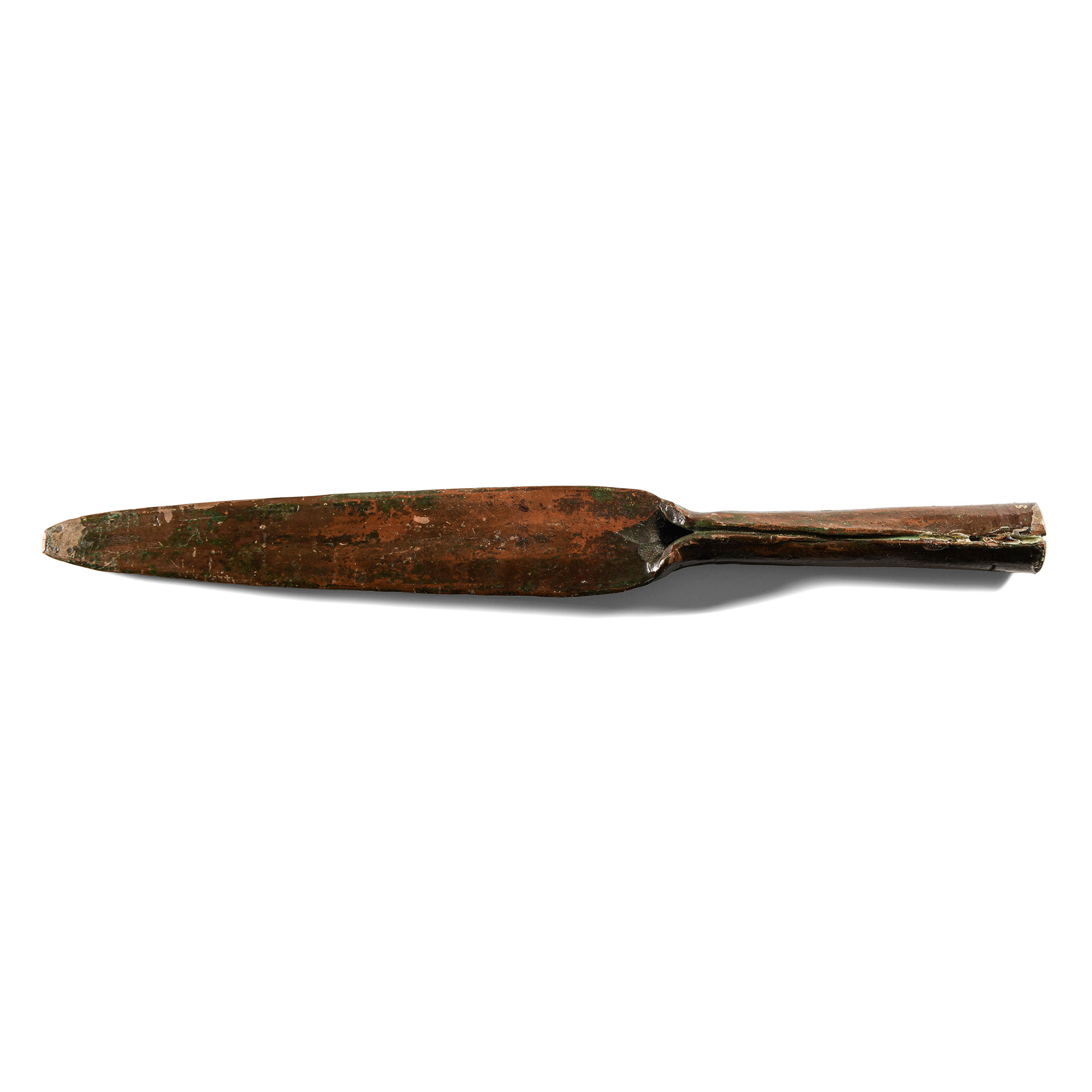
Bronze Age Socketted Spearhead
CIRCA 19TH CENTURY B.C.
10 1/8 in. (183 grams, 25.6 cm).
With foliate blade and tapering socket. [No Reserve]
ProvenanceFrom a collection acquired on the UK art market from various auction houses and collections mostly before 2000.
From an important Cambridgeshire estate; thence by descent.
Cf. Gorelik, M., Weapons of Ancient East, IV millennium BC-IV century BC, Saint Petersburg, 2003, in Russian, see pl.XXXIV, no.1, for identical spearhead from Kanesh (Nesa or Kultepe).
FootnotesThe bronze spearhead developed considerably during the period of the Assyrian colonies in Anatolia and even during the period Karum III-IV, maintaining consistently its southern shape. Conical points are also known from Bogazkoy's Karum levels. While spearheads from the first half of the 2nd millennium B.C. were hafted by means of a tang, with two slots in the blade providing additional support, most of the Late Bronze Age spearheads were socketted.
CONDITIONTimeLine Auctions follows a vetting process to ensure the authenticity and legality of all items, reinforcing our commitment to integrity and responsible trading. Each antiquity, antique, and coin lot undergoes thorough examination by a vetting committee of at least ten external specialists, professional trade association members, scientists, and archaeologists: Our Vetting Process
AUCTIONS:
TimeLine is a leading auction house specialising in antiquities, ancient art, collectables, natural history, coins, medals, and books. Our auctions offer museums, collectors, historians, and enthusiasts the opportunity to acquire unique and historically significant pieces.
-
Canaanite Bronze Dirk
13th-12th century B.C.Estimate: £400 - 600 (‡+bp*)
Opening Bid: £200
With lentoid-section blade, tongue-shaped in plan, integral tapering hilt with flared finial, lateral flanges to accept a panel of bone or wood to each face forming the grip. 174 grams, 34 cm
Ex Joseph J. Gancie (1923-2010), Washington, Silver Spring, Maryland. with Alex Cooper Auctioneers Inc., sale 1035, 27 January 2013, lot 162a.
The dirk belongs to the type III in the Medvedskaya classification, used in Near East from the 13th to the 6th century B.C. The type is the 32a of the Maxwell-Hyslop study. The Asiatic daggers of this type are confined to Syria and Persia, but Transcaucasia also provides an interesting analogy from Kalekent on the Baku peninsula, where a pointed straight-sided dagger blade has a flanged hilt with the whole of the side flanges bent over the centre. -
Roman Iron Gladius Sword with Bird Triskeles
Circa 1st-2nd century A.D.Sold for (Inc. bp): £2,600
With fish-shaped blade of piled iron construction with square shoulder and flat-section tang; incised triskele motif to one face, each arm terminating in a bird's head with curved beak and lentoid eye; accompanied by a custom-made display stand. 870 grams total, 67 cm high including stand
Acquired in the 2000s. From the private collection of John Lawton, Surrey, UK. -
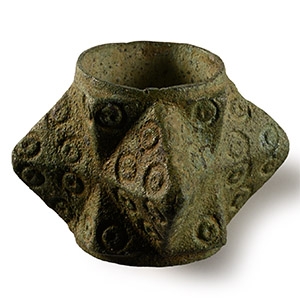
Decorated Star-Shaped Macehead
Eastern European, circa 14th century A.D.Sold for (Inc. bp): £260
With short thick triangular spikes, decorated with engraved concentric circles. 85 grams, 53 mm
From a collection acquired on the UK art market from various auction houses and collections mostly before 2000. From an important Cambridgeshire estate; thence by descent.
The polygonal mace evolved into the hexagonal winged mace. Originating in the east, this weapon spread across Eastern Europe during the 13th century A.D., and from there to the west. The winged mace, used by the western Europeans, was almost certainly based upon Eastern Roman or Islamic prototypes. It is relevant to note that the polygonal mace was widely used by the eastern cavalrymen (like Turkish and Mongols), during the 14th century A.D.
