
Loading, please wait...
_900x900.jpg "Bronze Age Socketted Axehead")
_200x200.jpg "Bronze Age Socketted Axehead")
.jpg "Bronze Age Socketted Axehead")
LOT 1631
Bronze Age Socketted Axehead
10TH-9TH CENTURY B.C.
2 7/8 in. (172 grams, 72 mm).
With rectangular-section mouth, integral collar developing to five vertical ribs on each broad face, two lateral loops; vent to each broad face, remains at casting sprue at collar.
ProvenancePrivate collection of Mr S.A., Switzerland, 1990s, thence by descent.
LiteratureCf. Novotná, M., Die Äxte und Beile der Slowakei, Abteilung IX Band 3, Munich, 1970, item 750, for type.
FootnotesThe form with two lateral loops is unusual.
CONDITIONTimeLine Auctions follows a vetting process to ensure the authenticity and legality of all items, reinforcing our commitment to integrity and responsible trading. Each antiquity, antique, and coin lot undergoes thorough examination by a vetting committee of at least ten external specialists, professional trade association members, scientists, and archaeologists: Our Vetting Process
AUCTIONS:
TimeLine is a leading auction house specialising in antiquities, ancient art, collectables, natural history, coins, medals, and books. Our auctions offer museums, collectors, historians, and enthusiasts the opportunity to acquire unique and historically significant pieces.
LOT 1631
Bronze Age Socketted Axehead
Estimate £100 - 140€120 - 160 (for guidance only)$140 - 190 (for guidance only)
-
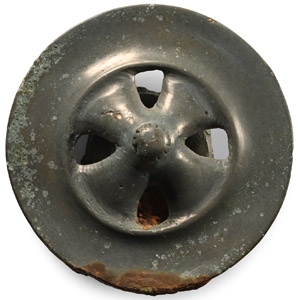
European Bronze Age Tinned Bronze Strap Junction
2nd-1st millennium B.C.Sold for (Inc. bp): £169
Formed as a disc with four flat spokes radiating from a hatched hub, with ring to the underside attached by four short posts. 30.2 grams, 50 mm
From the private collection of Mr J.L., Surrey, UK. -
.jpg)
Bronze Age Ritual Limestone Slab with 'Astrological?' Drillings
Circa 2nd millennium B.C.Sold for (Inc. bp): £416
Rectangular worked stone block with one irregular edge; the thicker, dressed edge with a group of five drilled holes, possibly cup-marks, in a V-shaped formation. 65.7 kg, 65.5 cm
From a collection acquired on the UK art market from various auction houses and collections mostly before 2000. From an important Cambridgeshire estate; thence by descent.
Cup-marks, with or without surrounding rings, are among the most enigmatic signs which can be found widely across ancient European landscapes, most often in association with running water. Circular arrangements are one notable and recurrent feature, while straight lines and parallel rows are less frequently represented. The present stone most closely resembles the kind of feature found at e.g. Østergård, Risehøj, Østermarie on the island of Bornholm in the Baltic Sea (Milstreu & Dodd, 2018, fig.15). -
.jpg)
Bronze Age Socketted Axehead
10th-9th century B.C.Estimate: £100 - 140 (‡+bp*)
Opening Bid: £50
With rectangular-section mouth, integral collar developing to five vertical ribs on each broad face, two lateral loops; vent to each broad face, remains at casting sprue at collar. 172 grams, 72 mm
Private collection of Mr S.A., Switzerland, 1990s, thence by descent.
The form with two lateral loops is unusual.
