
Loading, please wait...
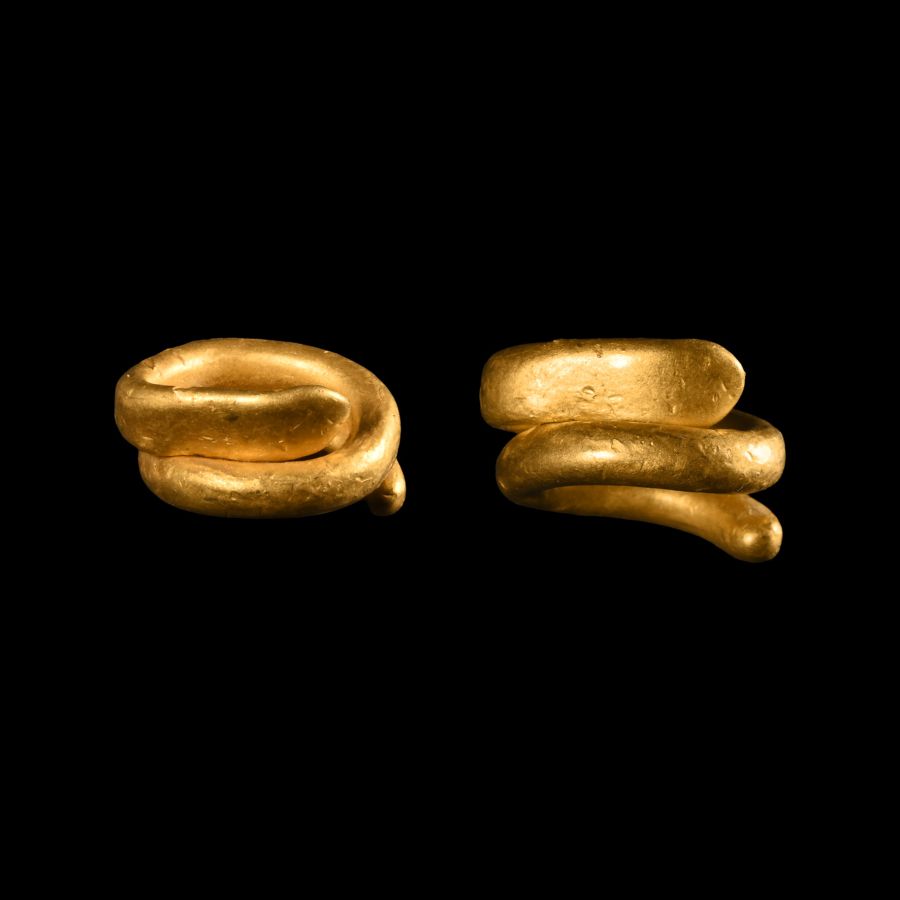
_900x900.jpg "Bronze Age Gold Hair Ring")
_200x200.jpg "Bronze Age Gold Hair Ring")
.jpg "Bronze Age Gold Hair Ring")
LOT 0356
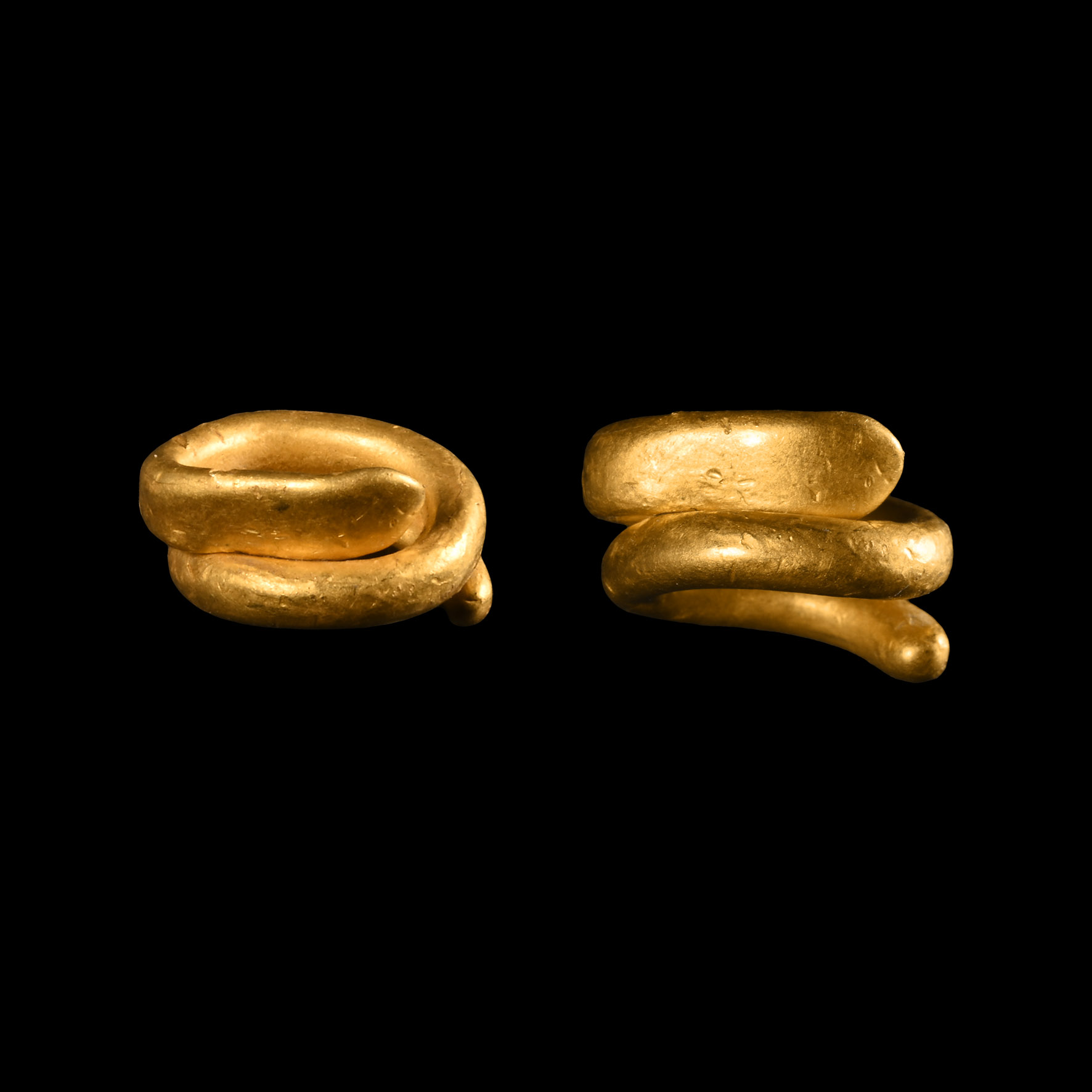
Bronze Age Gold Hair Ring
2ND MILLENNIUM B.C.
1/2 in. (5.93 grams, 13 mm).
A round-section rod coiled and partly flattened to form a hair ornament.
ProvenanceBy repute found Lincolnshire in the 1960s.
From the collection of Lord McAlpine of West Green.
From the private collection of John Lawton, Surrey, UK.
Accompanied by a copy of a previous cataloguing information page.
See Taylor, J.T., Bronze Age Goldwork of the British Isles, Cambridge, 1980, for discussion.
CONDITIONTimeLine Auctions follows a vetting process to ensure the authenticity and legality of all items, reinforcing our commitment to integrity and responsible trading. Each antiquity, antique, and coin lot undergoes thorough examination by a vetting committee of at least ten external specialists, professional trade association members, scientists, and archaeologists: Our Vetting Process
AUCTIONS:
TimeLine is a leading auction house specialising in antiquities, ancient art, collectables, natural history, coins, medals, and books. Our auctions offer museums, collectors, historians, and enthusiasts the opportunity to acquire unique and historically significant pieces.
-
.jpg)
Bronze Age Ritual Limestone Slab with Drillings
Circa 2nd millennium B.C.Sold for (Inc. bp): £364
Rectangular worked stone block with one irregular edge; the thicker, dressed edge with a group of five drilled holes, possibly cup-marks, in a V-shaped formation. 65.7 kg, 65.5 cm
From a collection acquired on the UK art market from various auction houses and collections mostly before 2000. From an important Cambridgeshire estate; thence by descent.
Cup-marks, with or without surrounding rings, are among the most enigmatic signs which can be found widely across ancient European landscapes, most often in association with running water. Circular arrangements are one notable and recurrent feature, while straight lines and parallel rows are less frequently represented. The present stone most closely resembles the kind of feature found at e.g. Østergård, Risehøj, Østermarie on the island of Bornholm in the Baltic Sea (Milstreu & Dodd, 2018, fig.15). -
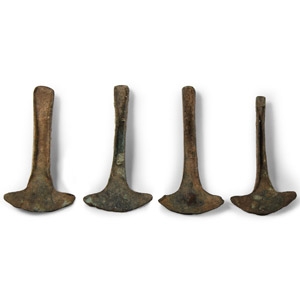
Bronze Age Miniature Votive Palstave Axehead Collection
2nd millennium B.C.Sold for (Inc. bp): £117
Group of miniature palstaves each with transverse lunate balde, raised lateral flanges to the shank. 11.7 grams total, 42-44 mm
Private collection formed in the 1990s. Acquired from a central London gallery. Property of an Essex gentleman. -
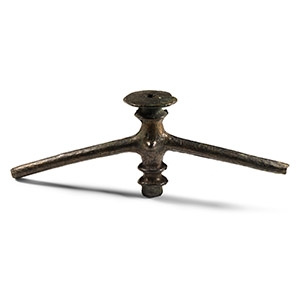
Bronze Age Decorated Sceptre Head
13th-11th century B.C.Sold for (Inc. bp): £650
Composed of a high profiled tubular shaft with two long arms slightly inclining downwards; three collars to the shaft and a flat round disc to one end. 558 grams, 27 cm
Acquired on the Austrian art market, 2000, from Mr N.C. European private collection.
