
Loading, please wait...
LOT 1522
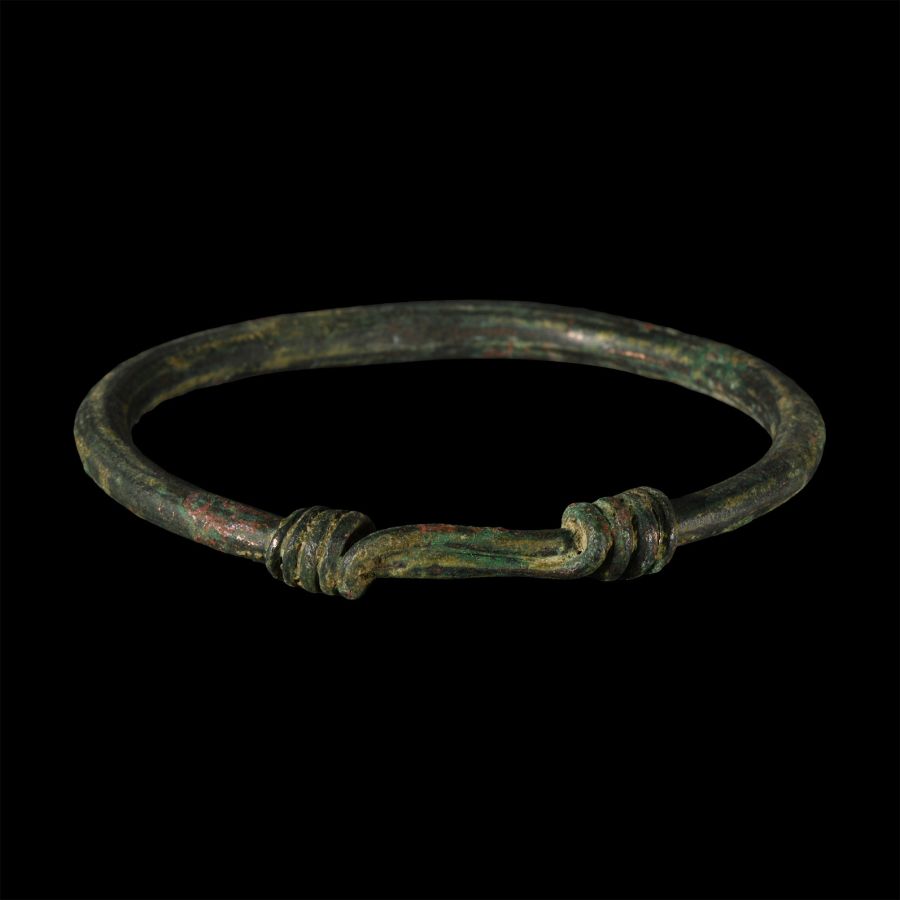
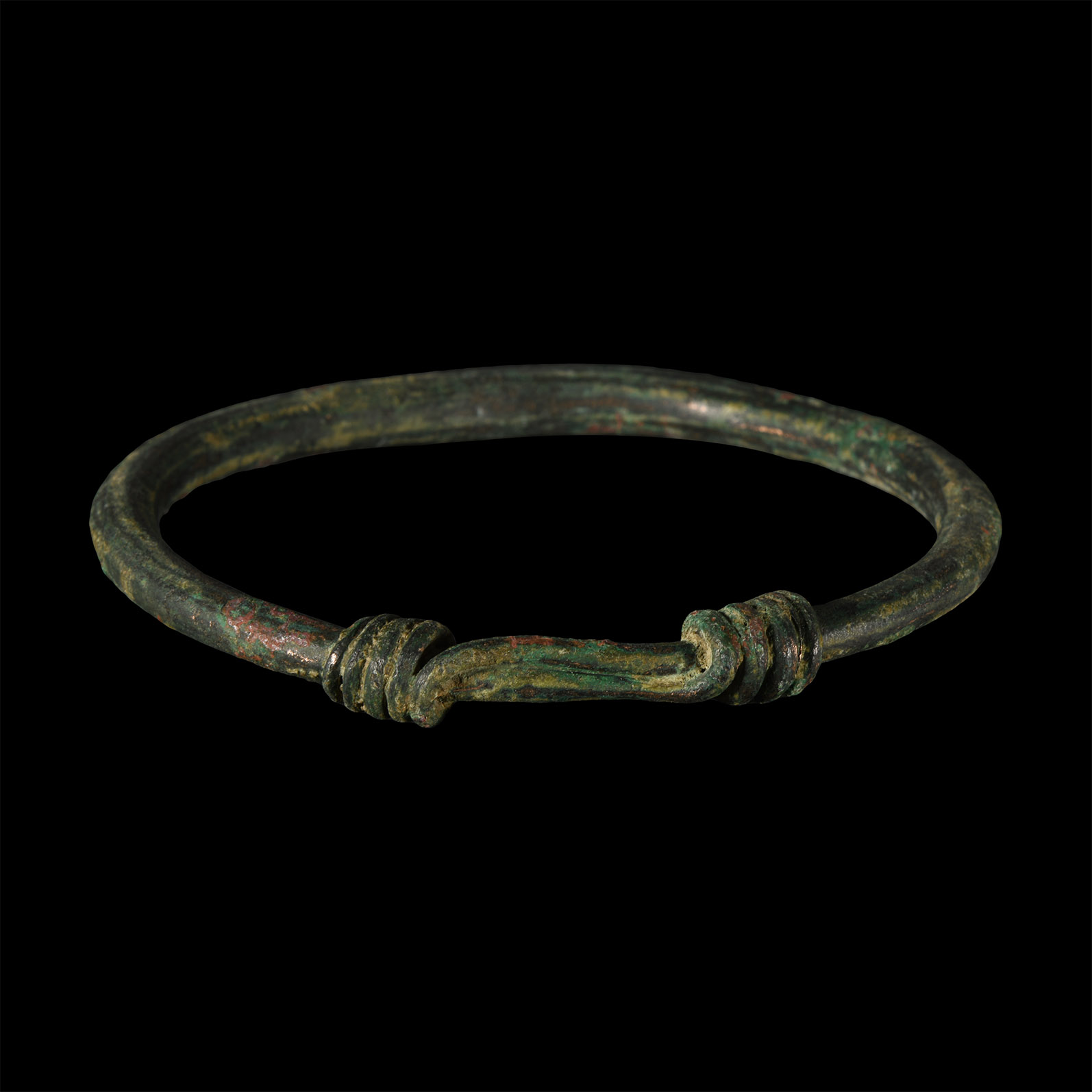
Bronze Age Arm Ring
1ST MILLENNIUM B.C.
4 in. (100 grams, 10.2 cm).
With a round-section body, overlapping tapering terminals wound around the body. [No Reserve]
ProvenanceEx old English collection.
London art market, pre 2000.
Property of a London, UK, gentleman.
TimeLine Auctions follows a vetting process to ensure the authenticity and legality of all items, reinforcing our commitment to integrity and responsible trading. Each antiquity, antique, and coin lot undergoes thorough examination by a vetting committee of at least ten external specialists, professional trade association members, scientists, and archaeologists: Our Vetting Process
AUCTIONS:
TimeLine is a leading auction house specialising in antiquities, ancient art, collectables, natural history, coins, medals, and books. Our auctions offer museums, collectors, historians, and enthusiasts the opportunity to acquire unique and historically significant pieces.
-

Bronze Age Ceramic Vessel
Middle Bronze Age, circa 1000-800 B.C.Sold for (Inc. bp): £598
Squat jar with convex underside, caribated shoulder with incised ring, flared and everted rim, burnished surface. 778 grams, 20.5 cm wide
Found UK. From a collection acquired on the UK art market from various auction houses and collections mostly before 2000. From an important Cambridgeshire estate; thence by descent. -
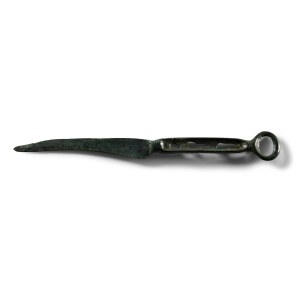
Bronze Age Knife with Looped Pommel
Circa 800-100 B.C.Estimate: £800 - 1,000 (+bp*)
Opening Bid: £425
Comprising a flat, gently curving single-edged blade with pointillé decoration to the upper edge, the flat ridge with hatched panels extending to the integral openwork handle, a loop to the end, the handle recessed to accept organic inserts. 49.1 grams, 21.5 cm
Numisart collection, Munich, Germany, circa 1995. Acquired in the 2000s. From the private collection of John Lawton, Surrey, UK. Accompanied by a copy of a previous catalogue information page.
The knife is reminiscent of the late Bronze Age- early Iron Age sickle blades, which developed in the falcata blade, a type of short sword used by the Celts in the Iberian peninsula. A falcata was a single-edged blade with an inward curve, allowing both momentum and thrust when used. -

Bronze Age Ceremonial Cup Stone Slab
Circa 2nd millennium B.C.Sold for (Inc. bp): £1,235
Irregular slab fragment with weathered upper face, cluster of seven cup-marks without surrounding rings. 50.6 kg, 57.5 cm
From a collection acquired on the UK art market from various auction houses and collections mostly before 2000. From an important Cambridgeshire estate; thence by descent.
The fragment plausibly represents one corner of an arrangement such as that at Tanum, Denmark (Milstreu & Dodd, 2018, fig.8) in which a cluster of shallow depressions forms a larger pattern. The depressions may have been used to collect dew or rainwater, visualised as a gift from the gods provided without human intervention, as well as for ceremonial uses.
