
Loading, please wait...
LOT 0065
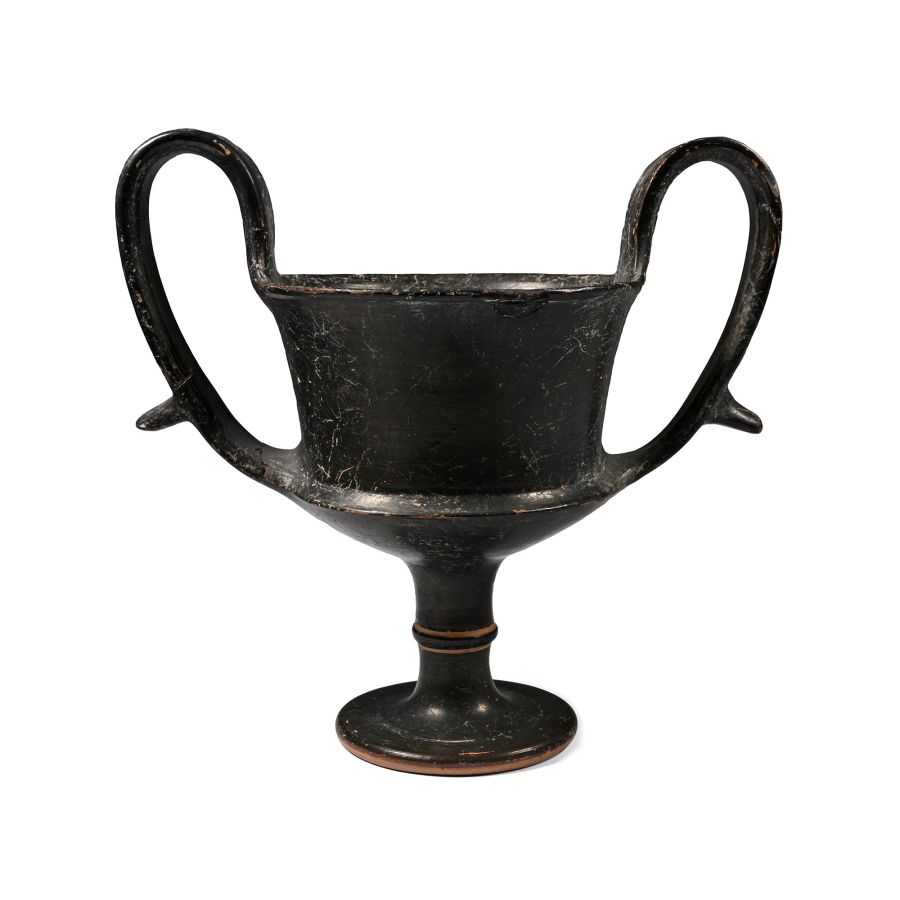
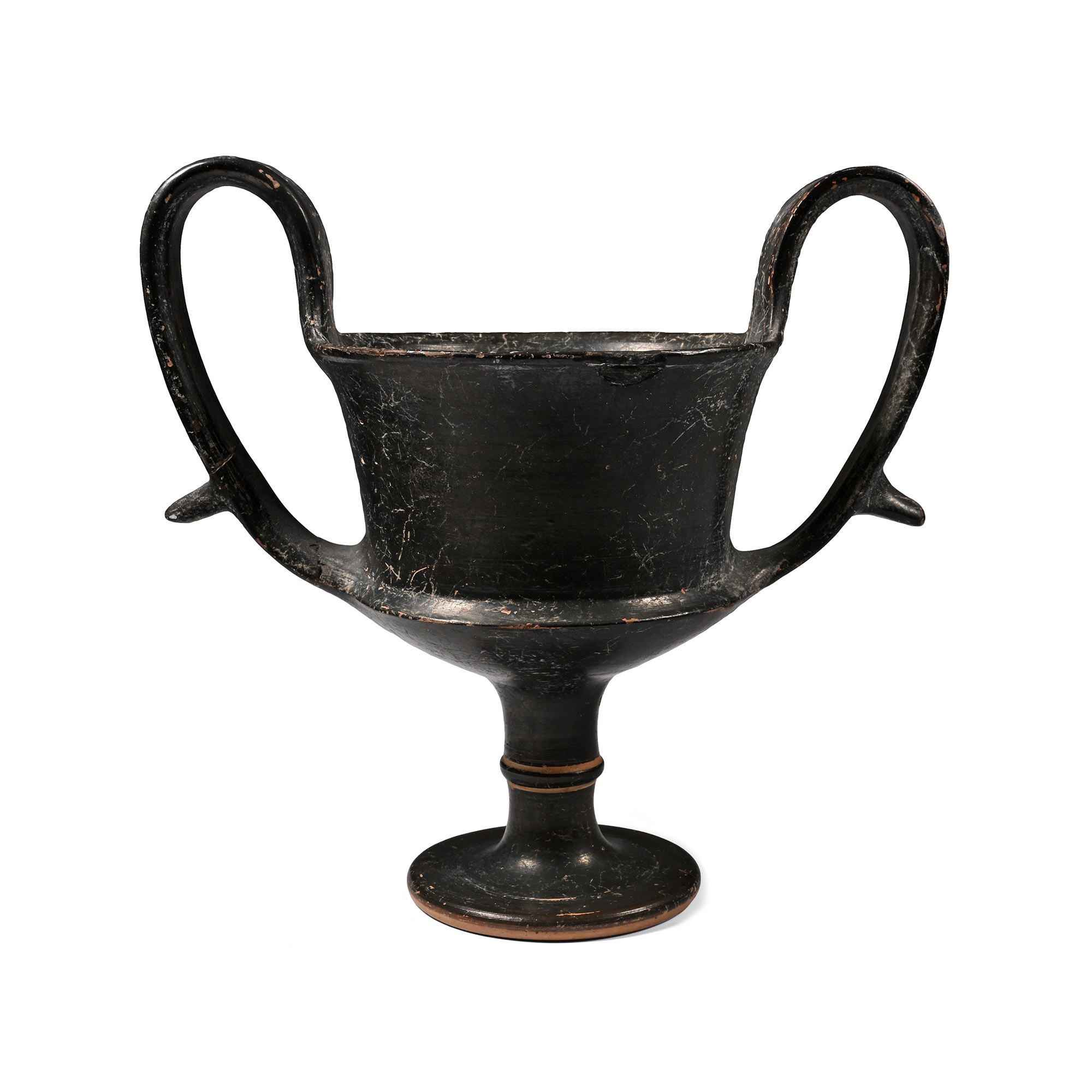
Boeotian Black-Glazed Terracotta Kantharos
CIRCA 5TH CENTURY B.C.
7 1/2 in. (310 grams, 19 cm wide).
The high-handled drinking cup with carinated lower body and a tall offset foot with a collar.
ProvenanceEx Galleria Serodine, Arte Antichità, Fritz Huchelmann-Tieche, Ascona 13 November 1987.
Private collection, Bern, Switzerland.
This lot is accompanied by an illustrated lot declaration signed by the Head of the Antiquities Department, Dr Raffaele D'Amato.
Cf. The Metropolitan Museum, New York, accession number 1993.197, for a similar with vine-leaf decoration.
CONDITIONTimeLine Auctions follows a vetting process to ensure the authenticity and legality of all items, reinforcing our commitment to integrity and responsible trading. Each antiquity, antique, and coin lot undergoes thorough examination by a vetting committee of at least ten external specialists, professional trade association members, scientists, and archaeologists: Our Vetting Process
AUCTIONS:
TimeLine is a leading auction house specialising in antiquities, ancient art, collectables, natural history, coins, medals, and books. Our auctions offer museums, collectors, historians, and enthusiasts the opportunity to acquire unique and historically significant pieces.
LOT 0065
Boeotian Black-Glazed Terracotta Kantharos
Estimate £1,000 - 1,400€1,160 - 1,620 (for guidance only)$1,350 - 1,890 (for guidance only)
-

Gnathian Plastic Vase in the Shape of a Woman
4th-3rd century B.C.Estimate: £8,000 - 10,000 (‡+bp*)
Opening Bid: £3,600
Hollow-formed with broad chamfered base, body modelled as the head of a woman supporting the neck in the form of a trefoil oinochoe with a high, curving handle to the rear; moulded head with detailed swept hair hair wrapped in a cloth (sakkos), and stern facial features; circumferential painted band beneath the rim and vertical strokes; supplied with a custom-made stand. 1.34 kg total, 31 cm high excluding stand
Acquired from Galerie Simone de Monbrison, Rue Bonaparte, Paris, France, 1980. Accompanied by a thermoluminescence analysis report no.N125e36 from Oxford Authentication. Accompanied by a copy of French passport no.150924, dated 19 December 2013. This lot has been checked against the Interpol Database of stolen works of art and is accompanied by a search certificate number no.12666-234641. This lot has been cleared against the Art Loss Register database, and is accompanied by an illustrated lot declaration signed by the Head of the Antiquities Department, Dr Raffaele D'Amato. -

Greek Terracotta Head Collection
1st millennium B.C.Sold for (Inc. bp): £390
Comprising: a head of a kore wearing a tall polos crown; head of Eros; a head of a lady with almond-shaped eyes and Archaic smile; a rectangular plaque with low-relief nude figure; all mounted on custom-made display stands. 118 grams total, 4-10.5 cm including stand
Private collection, before 1970. with Galerie Rhéa, Zurich, Switzerland. This lot is accompanied by an illustrated lot declaration signed by the Head of the Antiquities Department, Dr Raffaele D'Amato. -
Cypriot Gold Bull-Headed Pendant Pair
7th century B.C.Sold for (Inc. bp): £6,500
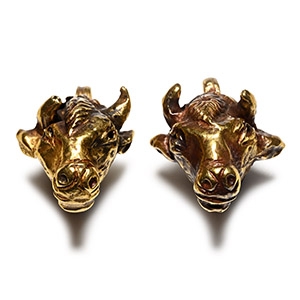
Matched pair of hollow-formed pendants, each a bull's head modelled in the round with a rosette to the rear beneath the loop. 5.39 grams total, 23-24 mm
Acquired in 1986. with Taisei Gallery, Gold & Silver Auction, Part II, Ancient to Renaissance, 5 November 1992, The Conrad Salon, The Waldorf-Astoria, New York, no.165. This lot has been checked against the Interpol Database of stolen works of art and is accompanied by search certificate no.11969-210472. This lot has been cleared against the Art Loss Register database, and is accompanied by an illustrated lot declaration signed by the Head of the Antiquities Department, Dr Raffaele D'Amato.
In Cyprus, the cult of the bull developed from the 3rd millennium B.C. until the 6th century B.C. The bull was a 'frequently invoked manifestation of divinity', and its cult was widespread since the Minoan Age. The appearance of gold bull-head pendants in tombs had an aesthetic and social value, but at the same time it also had a deeper symbolic and religious meaning.
