
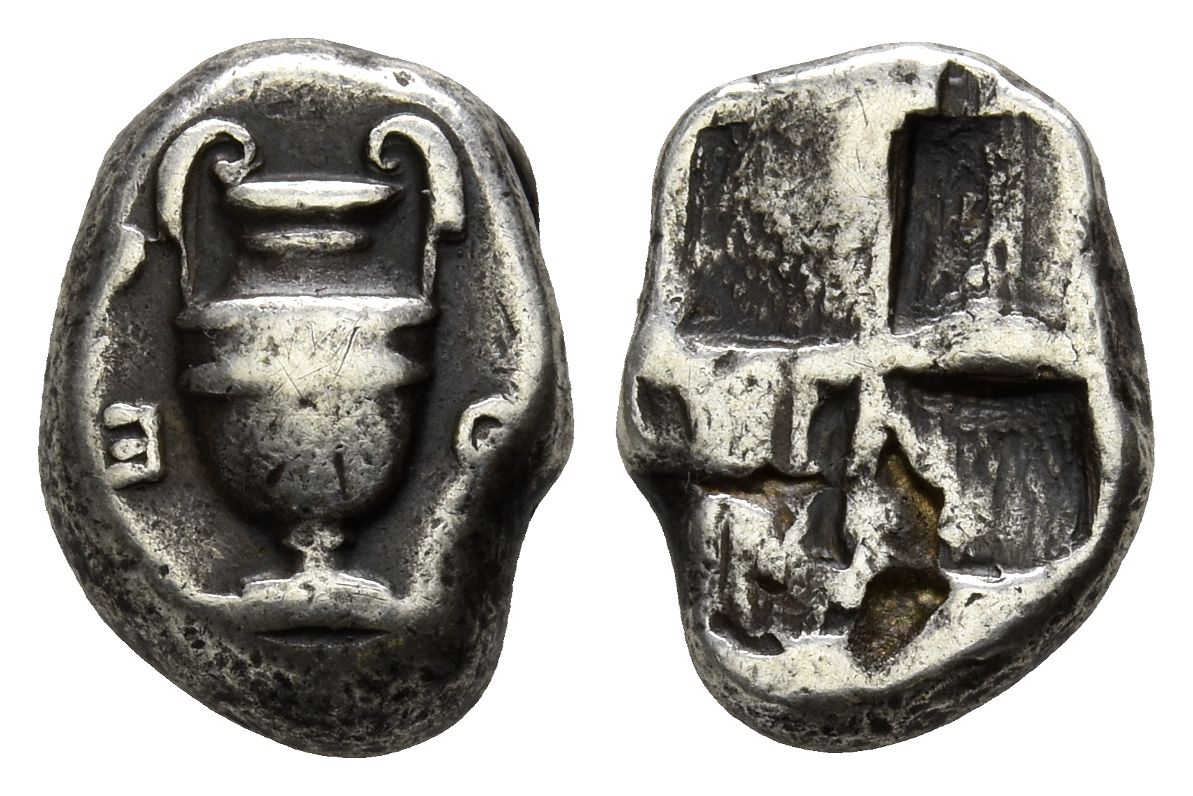
LOT 2920
Boeotia, Thebes AR Quarter Stater or Hemidrachm. Circa 458-456 BC.
Struck after the battle of Oenophyta 457 BC. Aeginetic Standard. Volute krater decorated with parallel circle lines, Ǝ-Θ flanking / Quadripartite incuse square. Unpublished in the most references; for a similar specimen see Traité III, p.220, 205 / pl.CXCIX, 1 (diobol). Very Fine. Toned. The only known issue of this short period of Theban coinage and possibly unique.(3.09gr, 14mm). [No Reserve]
ProvenanceProperty of a North London, UK, gentleman.
FootnotesThis very special coin struck during the short period after the end of the Persian Wars (478 BC) and up to the Battle of Oenophyta (457 BC), when after the conflict between the Thebans and the Athenians, the latter managed to regain control of Boeotia and Phocis. This was the period of transition of Theban coinage from the early period, when the multiple variations of the incuse on the reverse were replaced by the krater depiction, characteristic for all the denominations. Abandoned is the local use of the initial Theta ⴲ in its classical form ϴ. The only known similar example of Traité depicts a krater with the leaf of an ivy, a symbol of Dionysian worship, hanging from its left handle. Its incuse in the form of a swastika reminds those of the archaic coinage of Corinth and probably dates earlier than our example.
TimeLine Auctions follows a vetting process to ensure the authenticity and legality of all items, reinforcing our commitment to integrity and responsible trading. Each antiquity, antique, and coin lot undergoes thorough examination by a vetting committee of at least ten external specialists, professional trade association members, scientists, and archaeologists: Our Vetting Process
AUCTIONS:
TimeLine is a leading auction house specialising in antiquities, ancient art, collectables, natural history, coins, medals, and books. Our auctions offer museums, collectors, historians, and enthusiasts the opportunity to acquire unique and historically significant pieces.
-
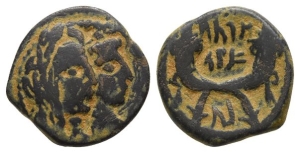
Nabataea, Aretas IV, with Shaqilat, AE 18mm. 9 BC-AD 40.
Sold for (Inc. bp): £33
Petra mint. Jugate busts of Aretas and Shaqilat to right; letter(?) before / Crossed cornucopiae; legend between and below. Cf. Meshorer, Nabataea 114; cf. SNG ANS 1438-43; cf. Sofaer 67-9. 4.14gr, 18mm, 11h
Near Very Fine.
Property of a North London, UK, gentleman. -
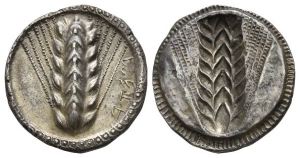
Lucania, Metapontion AR Stater. Circa 510-470 BC.
Estimate: £1,000 - 1,400 (‡+bp*)
Opening Bid: £500
Ear of barley with seven grains; META retrograde downwards to right; all within cable border / Incuse ear of barley with eight grains. Cf. Noe Class IX, 193; HN Italy 1482. 8.11gr, 24mm, 12h
Near Extremely Fine.
Ex Chaponnière & Firmenich SA, Auction 16, 13 November 2022, lot 9b (dealer's ticket included); From a Swiss private collection, before 2005. -
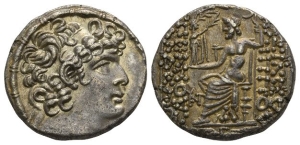
Sextus Julius Caesar, Proconsul AR Tetradrachm of Antioch, Seleucis and Pieria. 47-46 BC.
Estimate: £400 - 600 (‡+bp*)
Opening Bid: £200
In the name and types of the Seleucid king Philip I Philadelphos. Dated year 3 of the Caesarean Era (47/6 BC). Diademed head to right / ΒΑΣΙΛΕΩΣ ΦΙΛΙΠΠΟΥ ΕΠΙΦΑΝΟΥΣ ΦΙΛΑΔΕΛΦΟΥ, Zeus Nicephorus seated to left; monogram of AYT to inner left, Γ (date) above thunderbolt in exergue; all within laurel wreath. RPC I 4127; McAlee 4; Prieur 4; SC 2491.1; HGC 9, 1360a. 15.57gr, 27mm, 1h
Extremely Fine. Beautiful old cabinet tone. Extremely rare, Prieur recorded just two examples.
Ex Nomos AG, obolos 20, 3 October 2021, lot 1016; From a North American collection.
