
Loading, please wait...
_900x900.jpg "Blue Glass Bead Necklace String")
_200x200.jpg "Blue Glass Bead Necklace String")
.jpg "Blue Glass Bead Necklace String")
LOT 2104
Blue Glass Bead Necklace String
20TH CENTURY A.D. OR EARLIER
30 in. (8.01 grams, 76 cm long).
Restrung; composed of translucent blue glass beads interspersed with umber-coloured spacer beads. [No Reserve]
ProvenanceUK gallery, early 2000s.
CONDITIONTimeLine Auctions follows a vetting process to ensure the authenticity and legality of all items, reinforcing our commitment to integrity and responsible trading. Each antiquity, antique, and coin lot undergoes thorough examination by a vetting committee of at least ten external specialists, professional trade association members, scientists, and archaeologists: Our Vetting Process
AUCTIONS:
TimeLine is a leading auction house specialising in antiquities, ancient art, collectables, natural history, coins, medals, and books. Our auctions offer museums, collectors, historians, and enthusiasts the opportunity to acquire unique and historically significant pieces.
-
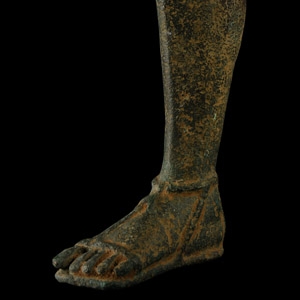
Roman Style Bronze Votive Leg
19th century A.D.Estimate: £100 - 140 (+bp*)
Opening Bid: £50
Hollow-formed lower left leg with integral modelled sandal; open at the knee. 459 grams, 15.5 cm
English private collection. -
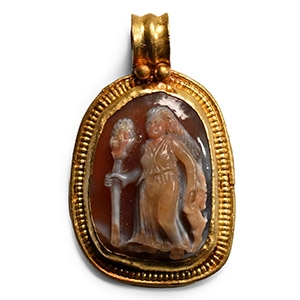
Gold Pendant with Hera Gemstone
20th century A.D.Sold for (Inc. bp): £715
D-shaped plaque with raised rim, beaded wire collar, central cell with inset cameo depicting Hera advancing with a thyrsus in one hand and supporting goat at her side; ribbed suspension loop; after the antique. 6.14 grams, 30 mm
Ex German art market, 2000s. Acquired from an EU collector living in London. From the collection of Surrey, UK, gentleman. -
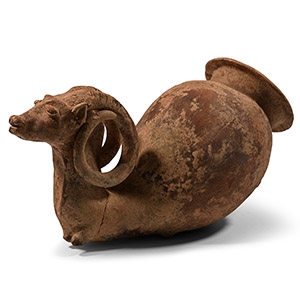
Anatolian Style Terracotta Rhyton
20th century A.D.Sold for (Inc. bp): £85
With trumpet-shaped mouth and barrel-shaped body, ibex-shaped finial with coiled horns and legs folded beneath the body, spout to the chest, repaired; after the antique. 1 kg, 31 cm
Acquired on the UK art market. Property of a North London, UK, gentleman.
