
Loading, please wait...
LOT 1929
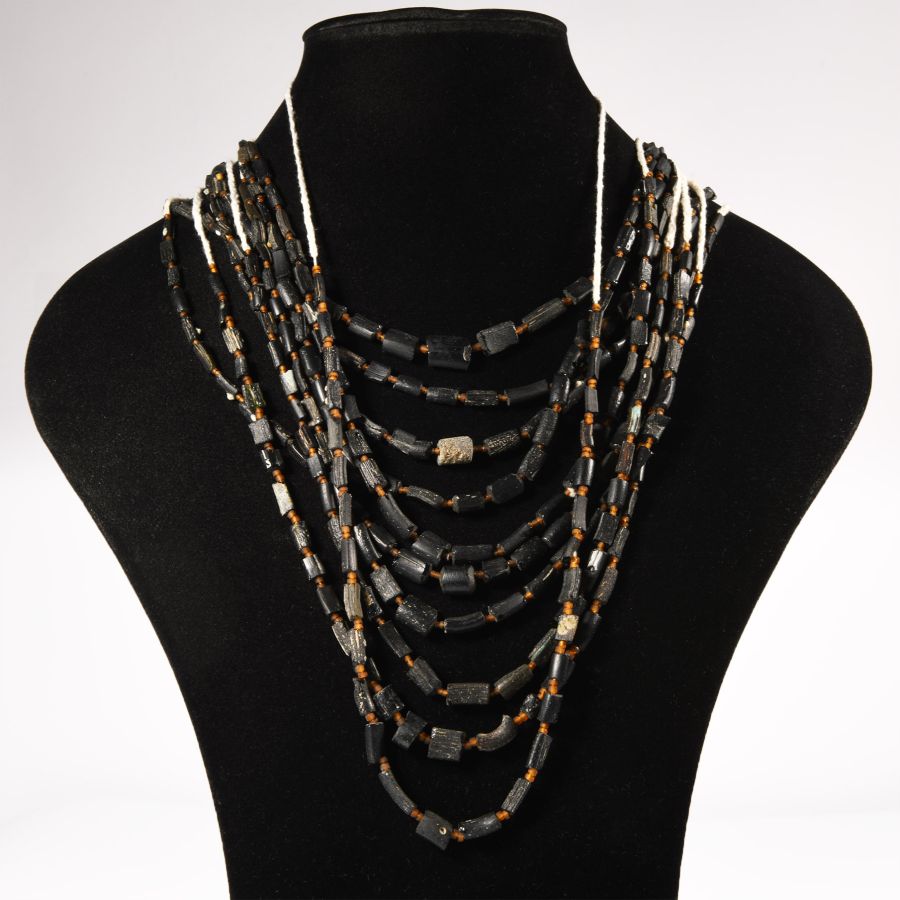
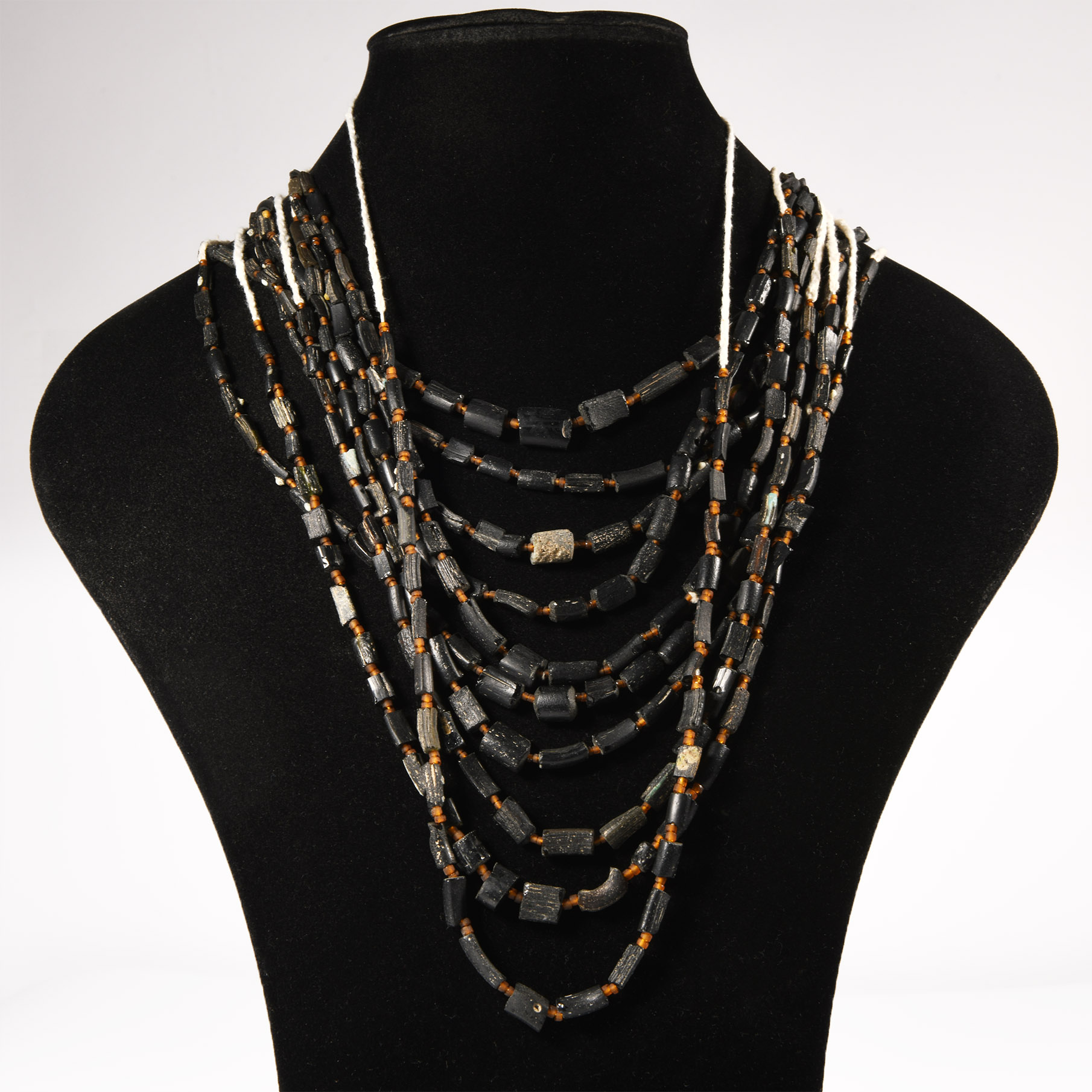
Black and Other Glass Bead Necklace String Collection
20TH CENTURY A.D. AND EARLIER
26 in. (120 grams total, 66 cm long).
Comprising ten restrung necklaces composed of recently made facetted black glass beads made from old glass, interspersed with umber-coloured seed beads. [10]
ProvenanceUK gallery, early 2000s.
CONDITIONTimeLine Auctions follows a vetting process to ensure the authenticity and legality of all items, reinforcing our commitment to integrity and responsible trading. Each antiquity, antique, and coin lot undergoes thorough examination by a vetting committee of at least ten external specialists, professional trade association members, scientists, and archaeologists: Our Vetting Process
AUCTIONS:
TimeLine is a leading auction house specialising in antiquities, ancient art, collectables, natural history, coins, medals, and books. Our auctions offer museums, collectors, historians, and enthusiasts the opportunity to acquire unique and historically significant pieces.
-
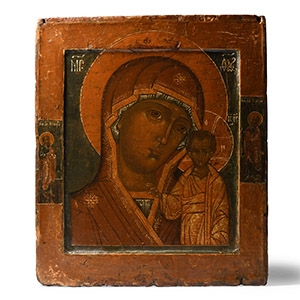
Russian Wooden Icon with Virgin of Kazan
17th-18th century A.D.Estimate: £3,000 - 4,000 (+bp*)
Opening Bid: £1,500
Painted on board with mounting panels to the reverse, gessoed surface with central painting of the Virgin of Kazan (also called the Virgin of Tenderness) in a recess, comprising the bust of Mary and standing figure of infant Jesus, both nimbate, monograms to the upper corners; miniature figures of Saints Peter and Paul to the border; on each side of the head of the Virgin inscriptions 'ΜΡ' and 'ΘΥ' (Μήτηρ (τοῦ) Θεοῦ = Mother of God), inscription in Greek letters 'ΙϹ ΧϹ' (ΙΗϹΟΥϹ ΧΡΙϹΤΟϹ = Jesus Christ) above the child, three letters (only two visible) inside the nimbus of Christ representing the continuous divine self-existence of Christ as God ('O ѾN' = The Only One who always exists); Yaroslavl School. 1.39 kg, 32 cm high
Fine condition.
Ex property of a London lady, part of her family's collection. This lot has been checked against the Interpol Database of stolen works of art and is accompanied by search certificate no. 11544-196360.
The original icon, also known as the Theotokos of Kazan, is thought to have originated in Constantinople in the 13th century before it was taken to Russia. When the Turks took over Kazan in 1438, the icon was most probably hidden to keep it safe. Ivan the Terrible liberated Kazan in 1552, and the town was destroyed by fire in 1579, after which the icon was found and brought to the Church of Saint Nicholas. It was subsequently stolen in 1904 and never found again, though there are many copies in existence. -
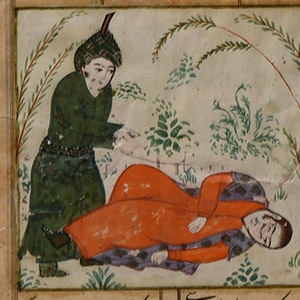
Framed Watercolour Painting
Persia, late 19th-early 20th century A.D.Sold for (Inc. bp): £26
With a watercolour scene of two men in a landscape, one lying on the ground, surrounded by trees and grass, panels of five lines of a poem above and below, border around the whole; set in a reveal within a glazed wooden frame. 637 grams, 27.2 x 20 cm
Fair condition.
Acquired on the UK art market, 1980s-1990s. The Woodbridge collection of Indo-Persian art. -
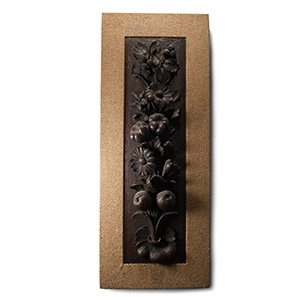
Oak Wainscot Panel with Carved Foliage in the Manner of Grinling Gibbons
Early 18th century A.D.Sold for (Inc. bp): £286
Rectangular panel with carved design of flowers, berries and fruit; all modelled in high relief with gentle curvature and deep undercuts; mounted on a fabric-covered backing board. 2.1 kg, 74.5 cm
Private collection, London, UK.
Grinling Gibbons (4 April 1648 – 3 August 1721) was an Anglo-Dutch wood-carver who became famous for his work in Windsor Castle, St Paul's Cathedral and some other London churches, and various major buildings of the time. He was born in Holland to English parents, and his father was a merchant while Gibbons himself became a member of the Drapers' Company of London. He is usually regarded as the finest wood-carver of his day in England.
