
Loading, please wait...
_900x900.jpg "Belgian Rimfire Pistol")
_200x200.jpg "Belgian Rimfire Pistol")
.jpg "Belgian Rimfire Pistol")
LOT 1438
Belgian Rimfire Pistol
LATE 19TH CENTURY A.D.
5 in. (127 grams, 12.5 cm).
An antique Belgian manufactured single-shot rimfire pocket pistol, the action with separately hinged loading gate and single action hammer with spur trigger; Liege proof marks.
ProvenanceAcquired on UK art market; previously in a Nottinghamshire, UK, collection.
Ex property of a Nottinghamshire gentleman.
These small calibre, cheap and often quite crudely made pocket pistols (sometimes known as 'Saturday Night Specials') were popular in the later 19th century as weapons for personal defence; large numbers were made in Europe. Sold as an exempt item under Section 58 (2) of the Firearms Act, 1968, to be held as a curiosity or ornament. No license required but buyer must be over 18 years of age.
CONDITIONTimeLine Auctions follows a vetting process to ensure the authenticity and legality of all items, reinforcing our commitment to integrity and responsible trading. Each antiquity, antique, and coin lot undergoes thorough examination by a vetting committee of at least ten external specialists, professional trade association members, scientists, and archaeologists: Our Vetting Process
AUCTIONS:
TimeLine is a leading auction house specialising in antiquities, ancient art, collectables, natural history, coins, medals, and books. Our auctions offer museums, collectors, historians, and enthusiasts the opportunity to acquire unique and historically significant pieces.
-
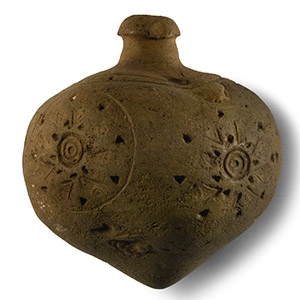
Arab 'Greek Fire' Ceramic Fire Bomb or Hand Grenade
13th century A.D.Sold for (Inc. bp): £143
Piriform body decorated with concentric circles inside a eight rays pointed star pattern, with domed filler-hole, intended to be filled with explosive liquid and wick, used as a hand grenade. 610 grams, 11.5 cm
Acquired 1980-2015. Ex Abelita family collection. Accompanied by an academic paper by military specialist Dr Raffaele D'Amato, dated 15 July 2019 and titled 'Eastern Roman Empire - Greek Fire Bomb or Hand Grenade (μεσαίον kακάβιον) 9th-11th century AD'.
The Arabs, following the Roman examples, made great use of these weapons. The efficiency of the weapon appears, for example, from the account of the siege of Akka in 1189, given by the contemporary historian Ibn al-Athir. He tells how the Christians exercised their engineering skill and built mighty beffroys. The situation was hopeless for the defending Arabs until a man from Damascus showed up, because he knew how to produce Greek Fire: ‘To trick the Christians he first threw some vesseIs with naptha and other things, which were not set on fire, upon one of the beffroy’s, and it was without power. The Christians...climbed the top of the beffroy...the man from Damascus waited until the contents of the vessels were spread all over. When the moment came,he threw a new pot, which was set on fire. In a few moments the fire was spread all over, and the beffroy was eaten up by the flames. The fire was spread in such a hurry that the Christians could not manage to climb down from the beffroy. Men, weapons, everything was eaten up by the flames.’ -
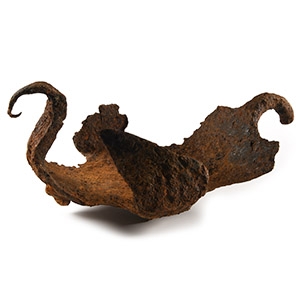
Roman Iron 'Hipposandal' Military Ice Horseshoe
1st-4th century A.D.Sold for (Inc. bp): £390
With lateral curved plates and scrolled bar to the front, rear panel with hooked spur for attachment. 617 grams, 21 cm
From a collection acquired on the UK art market from various auction houses and collections mostly before 2000. From an important Cambridgeshire estate; thence by descent.
Hipposandals (soleae ferreae) were used on horses with injured hooves, a sort of equine orthopaedic shoe used by the mulomedicus, i.e. a Roman military veterinarian. Another important function was that to protect the hooves of the horse from injuries and damages from hard objects. The hipposandal of type 1 was formed from a sub-oval plate which tapered towards the front and rear with projections at the front, back and on either side. The heel was upturned at about 45 degrees and flared outwards. It would have terminated with a downward facing hook, now missing. The base of the sole was flat. -
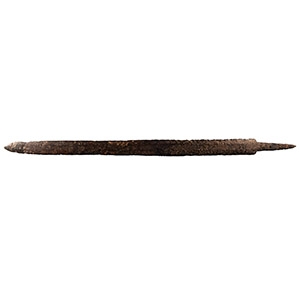
Byzantine Iron Spathion Sword
9th-11th century A.D.Sold for (Inc. bp): £845
An Eastern Roman spathion with long, double-edged parallel blade, a tapering, medium length tang, retaining possible remains of the fabrica mark in the middle, near the rivet hole for the handle. 698 grams, 81cm
Acquired 1970-1980. From the collection of a Surrey gentleman.
