
Loading, please wait...
_900x900.jpg "Bactrian Stone 'Hand Bag' Ceremonial Weight")
_200x200.jpg "Bactrian Stone 'Hand Bag' Ceremonial Weight")
_900x900.jpg "Bactrian Stone 'Hand Bag' Ceremonial Weight")
_200x200.jpg "Bactrian Stone 'Hand Bag' Ceremonial Weight")
.jpg "Bactrian Stone 'Hand Bag' Ceremonial Weight")
.jpg "Bactrian Stone 'Hand Bag' Ceremonial Weight")
LOT 0310
Bactrian Stone 'Hand Bag' Ceremonial Weight
LATE 3RD-EARLY 2ND MILLENNIUM B.C.
10 3/4 in. (9.95 kg, 27.5 cm).
Rectangular block with round-section loop handle.
ProvenanceEx West London, UK, collection, 1990s.
This lot has been cleared against the Art Loss Register database, and is accompanied by an illustrated lot declaration signed by the Head of the Antiquities Department, Dr Raffaele D'Amato.
See Vidale, M., Treasures from the Oxus: The Art and Civilisation of Central Asia, London, 2017, pp.44-51, figs.41-45, for a variety of stones and shapes.
FootnotesAmong the most iconic intercultural style objects are the so-called 'lock' or 'hand bag' weights. These were probably not weights at all, but were likely badges of high office, carried to indicate authority. Similar objects have been found throughout Mesopotamia, the islands of the Persian Gulf, on the Iranian steppe, as well as the Indus Valley.
CONDITIONTimeLine Auctions follows a vetting process to ensure the authenticity and legality of all items, reinforcing our commitment to integrity and responsible trading. Each antiquity, antique, and coin lot undergoes thorough examination by a vetting committee of at least ten external specialists, professional trade association members, scientists, and archaeologists: Our Vetting Process
AUCTIONS:
TimeLine is a leading auction house specialising in antiquities, ancient art, collectables, natural history, coins, medals, and books. Our auctions offer museums, collectors, historians, and enthusiasts the opportunity to acquire unique and historically significant pieces.
-
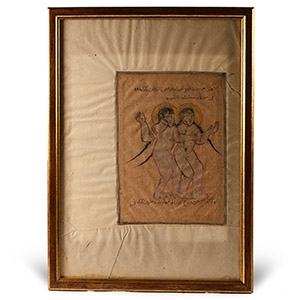
Western Asiatic Framed Gilt Manuscript Page with Gemini Constellation
Late 19th century A.D.Sold for (Inc. bp): £33
Depicting the Gemini constellation, the twins shown nude and with long braided hair, Arabic text above and below, thirteen lines of Arabic text to the reverse; set in a glazed frame with a reveal to both sides. 735 grams total, 32.5 x 23.2 cm
From the family collection of a Hampstead gentleman; formerly acquired in the 1980s. This lot has been cleared against the Art Loss Register database, and is accompanied by an illustrated lot declaration signed by the Head of the Antiquities Department, Dr Raffaele D'Amato. -
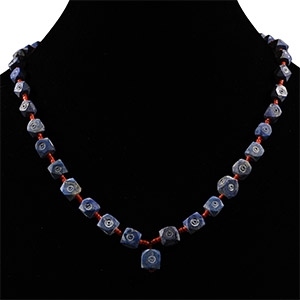
Bactrian Style Lapis Lazuli Bead Necklace String
20th century A.D.Sold for (Inc. bp): £33
Group of cornerless cube beads with incised ring-and-dot motif to each face. 40 grams, 41 cm
Ex London, UK, collection, 1990s. This lot has been cleared against the Art Loss Register database, and is accompanied by an illustrated lot declaration signed by the Head of the Antiquities Department, Dr Raffaele D'Amato. -
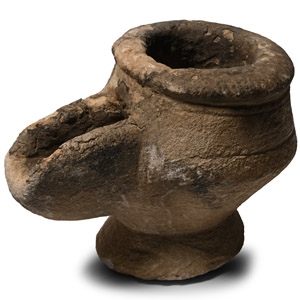
Western Asiatic Stone Libation Bowl
1st millennium B.C.Estimate: £100 - 140 (+bp*)
Opening Bid: £50
With a biconical body and flared foot set off-centre, large U-shaped spout and flat rim. 667 grams total, 11.9 cm
From a collection formed before 1988, London and Geneva. This lot has been cleared against the Art Loss Register database, and is accompanied by an illustrated lot declaration signed by the Head of the Antiquities Department, Dr Raffaele D'Amato.
